Listen to this article
0:00 / 4:14 · Read by ArtLogia
In September 1888 Van Gogh set up his easel on a street corner in Arles after dark. The result was his first starry sky — and a lesson in painting night with colour alone.
In this article
An easel in the street after dark
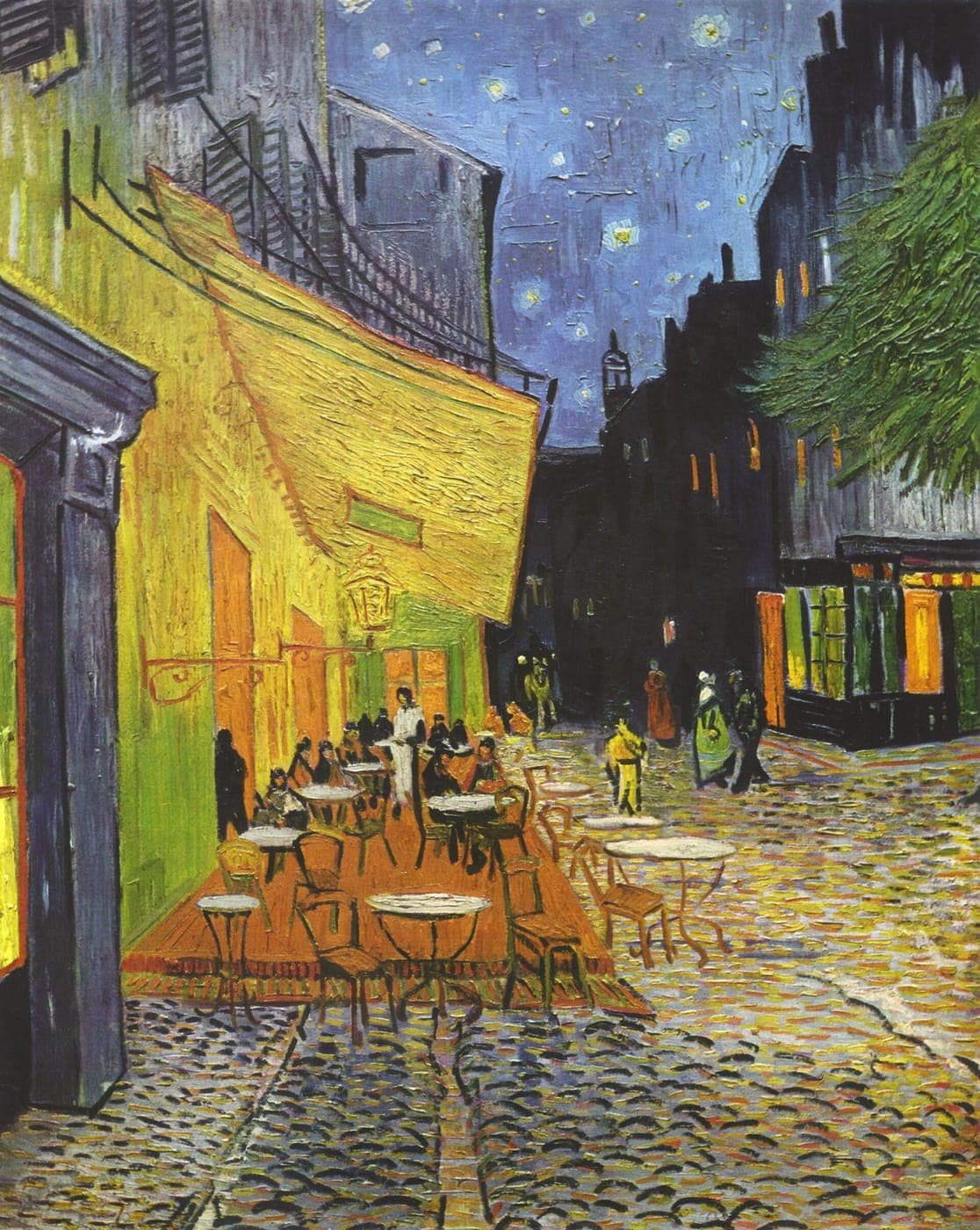
In September 1888 Vincent van Gogh did something unusual for his time: he carried his easel into the Place du Forum in Arles at night and painted what he saw on the spot. Most painters of the period sketched outdoors and finished night scenes in the studio by lamplight. Van Gogh wanted the real thing — the gaslight on the awning, the blue of the sky, the stars hanging over the rooftops.
The café still stands in Arles today, repainted yellow to match the canvas, and visitors can stand almost exactly where the easel stood.
Night without black
The most striking thing about the painting is what is missing: there is no black paint in the sky. Van Gogh wrote to his sister that he found night more richly coloured than day, and he set out to prove it. The sky is built from ultramarine and cobalt blues, deepened with violet and green. The darkness is a colour, not an absence.
Against that blue, the café blazes in yellow and orange. The two colours sit opposite each other on the colour wheel, so each makes the other look more intense. This is complementary contrast, and it is the engine of the whole picture.
The terrace
The awning and the wall under it are painted in a warm, almost acid yellow. The light seems to pour down onto the cobbles, which pick it up in patches of orange, pink and lilac. Small figures sit at the tables while a waiter in white moves between them. Nothing is described in detail — the scene is suggested by blocks of colour and short directional strokes.
The street
The street draws the eye diagonally from the bottom right corner into the distance, where a horse and carriage pass and a few pedestrians walk under the dark houses. Doors and windows glow faintly. The perspective is steep and slightly tilted, a device borrowed from the Japanese prints Van Gogh collected and admired.
The stars
This is the first painting in which Van Gogh shows a starry sky. The stars are not points but small flowers of light — dabs of white, yellow and pale green ringed with colour. A few months later he would paint Starry Night over the Rhône, and the following year, from memory, The Starry Night itself. Café Terrace at Night is where that obsession begins.
Painting directly from life at night forced Van Gogh to judge colour by feeling rather than by sight — and that freedom became his signature.
Café Terrace at Night or The Night Café?
The two paintings are often confused. The Night Café, also from September 1888, shows the inside of a different café in Arles, lit by harsh gas lamps against blood-red walls and a green ceiling. Van Gogh described it as a place where one could go mad or commit a crime. Café Terrace at Night is its calm, welcoming opposite: outdoors, open to the sky, full of soft light.
What does the painting mean?
Van Gogh left no single explanation. Read simply, it is a love letter to the warmth of a southern town at night. Some writers have pointed to the central waiter surrounded by figures and a cross-shaped window frame and suggested an echo of the Last Supper — Van Gogh was the son of a pastor and once trained as a preacher. The idea is speculative, but it shows how much room the painting leaves for the viewer.
Where is the original?
The original hangs in the Kröller-Müller Museum in Otterlo, the Netherlands. It measures 80.7 × 65.3 cm and is painted in oil on canvas. Because the painting is in the public domain, faithful hand-painted reproductions can be made in any size.
Bringing it home
Our artists recreate Café Terrace at Night with the same thick, directional brushwork as the original, building the blues of the sky in layers so the stars sit on top of the paint just as Van Gogh's do. Each canvas is photographed in the studio for your approval before it ships.
Own a hand-painted copy
Café Terrace at Night
Painted by hand in oil on canvas, any size. Free worldwide shipping.
From $299 — Make it yours.Frequently asked questions
When was Café Terrace at Night painted?
Van Gogh painted it in Arles, in the south of France, in September 1888.
Where is Café Terrace at Night today?
The original is in the Kröller-Müller Museum in Otterlo, the Netherlands.
Did Van Gogh use black paint in Café Terrace at Night?
No. The night sky is built from blues, violets and greens; Van Gogh deliberately avoided black to show that night has colour.
What is the difference between Café Terrace at Night and The Night Café?
Café Terrace at Night shows a café terrace outdoors under the stars. The Night Café shows the inside of a different Arles café with red walls and harsh gas lamps.
Can I buy a hand-painted reproduction of Café Terrace at Night?
Yes. ArtLogia artists paint it by hand in oil on canvas in sizes from 16 × 20 inches to 36 × 48 inches, with optional framing.
Sources and further reading
- Kröller-Müller Museum collection record for Café Terrace at Night
- Van Gogh Museum, Vincent van Gogh: The Letters (letter to Willemien van Gogh, September 1888)
- Ronald de Leeuw, Van Gogh at the Van Gogh Museum
