Listen to this article
0:00 / 2:52 · Read by ArtLogia
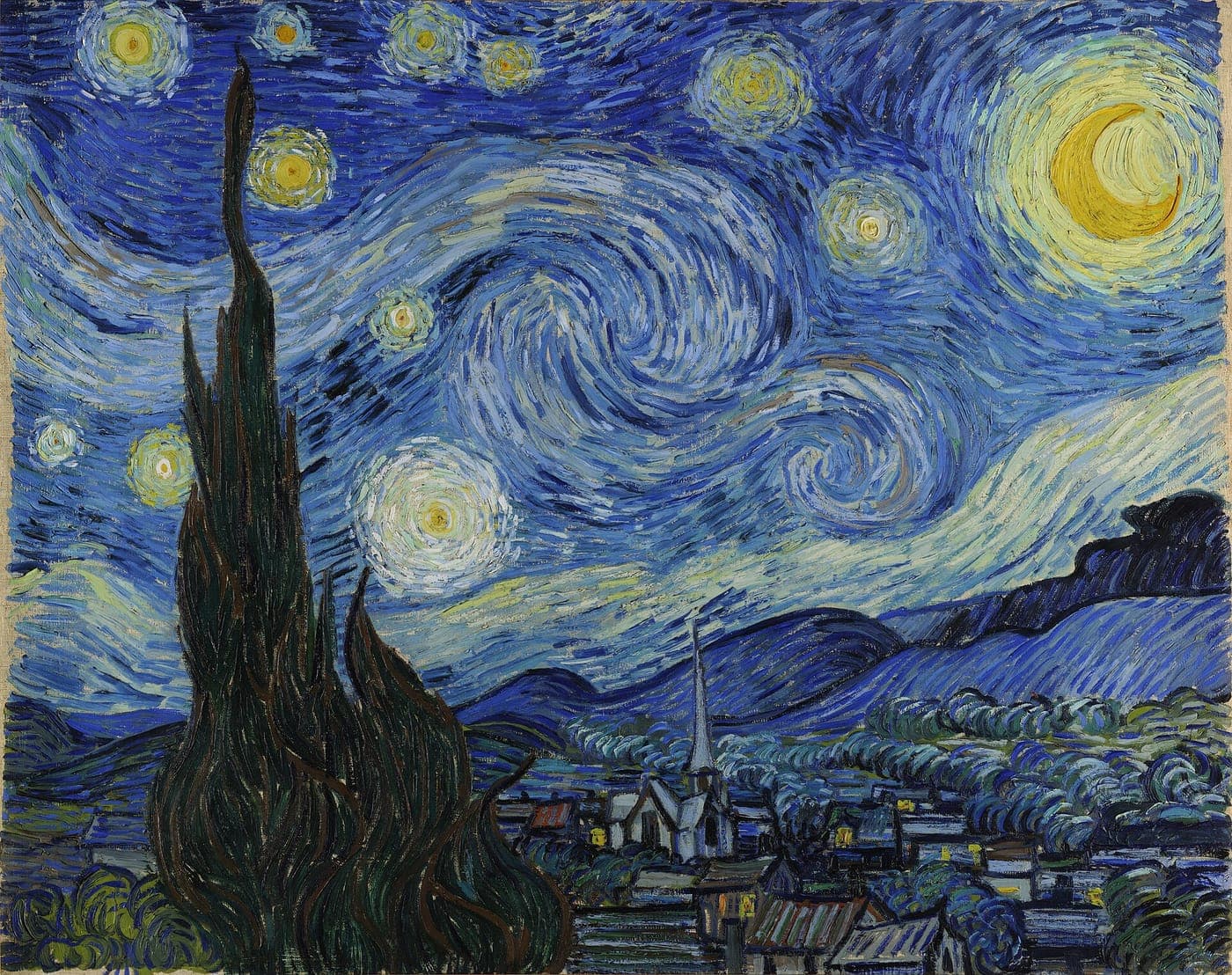
Painted in June 1889 at the Saint-Paul asylum in Saint-Rémy, The Starry Night mixes what Van Gogh saw from his window with what he remembered and imagined.
In this article
The view from Saint-Rémy
In May 1889, after a series of breakdowns, Van Gogh voluntarily entered the asylum of Saint-Paul-de-Mausole near Saint-Rémy-de-Provence. From his east-facing bedroom window he could see a walled wheat field, olive groves and the low Alpilles hills. He was not allowed to paint in his bedroom, so he made sketches there and worked on canvases in a ground-floor studio.
The Starry Night, painted in June 1889, began with that view before dawn — but it became something much bigger.
Memory and imagination
The village in the painting is not visible from the asylum window. Van Gogh invented it, and its church spire looks more like the churches of his Dutch childhood than anything in Provence. The cypress in the foreground is also moved closer and made larger than life. The painting is a composite: part observation, part memory, part vision.
The sky
The sky is the subject. Eleven stars burn in halos of yellow and white. A crescent moon glows in the upper right. Through the centre, a great spiral rolls across the sky like a wave. Astronomers have noted that Venus was visible as a bright morning star from Saint-Rémy at the time — it is probably the large white star just right of the cypress.
The cypress
The dark cypress rises like a flame from the bottom of the canvas to the top, linking earth and sky. Cypresses are traditional symbols of death and mourning in Mediterranean cemeteries, but Van Gogh admired them for their shape and wrote that they were as beautiful in line and proportion as an Egyptian obelisk.
The brushwork
Everything moves. The paint is laid on thickly in short, curved strokes that follow the forms — circling the stars, rolling through the sky, flickering up the cypress. Up close, you can see ridges of paint that catch the light. This physical texture is what separates a hand-painted reproduction from a flat print.
What did Van Gogh think of it?
Surprisingly little. He mentioned it only briefly in his letters and called it a failure in one of them, frustrated that he had again let himself paint stars too large. He much preferred his work painted directly from nature. History disagreed: it is now one of the most recognised paintings in the world.
Where is the original?
The Starry Night has been in the collection of the Museum of Modern Art in New York since 1941. It measures 73.7 × 92.1 cm, oil on canvas.
Bringing it home
To reproduce The Starry Night, our painters work the sky in thick impasto with loaded brushes, following the rhythm of Van Gogh's strokes so the spirals keep their movement. The result has real relief you can see when light rakes across the surface.
Own a hand-painted copy
The Starry Night
Painted by hand in oil on canvas, any size. Free worldwide shipping.
From $299 — Make it yours.Frequently asked questions
Where was The Starry Night painted?
At the Saint-Paul-de-Mausole asylum in Saint-Rémy-de-Provence, France, in June 1889.
Is the village in The Starry Night real?
No. Van Gogh added an imagined village; it could not be seen from his window, and its spire recalls Dutch churches.
Where can I see The Starry Night?
At the Museum of Modern Art (MoMA) in New York.
How big is The Starry Night?
The original measures 73.7 × 92.1 cm (29 × 36¼ inches).
Sources and further reading
- Museum of Modern Art collection record for The Starry Night
- Van Gogh Museum, Vincent van Gogh: The Letters
- Steven Naifeh and Gregory White Smith, Van Gogh: The Life
