


Listen to this article
0:00 / 3:27 · Read by ArtLogia
A barmaid stands behind a marble counter covered with bottles, oranges and flowers, looking out with a distant expression, while a mirror behind her reflects the glittering crowd of the music hall. Painted in 1882, it was Manet's last major work.
In this article
A night at the Folies-Bergère
In the 1880s the Folies-Bergère was the most famous music hall in Paris, offering acrobats, singers, ballets and operettas to a fashionable audience who came to drink, flirt and watch the crowd as much as the show. Édouard Manet, then seriously ill with the disease that would kill him a year later, painted a barmaid at one of its bars.
He made sketches on the spot, but painted the final work in his studio, where a real barmaid from the Folies-Bergère, known as Suzon, posed behind a counter set up with bottles and fruit. The painting was shown at the Salon of 1882.
The barmaid
Suzon stands in the centre, her hands resting on the counter, wearing a dark velvet bodice with a lace collar and a flower at her breast. Her face is pale and her expression detached, absent, perhaps tired or lost in thought. She seems isolated in the middle of the noise and glitter around her.
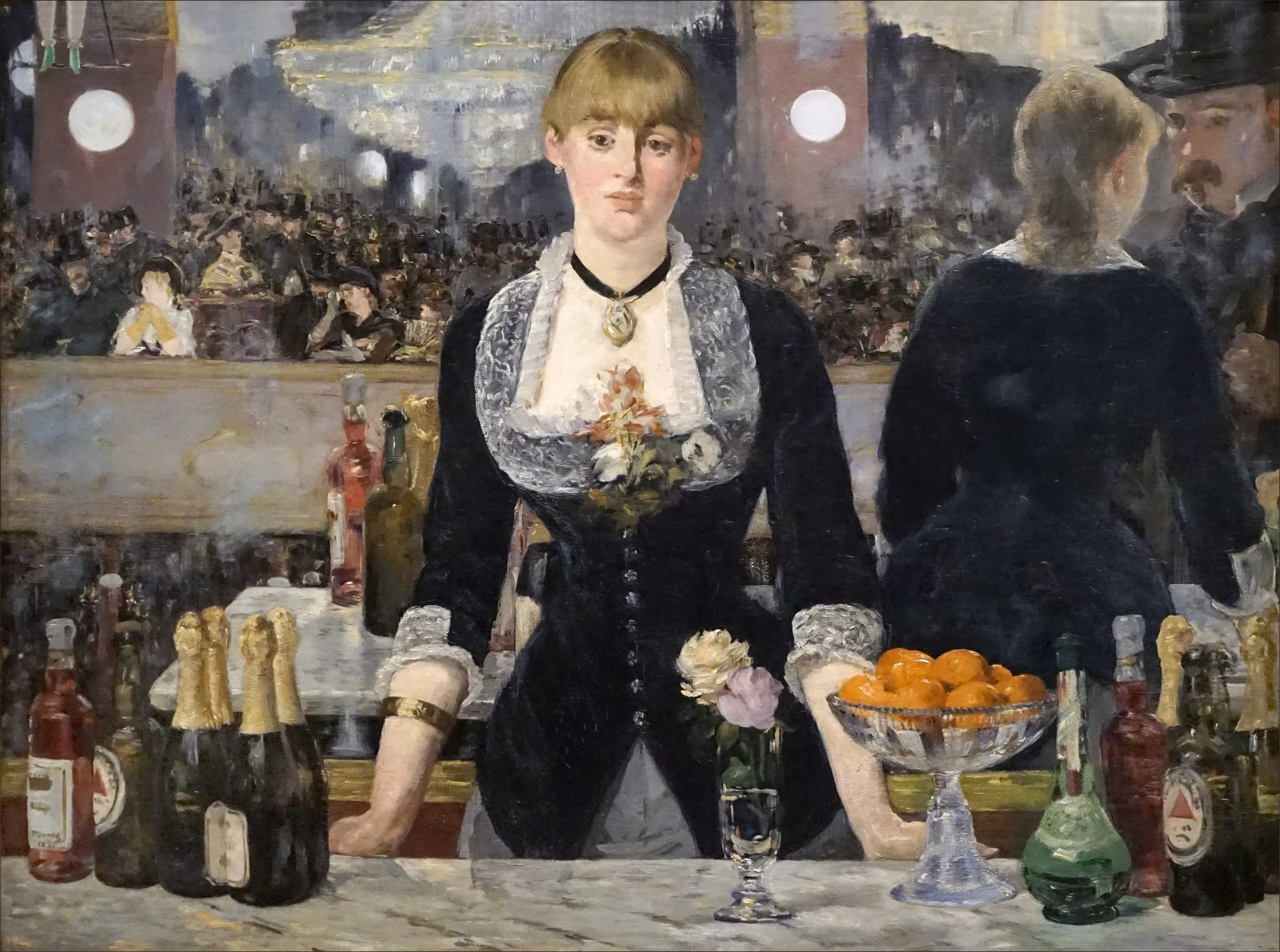 Detail 1
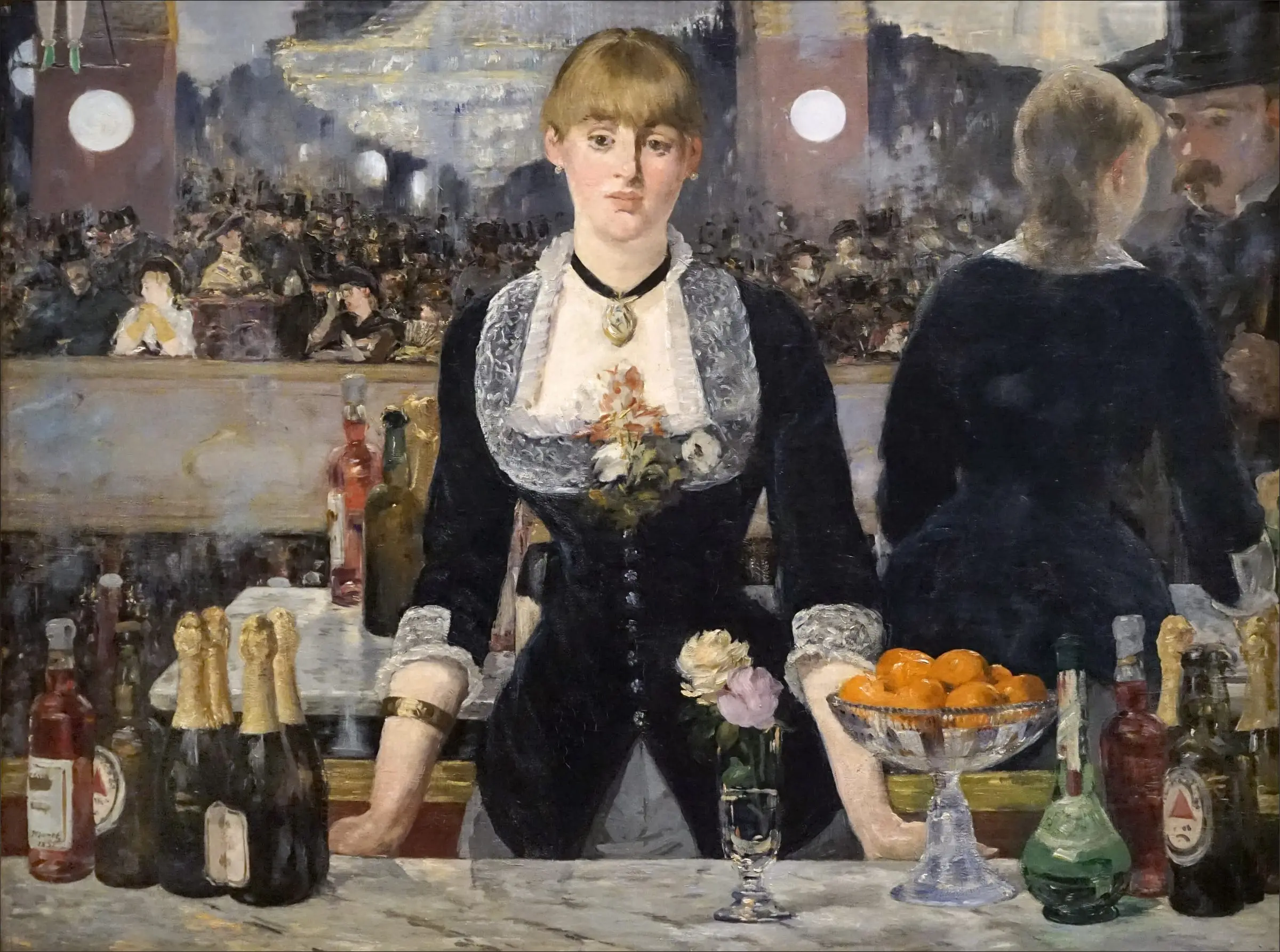
The barmaid's distant gaze
Suzon looks out with a remote, unreadable expression. Her isolation in the middle of the crowd is the emotional heart of the painting.
The impossible mirror
Behind her, a huge mirror reflects the hall: the balcony, the chandeliers, the crowd. On the right, the mirror shows the barmaid from behind, leaning towards a man in a top hat who seems to be talking to her. But the reflection does not match: in the mirror she leans forward, while in front she stands upright, and the man, who should be where the viewer is, does not appear in front of the counter. This contradiction has fascinated viewers and critics ever since.
Detail 2The reflection
In the mirror the barmaid leans towards a man in a top hat. Their reflection does not match the upright figure in front, creating a famous puzzle.
The crowd and the trapeze
In the reflection, the audience sits on the balcony, elegantly dressed women and men, among them, perhaps, the painter's friend Méry Laurent. In the upper left corner, two small green-booted feet dangle from a trapeze: an acrobat performing above the crowd, whom nobody in the painting seems to watch.
Detail 3The trapeze artist's feet
In the top corner, two feet in green boots hang from a trapeze. Manet included the show only as a tiny detail at the edge.
Detail 4The glittering crowd
The mirror reflects the balcony full of spectators, lit by chandeliers and electric globes, painted with quick, loose strokes.
The still life on the counter
On the marble counter, Manet painted a dazzling still life: bottles of champagne and of English Bass pale ale, recognisable by its red triangle label, liqueurs, a glass bowl of oranges and two roses in a glass. He signed and dated the painting on the label of a bottle at the lower left.
Detail 5Oranges in a glass bowl
The bowl of oranges catches the light on the marble counter. Manet's still life is as brilliant as the figure behind it.
Detail 6Champagne and pale ale
Champagne bottles stand beside bottles of Bass ale with its red triangle trademark. Manet signed his name on one of the labels.
Seeing the painting
The painting measures about 96 by 130 centimetres. It was bought by the industrialist Samuel Courtauld in 1926 and is in the Courtauld Gallery in London.
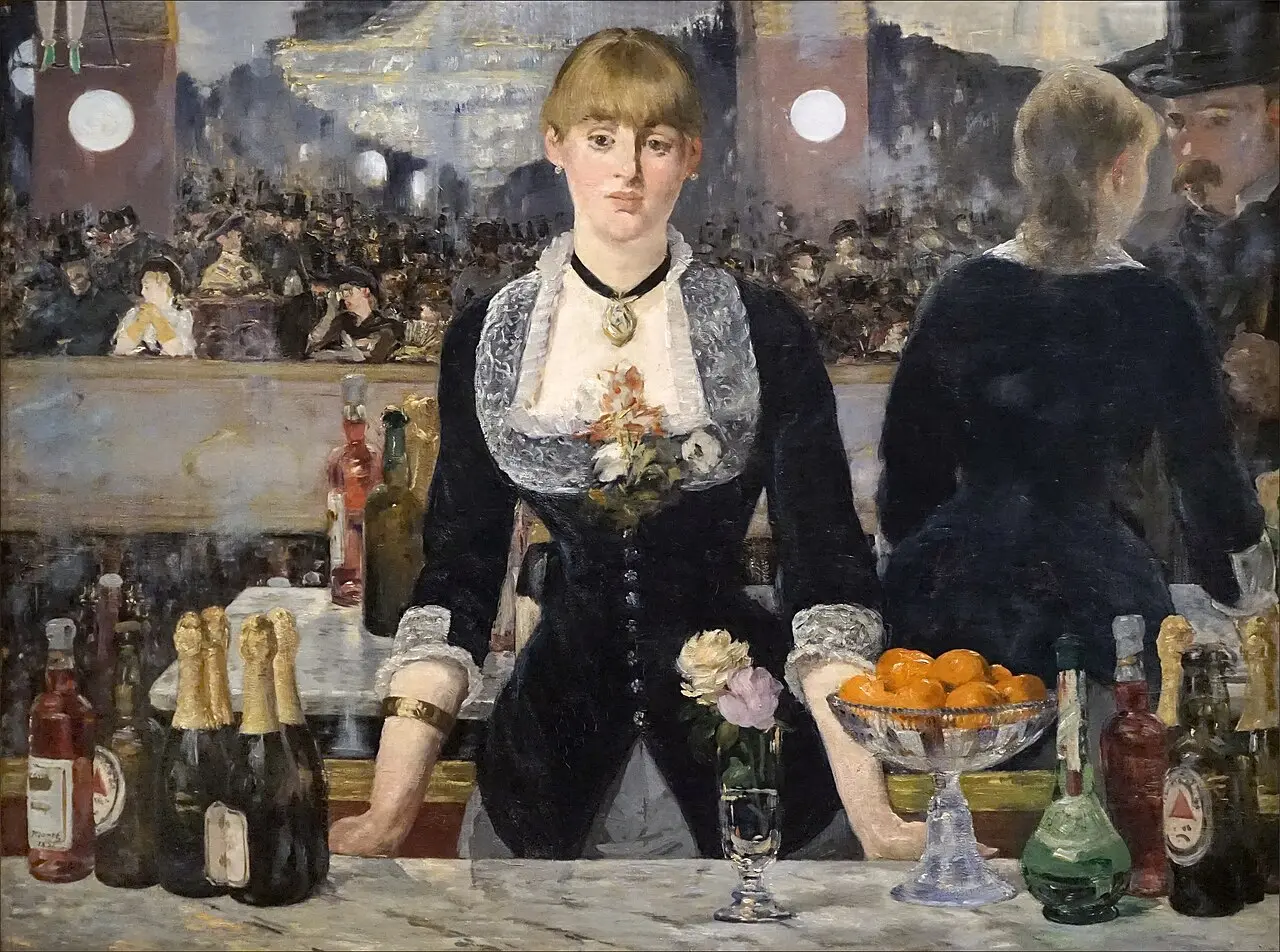
Own a hand-painted copy
A Bar at the Folies-Bergère
Painted by hand in oil on canvas, any size. Free worldwide shipping.
From $299 — Make it yours.Frequently asked questions
Who is the barmaid in A Bar at the Folies-Bergère?
She was a real barmaid at the Folies-Bergère known as Suzon, who posed for Manet in his studio.
Why is the mirror reflection strange?
The reflection of the barmaid and the man in the top hat does not match the scene in front, a deliberate inconsistency that has puzzled viewers.
Was it Manet's last painting?
It was his last major work, shown at the Salon of 1882, a year before his death.
Where is A Bar at the Folies-Bergère?
It is in the Courtauld Gallery in London.
Sources and further reading
- The Courtauld Gallery, collection notes on A Bar at the Folies-Bergère
- Bradford R. Collins (ed.), 12 Views of Manet's Bar (1996)
- T. J. Clark, The Painting of Modern Life (1985)
