Listen to this article
0:00 / 4:35 · Read by ArtLogia
Leonardo da Vinci worked on the Mona Lisa for more than a decade and never delivered it. Look closely and you find the reasons it still holds us: a smile that will not stay still, a landscape that dissolves into haze, and hands painted with total calm.
In this article
A portrait that was never delivered
Around 1503 the Florentine silk merchant Francesco del Giocondo asked Leonardo da Vinci to paint his wife, Lisa Gherardini. It was an ordinary commission: a portrait to mark a new house, perhaps the birth of a son. What happened next was not ordinary. Leonardo kept the panel, carried it with him to Milan, Rome and finally France, and was still refining it in the last years of his life. The Giocondo family never received their picture.
That long life in the studio is the key to the painting. The Mona Lisa is not a quick likeness but the summary of everything Leonardo had learned about light, anatomy, optics and the way the eye reads a face. It passed after his death to the French royal collection, hung in Fontainebleau and Versailles, and entered the Louvre after the Revolution.
The smile
Everyone comes for the smile, and the smile is a trick of technique. Leonardo painted the corners of the mouth and the eyes, the two places where we read expression, with the softest transitions of tone, so there is no line to fix on. The Italians called this sfumato, "vanished like smoke". When you look straight at the mouth it seems almost serious; when your eye moves to her eyes, the soft shadows at the corners of the lips read as a smile.
 Detail 1

The smile that moves
There is no outline at the corners of the mouth. Leonardo built the shadows from dozens of thin, translucent glazes, so the expression shifts as your eye moves across the face.
A face without eyebrows
Visitors often notice that Lisa has no eyebrows or eyelashes. High-resolution scans suggest they were once painted very finely and have been lost through cleaning and the ageing of the varnish. What remains is a face of extraordinary smoothness, modelled almost entirely by light, without any hard edge.
Detail 2Eyes that follow you
The eyes are set in soft, warm shadow. Because the face is turned three-quarters while the gaze comes straight out, she seems to watch the viewer from every angle in the room.
The landscape behind her
Behind the sitter opens one of the strangest landscapes in Renaissance art: winding roads, a river, rocky peaks and lakes that fade into blue haze. Leonardo used aerial perspective, making distant things paler and bluer, as the atmosphere does. The horizon on the left is lower than on the right, a small mismatch that adds to the sense of movement around her head.
Detail 3The bridge
A small arched bridge crosses the river on the right, one of the few signs of people in the landscape. Historians have tried to identify it with real bridges near Arezzo and Bobbio, but Leonardo's valley is best seen as an imagined world.
The hands
Below the face, the hands rest one over the other on the arm of a chair. They are painted with the same care as the face, the fingers softly rounded by light. Their calm is part of the effect: the whole figure forms a stable pyramid, and the stillness of the hands makes the movement of the smile even more mysterious.
Detail 4Folded hands
The right hand rests lightly on the left wrist. The gesture was a convention of portraits of married women, but Leonardo's modelling of the fingers makes it feel natural and relaxed.
From portrait to legend
The Mona Lisa was admired by painters from the start; Raphael sketched it within a few years. But its global fame is more recent. In August 1911 it was stolen from the Louvre by Vincenzo Peruggia, an Italian handyman, and was missing for more than two years. Newspapers around the world printed its image, and when it was recovered in Florence in 1913 it had become a star. Since then it has been copied, parodied and reproduced more than any other painting.
Today it hangs behind protective glass in the Salle des États, and most visitors see it for only a few seconds over a crowd. That is one reason so many people choose to live with a hand-painted copy: a reproduction lets you see, slowly and at home, the glazes, the haze and the half-smile that made Leonardo keep the painting for himself.
Seeing the Mona Lisa
The original is small, about 77 by 53 centimetres, painted in oil on a poplar panel. It is in the Louvre in Paris, in the Denon wing on the first floor.
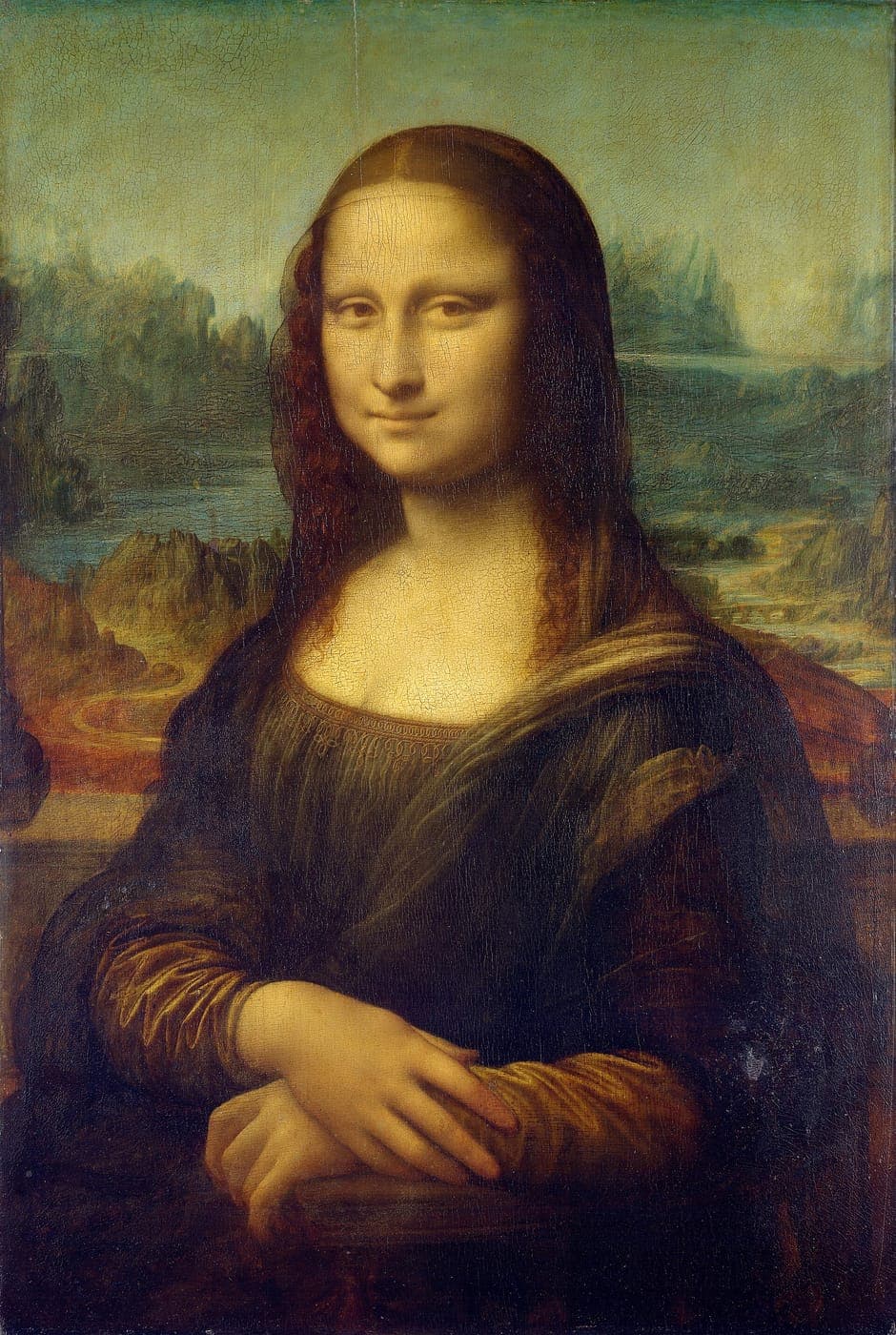
Own a hand-painted copy
Mona Lisa
Painted by hand in oil on canvas, any size. Free worldwide shipping.
From $299 — Make it yours.Frequently asked questions
Who is the woman in the Mona Lisa?
She is generally identified as Lisa Gherardini, wife of the Florentine merchant Francesco del Giocondo, which is why the painting is also called La Gioconda.
Why is the Mona Lisa so famous?
Its fame rests on Leonardo's revolutionary technique, the mysterious smile, and the 1911 theft from the Louvre, which made it an international celebrity.
How big is the Mona Lisa?
The original measures about 77 × 53 cm, smaller than many visitors expect. ArtLogia paints reproductions in sizes from 16 × 20 inches up to museum scale.
Where is the Mona Lisa today?
It is in the Musée du Louvre in Paris, in the Salle des États of the Denon wing.
Sources and further reading
- Musée du Louvre, collection notes on the Portrait of Lisa Gherardini
- Martin Kemp and Giuseppe Pallanti, Mona Lisa: The People and the Painting (2017)
- Giorgio Vasari, Lives of the Artists (1550)
