


Listen to this article
0:00 / 3:45 · Read by ArtLogia
She turns towards us out of the dark, lips parted, a huge pearl catching the light. Girl with a Pearl Earring is not a portrait of a known person but a study of a face, a turban and a single moment of attention.
In this article
A face, not a portrait
Johannes Vermeer painted Girl with a Pearl Earring around 1665 in Delft. Despite its fame, we do not know who the girl was. The painting is a tronie, a Dutch term for a study of a head, often in exotic costume, made to show a character or an expression rather than to record a sitter. Buyers in the seventeenth century collected tronies for their artistry, not as portraits of particular people.
That is why the painting feels both intimate and impersonal. The girl looks over her shoulder as if someone has just spoken her name. Her mouth is slightly open, her eyes wide. Nothing tells us where she is or what she is thinking, and that uncertainty is part of the spell.
The turban and the blue
The blue and yellow turban was a fantasy costume, inspired by Turkish dress that fascinated Europe at the time. The blue is natural ultramarine, made from ground lapis lazuli imported from Afghanistan, then more precious than gold. Vermeer used it lavishly, even in the shadows of other paintings, which says much about his ambitions.
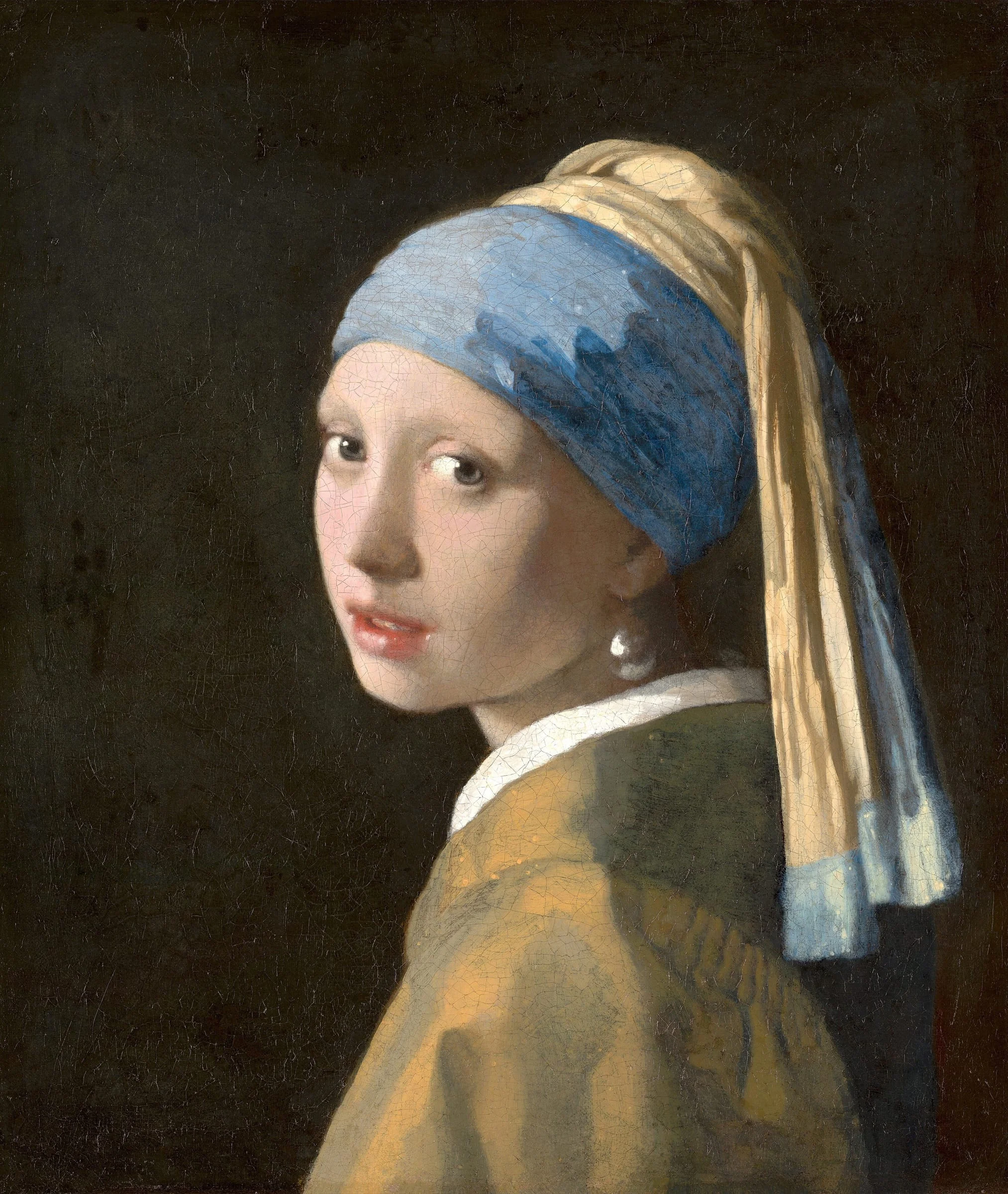 Detail 1
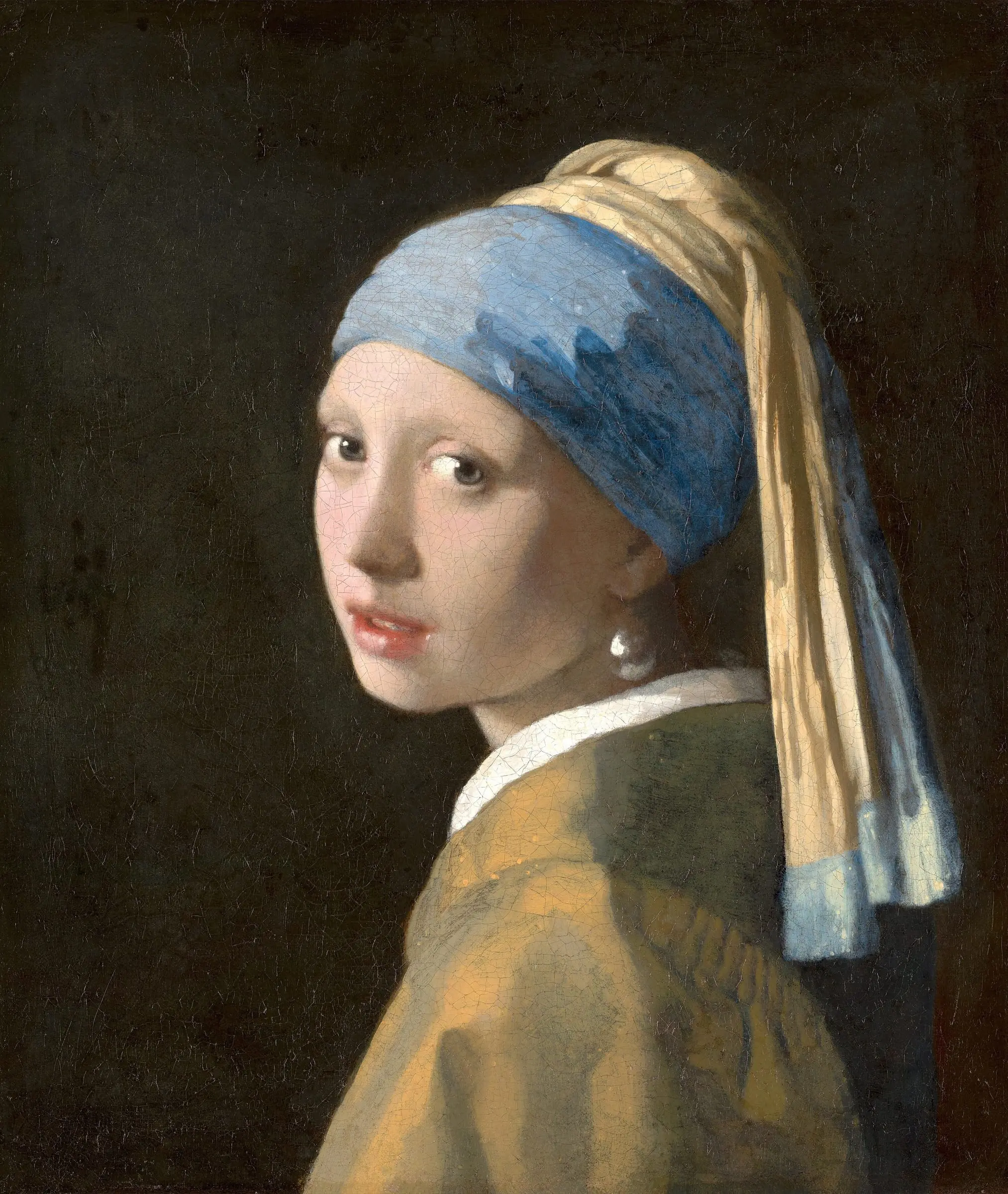
The ultramarine turban
The turban is painted in ultramarine with lead-tin yellow for the hanging cloth. Vermeer laid the blue over a darker underlayer, giving the folds their depth and glow.
The pearl
The pearl is the painting's signature, and it is almost not there. Look closely and you see that it is made of just two strokes: a bright highlight at the top and a soft reflection of the white collar below. There is no outline and no hook connecting it to the ear. Vermeer trusted the eye to complete it. Scholars have pointed out that a pearl of this size would have been extraordinary; it may have been a glass drop varnished to look like pearl, or simply an invention.
Detail 2Two strokes of paint
The pearl has no outline: a highlight above and the reflection of the collar below. The rest is suggested by the shadow of the neck.
The eyes and lips
The girl's eyes catch the light from the window on the left, with tiny white highlights that bring them to life. Her lips are moist and shining, with a small highlight at the corner of the mouth. These touches of light make the face seem to breathe. The 2018 research project by the Mauritshuis revealed, with microscopic imaging, that she once had fine eyelashes, and that the dark background was originally a green curtain whose glazes have faded.
Detail 3The gaze
The eyes are turned towards us more than the head is. A white highlight in each pupil and the shining corner of the lips give the face its sense of a living moment.
Detail 4Parted lips
A tiny highlight on the lower lip and another at the corner of the mouth make the lips seem moist. It is one of the most imitated details in painting.
How the painting became famous
For two centuries the painting was almost unknown. In 1881 it was bought at an auction in The Hague for just two guilders by the collector Arnoldus des Tombe, who left it to the Mauritshuis in 1902. Its fame grew through the twentieth century and exploded after Tracy Chevalier's 1999 novel and the 2003 film starring Scarlett Johansson, both of which imagined a story for the unknown girl.
Seeing the original
The painting is surprisingly small, about 44.5 by 39 centimetres. It hangs in the Mauritshuis in The Hague, which rarely lends it. A hand-painted reproduction allows you to enjoy the pure blue, the dark ground and the light on the pearl every day.
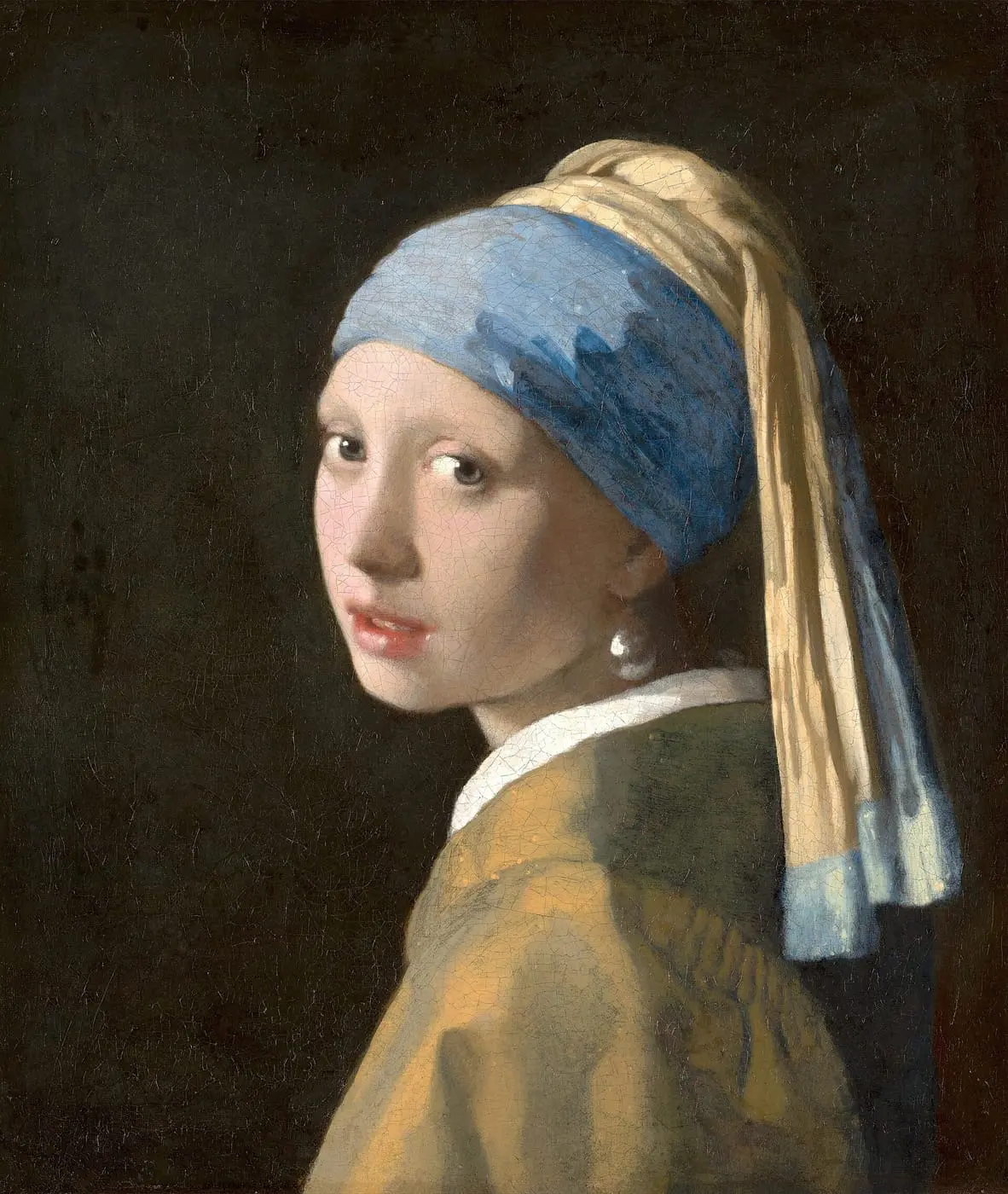
Own a hand-painted copy
Girl with a Pearl Earring
Painted by hand in oil on canvas, any size. Free worldwide shipping.
From $299 — Make it yours.Frequently asked questions
Who was the girl in Girl with a Pearl Earring?
Her identity is unknown. The painting is a tronie, a study of a face in costume, rather than a portrait of a particular person.
Is the pearl real?
We do not know. Some scholars think such a large pearl would have been unrealistic and that it may represent a glass or tin drop, or simply an invention by Vermeer.
Where is Girl with a Pearl Earring?
It is in the Mauritshuis in The Hague, the Netherlands.
How big is Girl with a Pearl Earring?
The original is about 44.5 × 39 cm. ArtLogia reproductions can be painted in that size or larger.
Sources and further reading
- Mauritshuis, The Hague, collection notes on Girl with a Pearl Earring
- Mauritshuis, The Girl in the Spotlight research project (2018)
- Walter Liedtke, Vermeer: The Complete Paintings (2008)
