Listen to this article
0:00 / 3:22 · Read by ArtLogia
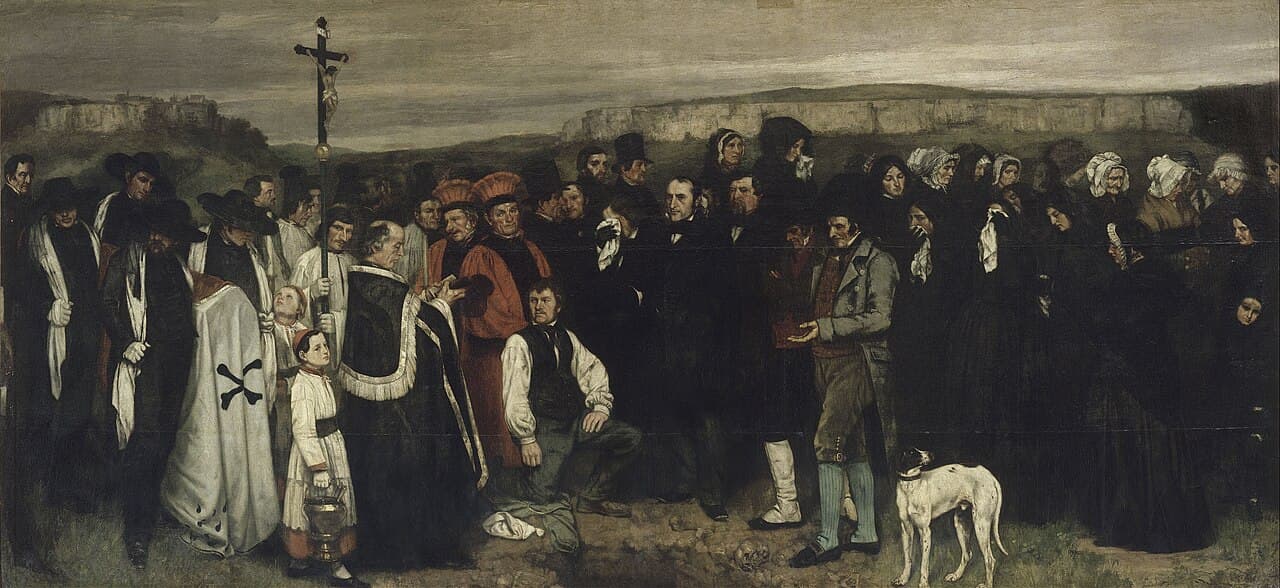
Around an open grave in a country cemetery, the people of a small town in eastern France gather for a funeral: priest, mayor, gravedigger, mourners and a dog. Gustave Courbet painted these ordinary people life-size on a canvas almost seven metres wide, and changed the course of art.
In this article
A funeral in Courbet's hometown
Gustave Courbet was born in 1819 in Ornans, a small town in the Franche-Comté region of eastern France. In the autumn of 1849 he returned home and painted a funeral in the new cemetery of the town, perhaps that of his great-uncle. About fifty townspeople posed for him one by one in his studio in an attic: the mayor, the priest, the beadles, his father, his sisters, local farmers and craftsmen.
The canvas is huge, about 3.1 by 6.7 metres. Such dimensions were reserved for history painting, the noblest category of art, depicting kings, heroes, saints and battles. Courbet used them for a funeral of anonymous provincial people.
A scandal at the Salon
When the painting was shown at the Paris Salon of 1850–1851, critics were outraged. They found the people ugly, the composition chaotic and the subject trivial. Courbet replied that the painting was the burial of Romanticism, and that he wanted to paint only what he could see: the real people of his time. A Burial at Ornans became the manifesto of Realism.
The crucifix
Above the crowd, a cross-bearer holds up a crucifix against the sky, the figure of Christ standing out against the grey cliffs. It is the only religious symbol in a scene that otherwise feels very earthly.
 Detail 1

The crucifix against the sky
The crucifix rises above the mourners against the pale sky and the cliffs of the Loue valley.
The priest and the officials
On the left, the priest reads the funeral service from his book, surrounded by choirboys and beadles in red robes. The beadles, with their red noses and robes, were mocked by critics as caricatures, but Courbet painted them as he saw them.
Detail 2The priest and the beadles
The priest reads the prayers while beadles in red robes stand by. Courbet painted each face as an individual portrait.
The open grave
At the bottom centre, a dark grave is open in the ground. The gravedigger kneels beside it, waiting. A skull lies on the edge, a reminder of death. There is no dead body or coffin in view, only the hole in the earth that awaits everyone.
Detail 3The open grave
The grave opens in the foreground, with a skull on its edge. It is the silent centre of the whole composition.
The dog and the mourners
On the right, the women of the town weep in black dresses and white bonnets, some covering their faces with handkerchiefs. In front of them, a white and brown dog looks away from the scene, unconcerned by human grief.
Detail 4The dog
A dog stands near the grave, indifferent to the ceremony. It brings a note of everyday life to the solemn scene.
Detail 5The mourning women
The women stand in a dark mass on the right, weeping into handkerchiefs. Their black clothes and white caps create a strong rhythm.
The landscape
Behind the mourners rise the limestone cliffs of the Loue valley around Ornans, under a heavy grey sky. The landscape anchors the scene in a precise place and gives it the solemn, horizontal rhythm of a frieze.
Seeing A Burial at Ornans
The painting is in the Musée d'Orsay in Paris, in a room devoted to Courbet's monumental works, near The Painter's Studio.
Own a hand-painted copy
A Burial at Ornans
Painted by hand in oil on canvas, any size. Free worldwide shipping.
From $349 — Make it yours.Frequently asked questions
Why is A Burial at Ornans important?
It applied the huge scale of history painting to an ordinary village funeral, becoming the manifesto of Realism.
Who are the people in A Burial at Ornans?
They are real inhabitants of Ornans, including Courbet's family, the mayor and the priest, who posed for the painter.
How big is A Burial at Ornans?
It measures about 3.1 by 6.7 metres.
Where is A Burial at Ornans?
It is in the Musée d'Orsay in Paris.
Sources and further reading
- Musée d'Orsay, collection notes on A Burial at Ornans
- T. J. Clark, Image of the People: Gustave Courbet and the 1848 Revolution (1973)
- Gustave Courbet, Realist Manifesto (1855)
