


Listen to this article
0:00 / 3:35 · Read by ArtLogia
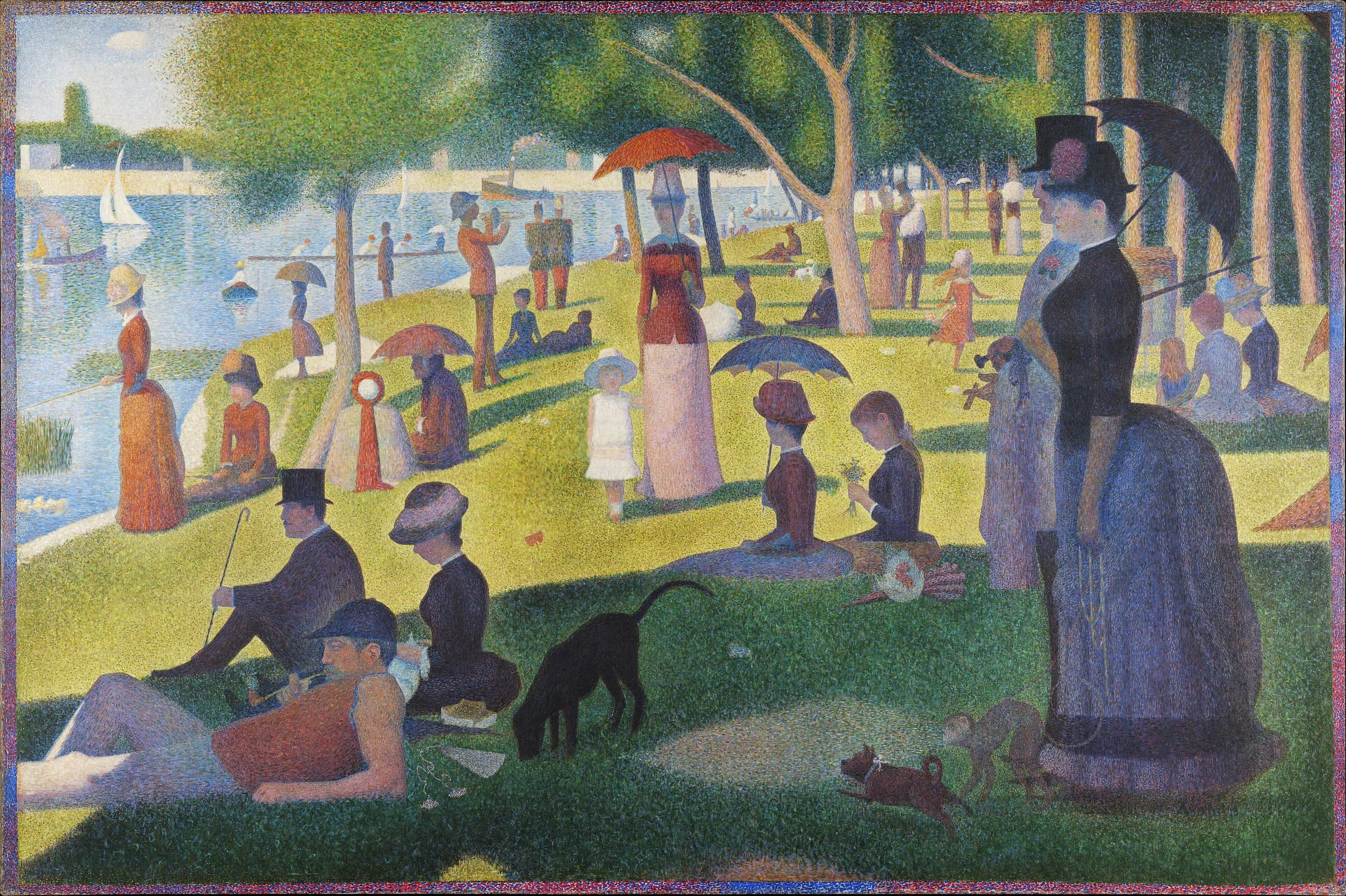
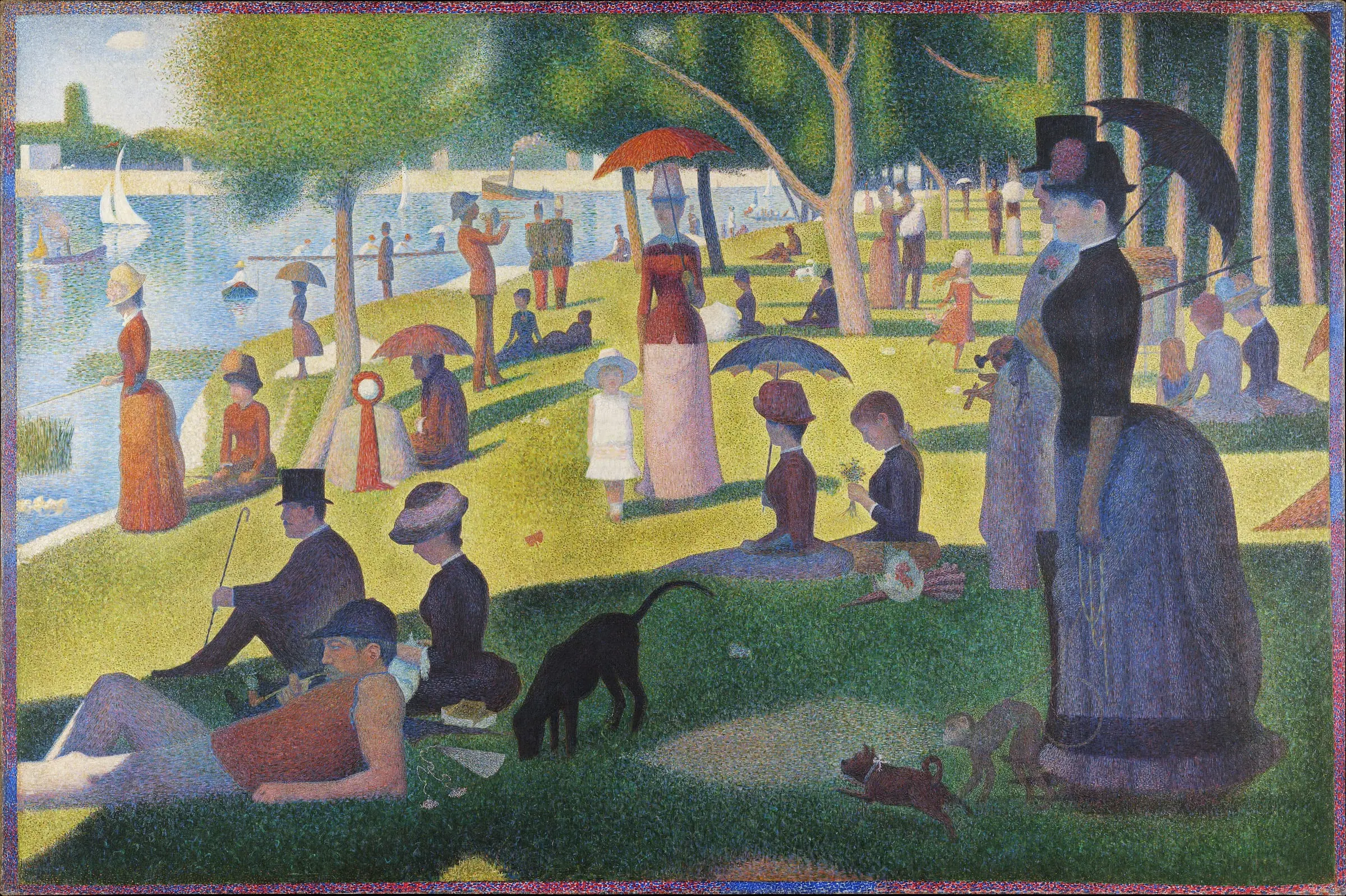
Parisians relax on an island in the Seine on a summer Sunday: couples stroll under parasols, a girl in white skips, a woman fishes and a monkey sits on a leash. Georges Seurat spent two years painting it with millions of tiny dots of pure colour.
In this article
A scientific painting
Georges Seurat was only twenty-four when he began A Sunday Afternoon on the Island of La Grande Jatte in 1884. The island lies in the Seine just west of Paris, and on Sundays it was a popular place for walking, picnicking and boating. Seurat went there almost every day for months to make sketches and studies, more than sixty of them, before painting the final canvas in his studio.
He wanted to give Impressionism a scientific basis. Inspired by the colour theories of the chemist Michel-Eugène Chevreul, he painted with small dots of pure colour placed side by side, so that the eye mixes them at a distance. This technique, called Pointillism or Divisionism, was meant to produce more luminous colours than mixing paint on the palette.
The woman with the monkey
On the right stands a fashionable woman with a bustle and a parasol, holding a monkey on a leash, accompanied by a man in a top hat. Monkeys were exotic pets, and the French word for a female monkey, singesse, was slang for a prostitute, so some historians see a hint of irony or social satire in this elegant couple.
 Detail 1
The monkey on a leash
A small monkey sits at the feet of the elegant woman. The exotic pet has been read as a playful or satirical comment on Parisian society.
The girl in white
In the centre of the painting, a little girl in a white dress walks hand in hand with her mother, the only figure who looks directly towards us. She is the brightest point of the composition and draws the eye into the heart of the crowd.
Detail 2The girl in white
The little girl in white is the brightest figure in the painting, and the only one who faces the viewer.
The people of the park
Around forty figures and animals fill the park, all rigid and silent, seen in profile or from the front, like figures on an ancient Egyptian frieze. A man reclines smoking a pipe, a woman fishes at the water's edge, soldiers stand at attention, a couple sits on the grass, a black dog sniffs about. Their stillness gives the scene a strange, timeless solemnity, very different from the lively scenes of the Impressionists.
Detail 3The reclining man
A man in shirtsleeves lies on the grass smoking a pipe. Like all the figures, he seems frozen in time.
Detail 4The black dog
A black dog bounds across the grass, one of the few moving figures in the park.
Boats on the Seine
On the left, the river is full of activity: sailing boats, a rowing crew and a steamboat glide on the blue water. Their small shapes, made entirely of dots, shimmer in the light.
Detail 5Boats on the river
Sailing boats and a rowing crew move on the Seine, built from countless dots of colour.
The painted border
Seurat later added a border of dots around the painting, in complementary colours that change to intensify the colours next to them. He believed this border would prevent the white frame from dulling the colours. It is part of the painting and is still visible today.
Seeing the painting
The painting is large, about 2 by 3 metres, and was shown at the last Impressionist exhibition in 1886, where it caused a sensation. It is in the Art Institute of Chicago, which acquired it in 1924. It is never lent, because of its fragility.
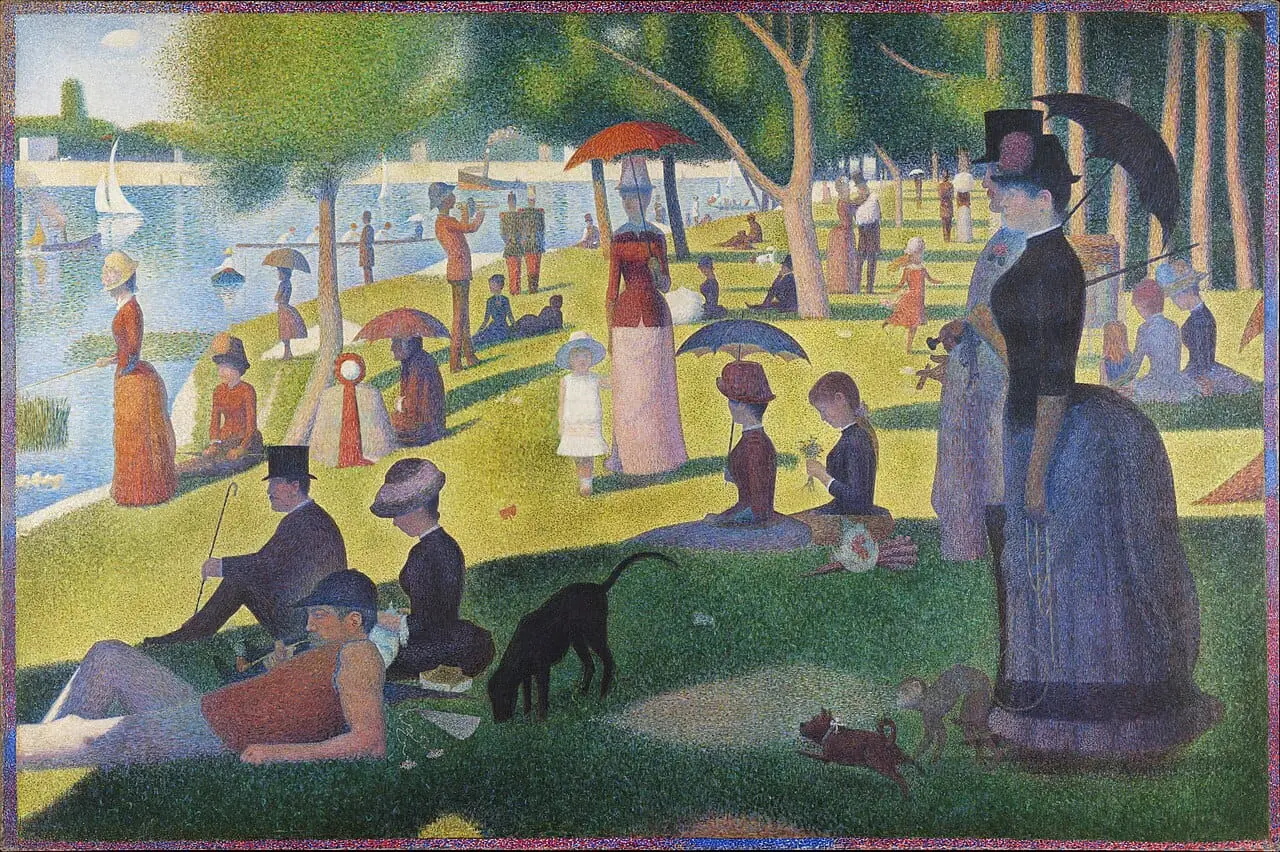
Own a hand-painted copy
A Sunday Afternoon on the Island of La Grande Jatte
Painted by hand in oil on canvas, any size. Free worldwide shipping.
From $299 — Make it yours.Frequently asked questions
What is Pointillism?
It is a technique of painting with small dots of pure colour that the eye blends at a distance, developed by Georges Seurat.
How long did Seurat take to paint La Grande Jatte?
He worked on it for about two years, from 1884 to 1886, making dozens of preparatory studies.
Why is there a monkey in the painting?
The monkey was an exotic pet, and may also be a satirical hint about the elegant woman holding it.
Where is A Sunday Afternoon on the Island of La Grande Jatte?
It is in the Art Institute of Chicago.
Sources and further reading
- Art Institute of Chicago, collection notes and Seurat and the Making of La Grande Jatte (2004)
- Robert L. Herbert, Georges Seurat 1859–1891 (1991)
- Michel-Eugène Chevreul, On the Law of Simultaneous Contrast of Colours (1839)
