


Listen to this article
0:00 / 3:19 · Read by ArtLogia
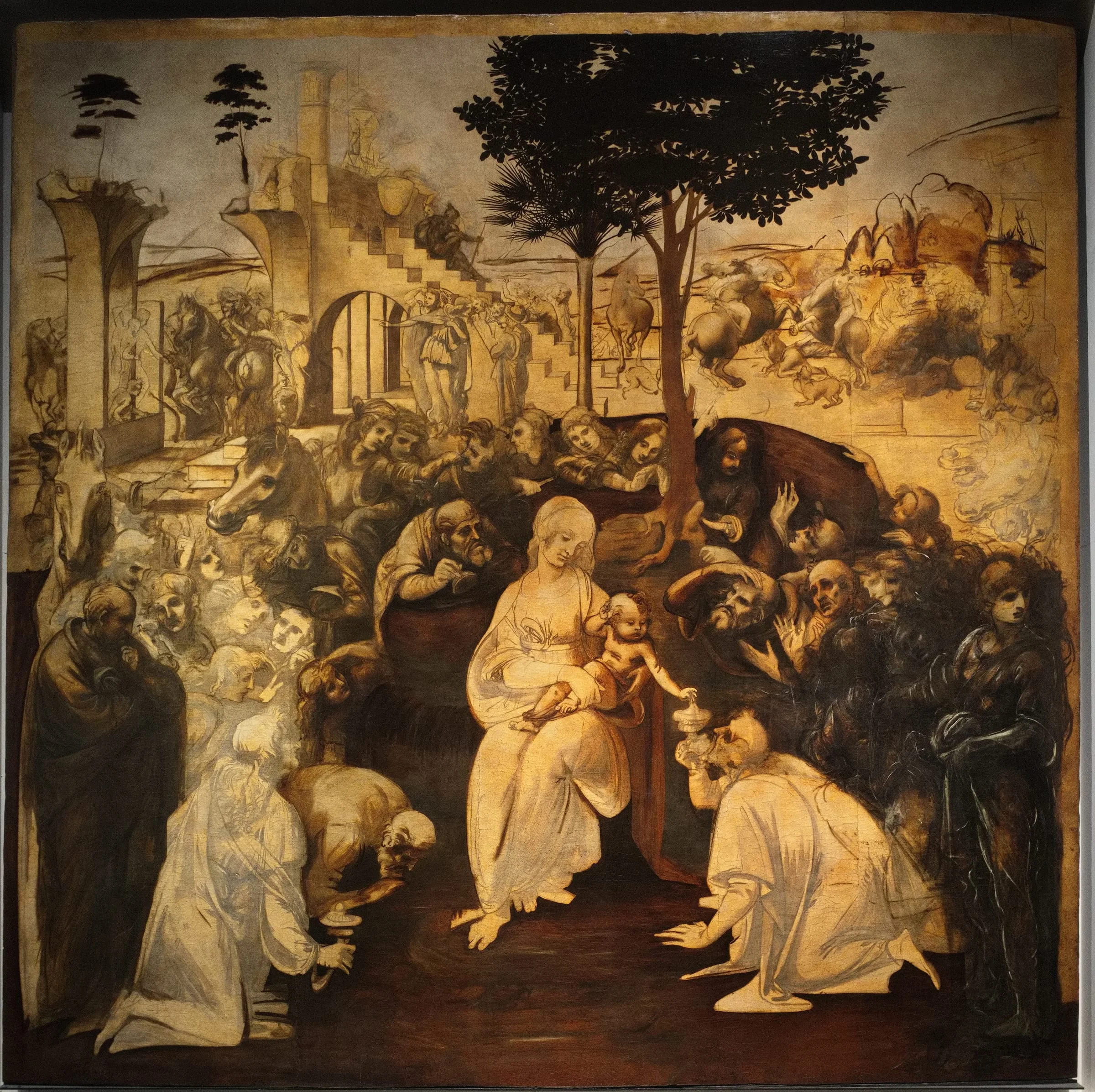
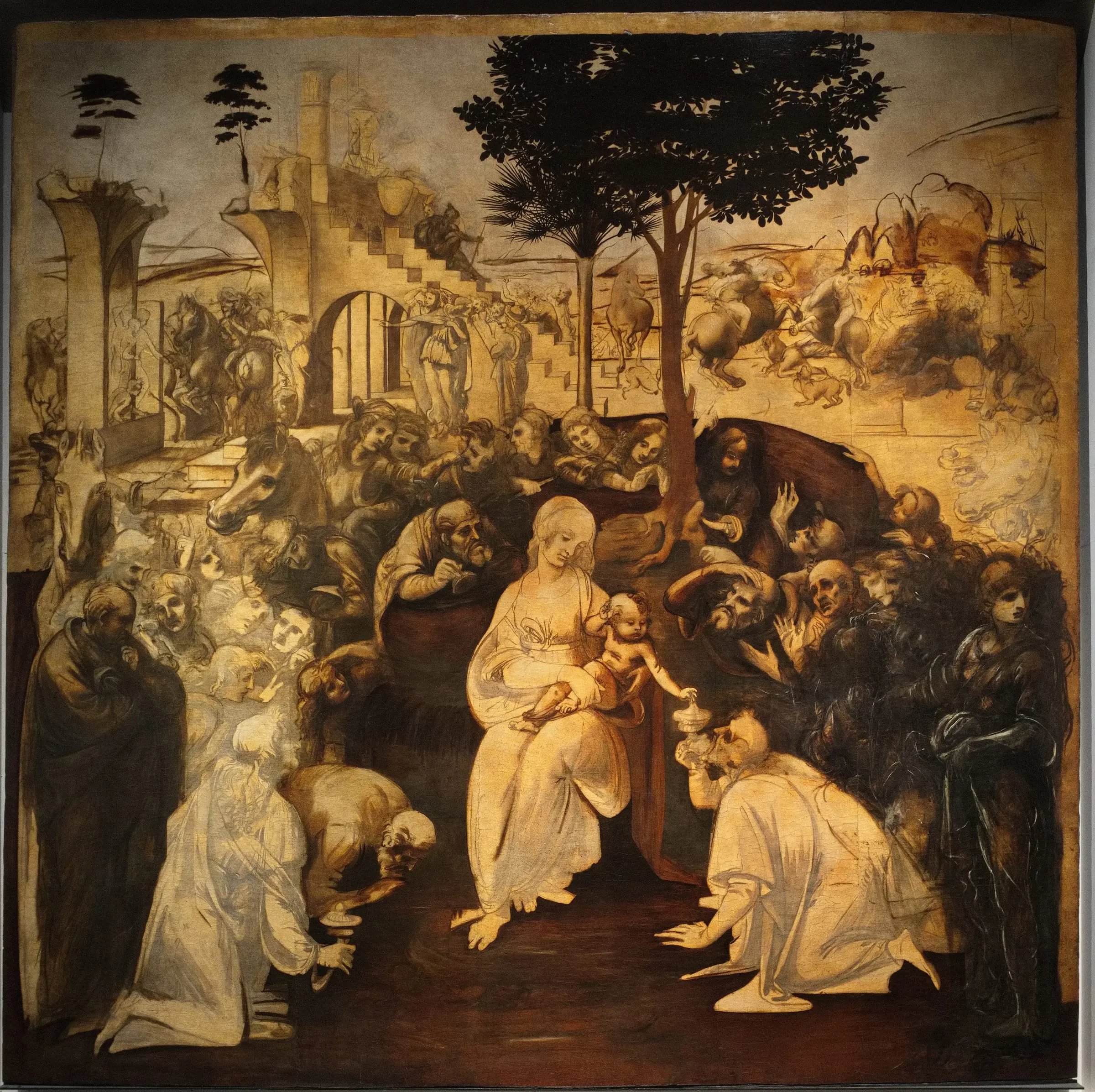
Around the Virgin and Child, a crowd of figures twists and gestures in amazement, while in the background horsemen fight among ruins. Leonardo da Vinci began the Adoration of the Magi in Florence in 1481 and left it unfinished when he moved to Milan, giving us a rare view of his mind at work.
In this article
An altarpiece left unfinished
In March 1481 the Augustinian monks of San Donato a Scopeto, outside Florence, commissioned Leonardo da Vinci, then twenty-nine, to paint an altarpiece of the Adoration of the Magi, the Three Kings who came to honour the newborn Christ. Leonardo worked on it for months, but in 1482 he left for Milan to enter the service of Ludovico Sforza and never returned to it. The monks later commissioned another painter, Filippino Lippi, to paint a new altarpiece.
What remains is an underdrawing and underpainting in brown and ochre tones on a large wooden panel, about 2.4 by 2.5 metres. Unfinished as it is, it is one of the most revolutionary compositions of the Renaissance.
The Virgin and Child
At the centre, the Virgin sits under a tree with the infant Christ on her lap, who reaches towards one of the kneeling kings offering a gift. Around them, the figures form a great semicircle, so that all the energy of the composition converges on the mother and child.
 Detail 1
The Virgin and Child
Mary sits at the centre holding the infant Jesus, who reaches towards a king's gift. Every movement in the painting turns towards them.
A crowd in amazement
Leonardo replaced the traditional orderly procession of kings with a crowd of people of all ages, overwhelmed by the revelation: some bend down, some raise their hands, some shield their eyes, some turn to each other in wonder. These figures show his intense study of human emotion and gesture.
Detail 2A kneeling king
An old king kneels and bows before the child, his gift in his hands. Around him, figures react with astonishment.
The ruined palace
In the upper left rise the ruins of a classical palace, with a double staircase on which workmen seem to be rebuilding. The ruins have been interpreted as the end of the pagan world, giving way to the new world of Christianity.
Detail 3The ruined palace
The ruins of a classical building with steep stairs symbolise the old pagan world. Small figures climb and work on its arches.
Fighting horsemen
In the upper right, horsemen rear and fight in a confused battle, an image of the violence and chaos of the world before Christ. Leonardo would later develop this theme in his lost mural of the Battle of Anghiari.
Detail 4Horsemen in battle
Rearing horses and riders clash in the background, an image of the chaos of the pagan world, painted with Leonardo's passion for movement.
The tree
Behind the Virgin rises a tree, often identified as a palm or carob tree, a symbol of the Tree of Life and of Christ's victory over death.
Detail 5The tree of life
A tall tree grows from the rocks behind the Virgin, a symbol of life and salvation that divides the two halves of the background.
A restoration that revealed Leonardo
From 2011 to 2017 the panel was studied and restored at the Opificio delle Pietre Dure in Florence. The cleaning of old varnishes revealed Leonardo's original drawing in great detail. The figure at the far right edge, a young man looking out, has been suggested as a possible self-portrait of the painter. The work is in the Uffizi Gallery in Florence.
Own a hand-painted copy
Adoration of the Magi
Painted by hand in oil on canvas, any size. Free worldwide shipping.
From $299 — Make it yours.Frequently asked questions
Why is the Adoration of the Magi unfinished?
Leonardo left it unfinished when he moved to Milan in 1482 to work for Ludovico Sforza.
What does the Adoration of the Magi show?
It shows the Three Kings and a crowd honouring the Virgin and the infant Christ, with ruins and battling horsemen in the background.
How big is the Adoration of the Magi?
It measures about 2.4 by 2.5 metres, one of Leonardo's largest works.
Where is the Adoration of the Magi?
It is in the Uffizi Gallery in Florence.
Sources and further reading
- Uffizi Galleries, collection notes and restoration report on the Adoration of the Magi (2017)
- Martin Kemp, Leonardo da Vinci: The Marvellous Works of Nature and Man (1981)
- Frank Zöllner, Leonardo da Vinci: The Complete Paintings (2003)
