Listen to this article
0:00 / 4:04 · Read by ArtLogia
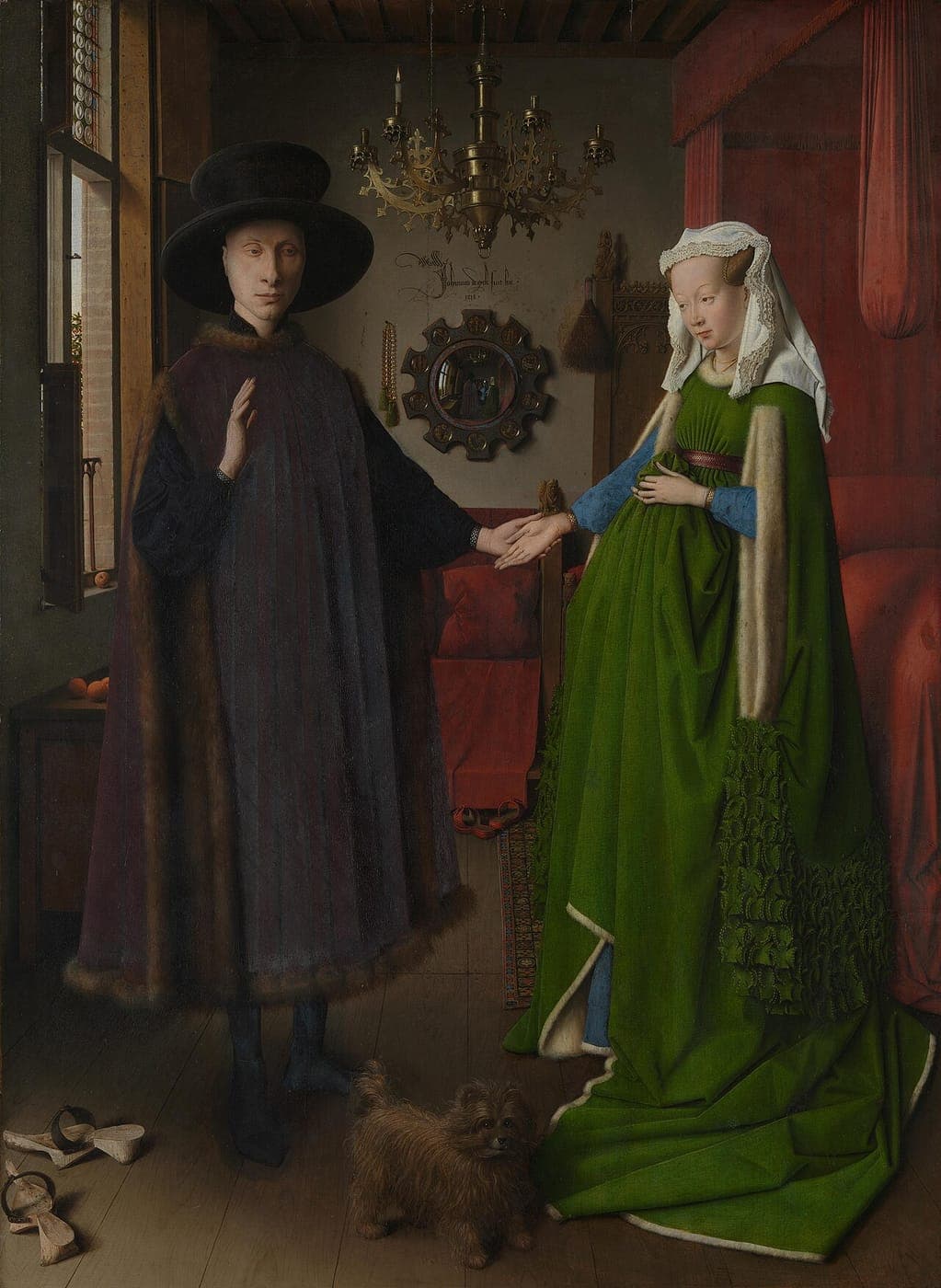
A merchant and his wife stand hand in hand in a room in Bruges, with a little dog at their feet and a mirror on the wall that reflects the whole room. Painted by Jan van Eyck in 1434, the Arnolfini Portrait is a marvel of detail and a mystery that historians still debate.
In this article
A merchant in Bruges
In the early fifteenth century Bruges was one of the richest trading cities of Europe, home to merchants from Italy, Spain and Germany. Giovanni di Nicolao Arnolfini, a merchant from Lucca, lived there, and in 1434 he commissioned Jan van Eyck, court painter to the Duke of Burgundy, to paint a portrait of himself and his wife in their home.
The painting is one of the earliest full-length double portraits in Western art, and one of the first panel paintings to show an interior so completely. Van Eyck was a pioneer of oil painting, building up thin transparent glazes that gave his colours an extraordinary depth and allowed him to paint minute details.
Who are they?
The man is generally identified as Giovanni di Nicolao Arnolfini. The woman was long thought to be his wife Giovanna Cenami, but documents show they married only in 1447, after Van Eyck's death. She may be his first wife, Costanza Trenta, who had died by 1433, which has led some historians to suggest the painting is partly a memorial.
The famous mirror
On the back wall hangs a convex mirror in a frame decorated with ten tiny scenes of the Passion of Christ. The mirror reflects the whole room from behind: the backs of the couple, the window, and two more figures standing in the doorway, where the viewer stands. One of them may be the painter himself.
 Detail 1

The convex mirror
The mirror reflects the couple from behind and two figures in the doorway. Its frame contains ten miniature scenes from the Passion of Christ, each smaller than a fingernail.
"Jan van Eyck was here"
Above the mirror, written in elegant Gothic letters on the wall, is the inscription Johannes de eyck fuit hic 1434: "Jan van Eyck was here, 1434". It is like the formula of a witness signing a document, and it has led to the theory that the painting records a marriage or a legal agreement. Today many historians see it simply as a proud signature by an artist who knew his worth.
Detail 2The signature on the wall
The ornate inscription reads "Johannes de eyck fuit hic 1434", Jan van Eyck was here. It is one of the most famous signatures in art.
The single candle
Above the couple hangs a brass chandelier with a single lit candle, though it is daylight. The detail has been read as a symbol of the presence of God, as a symbol of marriage, or, if the woman had died, as a memorial candle. Van Eyck painted the brass with dazzling realism, every reflection precisely placed.
Detail 3One burning candle
Only one candle burns in the brass chandelier in broad daylight. Its meaning, religious, matrimonial or memorial, is still debated.
The dog and the slippers
At the couple's feet stands a small griffon terrier, a symbol of fidelity and also simply a luxury pet. On the floor lie two pairs of shoes, wooden clogs at the left and red slippers at the back. Taking off shoes could indicate that the room was a sacred space, or simply the custom of the house.
Detail 4The little dog
The fluffy terrier at their feet is painted hair by hair. It is a symbol of loyalty and of the couple's wealth.
Wealth on display
Everything in the room speaks of wealth: the oranges on the window sill, expensive imports from the south; the oriental carpet; the fur-lined clothes; the bed with red hangings. The woman's green dress is lined with fur and made of so much fabric that she lifts it in front of her, a fashion of the time rather than a sign of pregnancy, as is often assumed.
Seeing the Arnolfini Portrait
The painting is small, about 82 by 60 centimetres, painted in oil on an oak panel. It entered the National Gallery in London in 1842, and it inspired the Pre-Raphaelites, who admired its clarity and detail.
Own a hand-painted copy
Arnolfini Portrait
Painted by hand in oil on canvas, any size. Free worldwide shipping.
From $349 — Make it yours.Frequently asked questions
Who is in the Arnolfini Portrait?
It shows the Italian merchant Giovanni di Nicolao Arnolfini, probably with his wife, in their house in Bruges.
Is the woman in the Arnolfini Portrait pregnant?
Most historians think not: she is lifting the folds of a fashionable, heavy dress.
What does the inscription say?
It reads "Johannes de eyck fuit hic 1434", meaning "Jan van Eyck was here, 1434".
Where is the Arnolfini Portrait?
It is in the National Gallery in London.
Sources and further reading
- The National Gallery, London, collection notes on the Arnolfini Portrait
- Lorne Campbell, The Fifteenth Century Netherlandish Paintings (National Gallery, 1998)
- Erwin Panofsky, "Jan van Eyck's Arnolfini Portrait", Burlington Magazine (1934)
