


Listen to this article
0:00 / 3:20 · Read by ArtLogia
Young Parisians dance, talk and flirt under the acacia trees of an open-air dance hall in Montmartre, while sunlight filters through the leaves in patches. Painted in 1876, Renoir's Bal du moulin de la Galette is the joyful heart of Impressionism.
In this article
A dance hall on the hill
In the 1870s Montmartre was still a village on the edge of Paris, with windmills, vineyards and gardens. One of its windmills, the Moulin de la Galette, had been turned into a popular dance hall. On Sunday afternoons the working people of the area, seamstresses, shop girls, artists and students, came to dance in the open air under the trees and eat the galettes, flat cakes, that gave the place its name.
Pierre-Auguste Renoir rented a studio nearby in 1876 and painted the scene on the spot, with friends carrying the large canvas to the garden each day. He wanted to capture not a particular moment but the whole atmosphere of a happy afternoon.
Light through the leaves
The great achievement of the painting is its light. Sunlight filters through the leaves of the acacia trees and falls in small bright patches on the dancers' clothes, faces, hats and the ground. Renoir painted these spots with dabs of pale pink, blue and white, so the whole surface seems to flicker and move. Critics of the time complained that the figures looked as if they had stains on their clothes; today this dappled light is the essence of Impressionism.
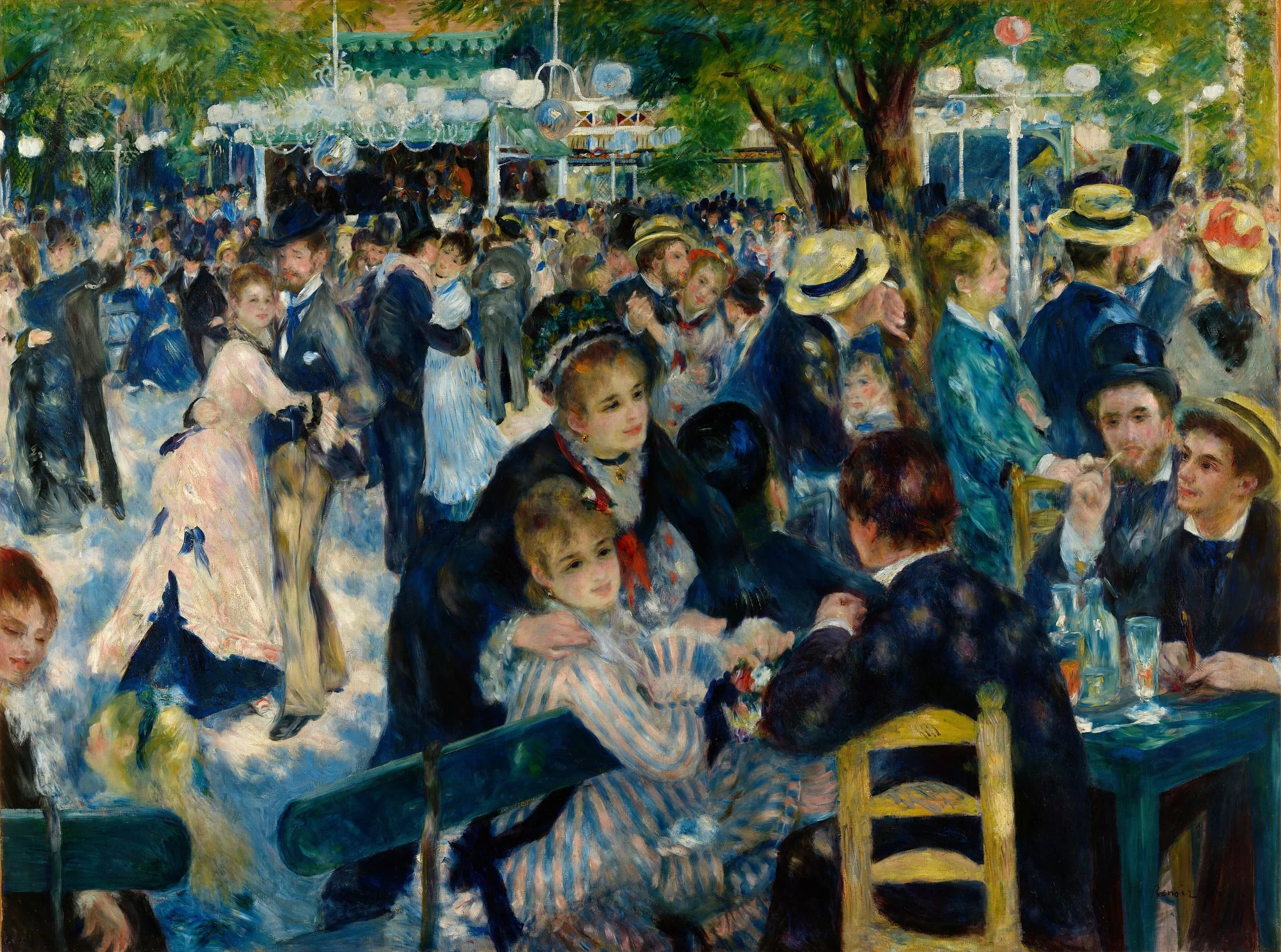 Detail 1
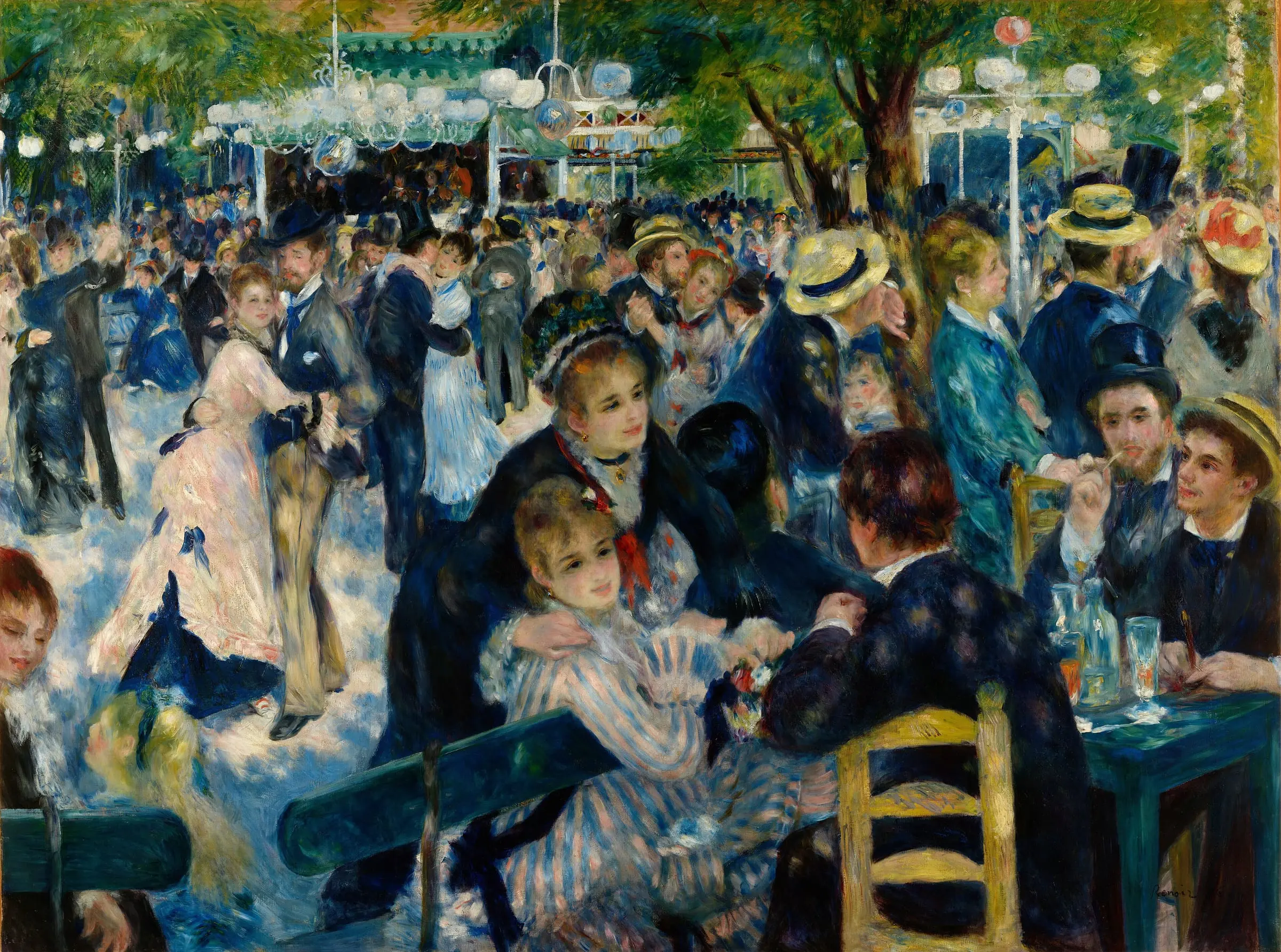
Dappled sunlight
Patches of light fall on the ground and the dresses in pale blue and pink. Renoir painted sunlight through leaves as a pattern of coloured dabs.
The dancing couples
On the left, a couple dances in the light: a young woman in a pink striped dress and her partner. Their faces turn towards each other with a tender, lively expression. Behind them, dozens of other dancers fill the space, their forms blurring into the crowd and the movement.
Detail 2The dancing couple
A young woman in pink dances with her partner in the light. The figures are painted with soft, quick strokes that convey movement and warmth.
The table of friends
In the foreground on the right, a group sits around a table with glasses of grenadine. The young woman in the striped dress leaning on the bench is Estelle, the sister of the model Jeanne Samary, and the men include Renoir's friends: the painter Norbert Goeneutte, the writer Georges Rivière and the painter Franc-Lamy. Renoir chose real people, not professional models, to keep the natural, relaxed feeling.
Detail 3Conversation at the bench
The young woman in the striped dress turns to talk as the friends around the table listen. Renoir posed his own circle in the scene.
Detail 4Straw hats and smiles
The men wear straw boaters and bowler hats, the fashion of the day. Their faces, caught in conversation, give the painting its feeling of real life.
The lamps
Above the dancers hang the gas lamps of the dance hall, round white globes against the green trees. In the evening they would be lit for the dancing to continue. Their presence reminds us that the scene is a modern urban leisure, not a timeless pastoral.
Seeing the original
The painting, about 1.3 by 1.75 metres, was bought by Renoir's friend and fellow painter Gustave Caillebotte and came to the state with his bequest. It is in the Musée d'Orsay in Paris. A smaller version is in a private collection.
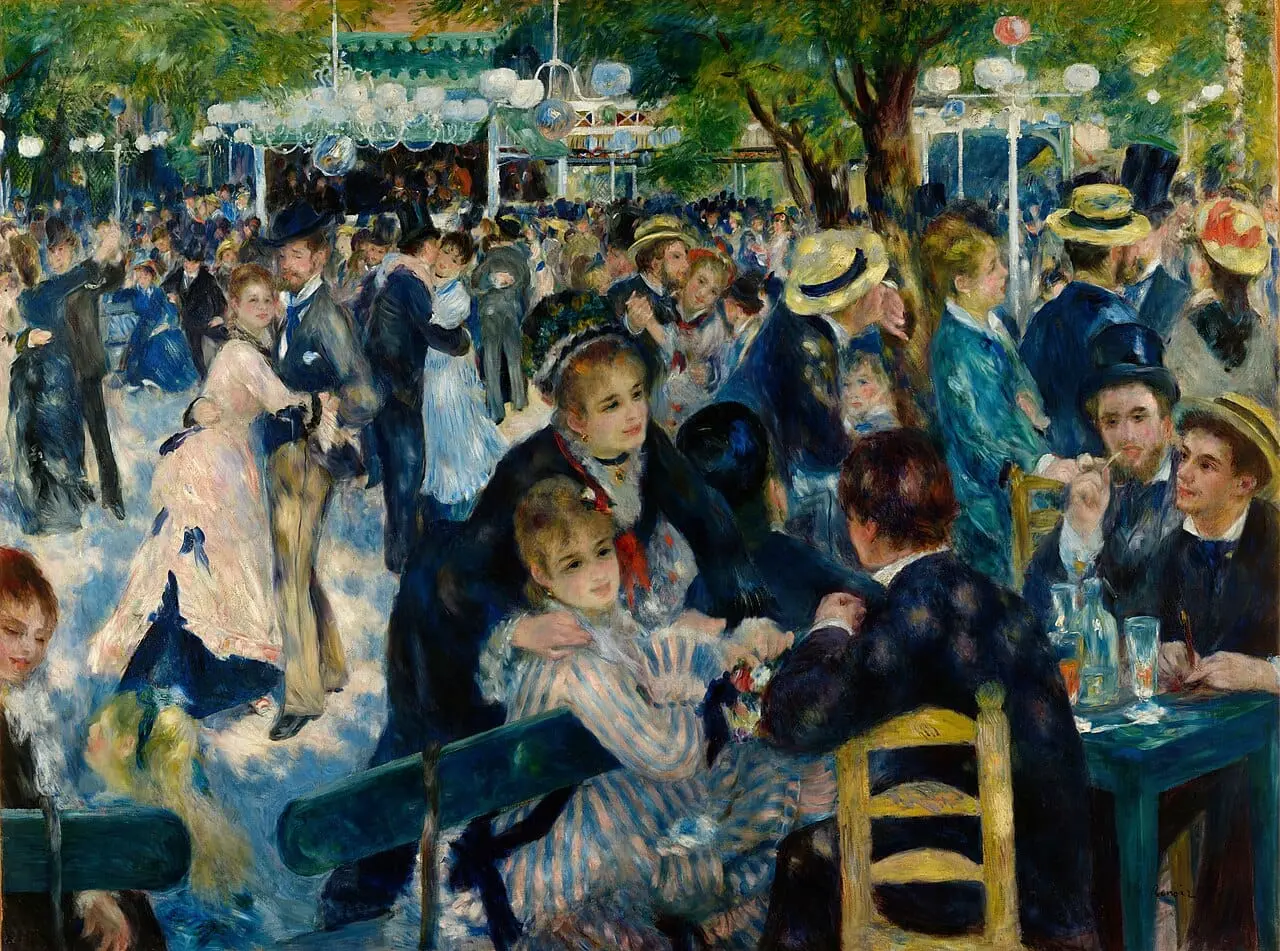
Own a hand-painted copy
Bal du moulin de la Galette
Painted by hand in oil on canvas, any size. Free worldwide shipping.
From $299 — Make it yours.Frequently asked questions
Where is the Moulin de la Galette?
It is in Montmartre in Paris. The windmill still stands today, and the dance hall was in its garden.
Who are the people in Bal du moulin de la Galette?
Renoir used his friends and people from Montmartre as models, including Estelle Samary and the writer Georges Rivière.
Why does the light look spotted?
Renoir painted sunlight filtering through leaves as patches of pale colour on the figures, a key innovation of Impressionism.
Where is Bal du moulin de la Galette?
The large version is in the Musée d'Orsay in Paris.
Sources and further reading
- Musée d'Orsay, collection notes on Bal du moulin de la Galette
- Georges Rivière, Renoir et ses amis (1921)
- Colin B. Bailey, Renoir's Portraits (1997)
