


Listen to this article
0:00 / 3:12 · Read by ArtLogia
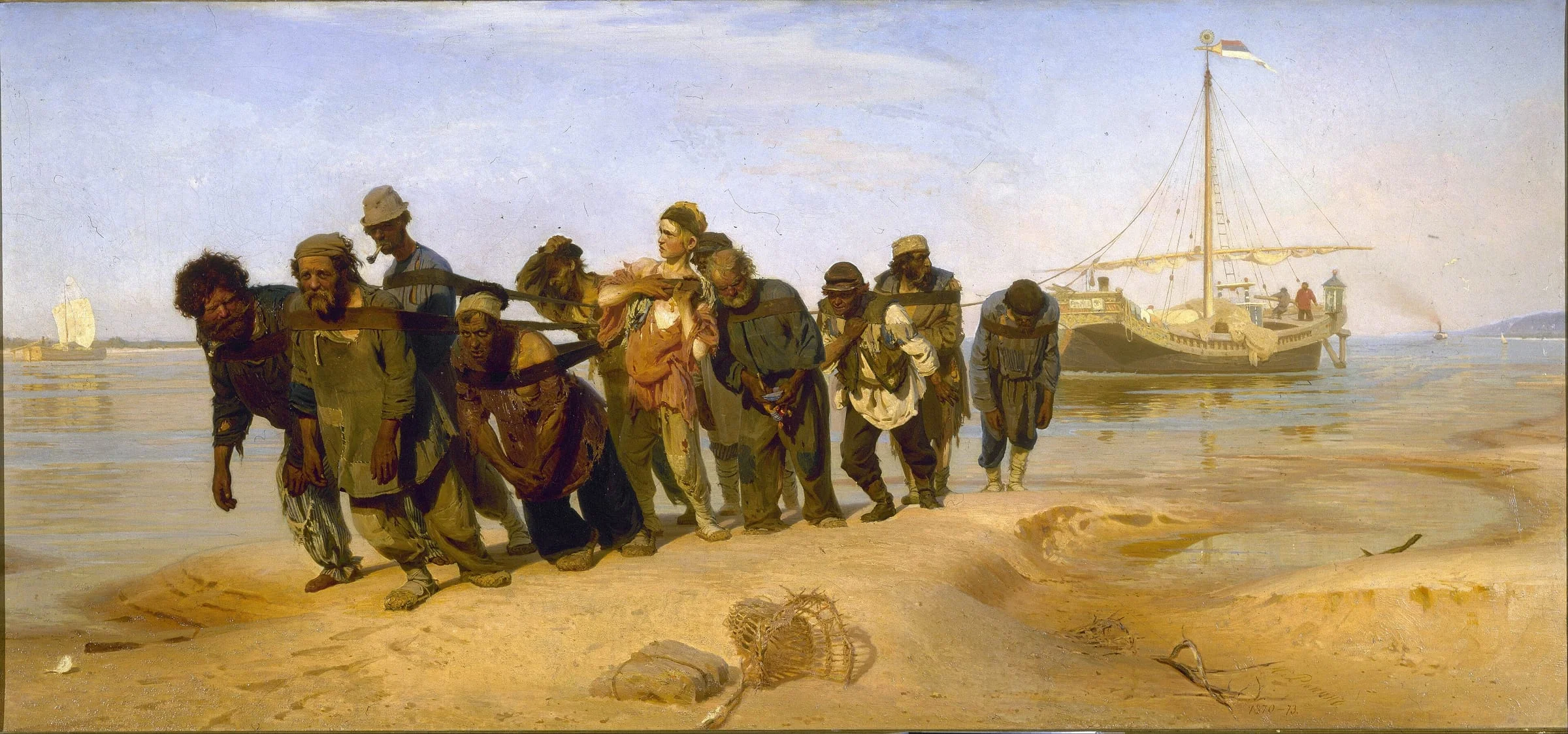
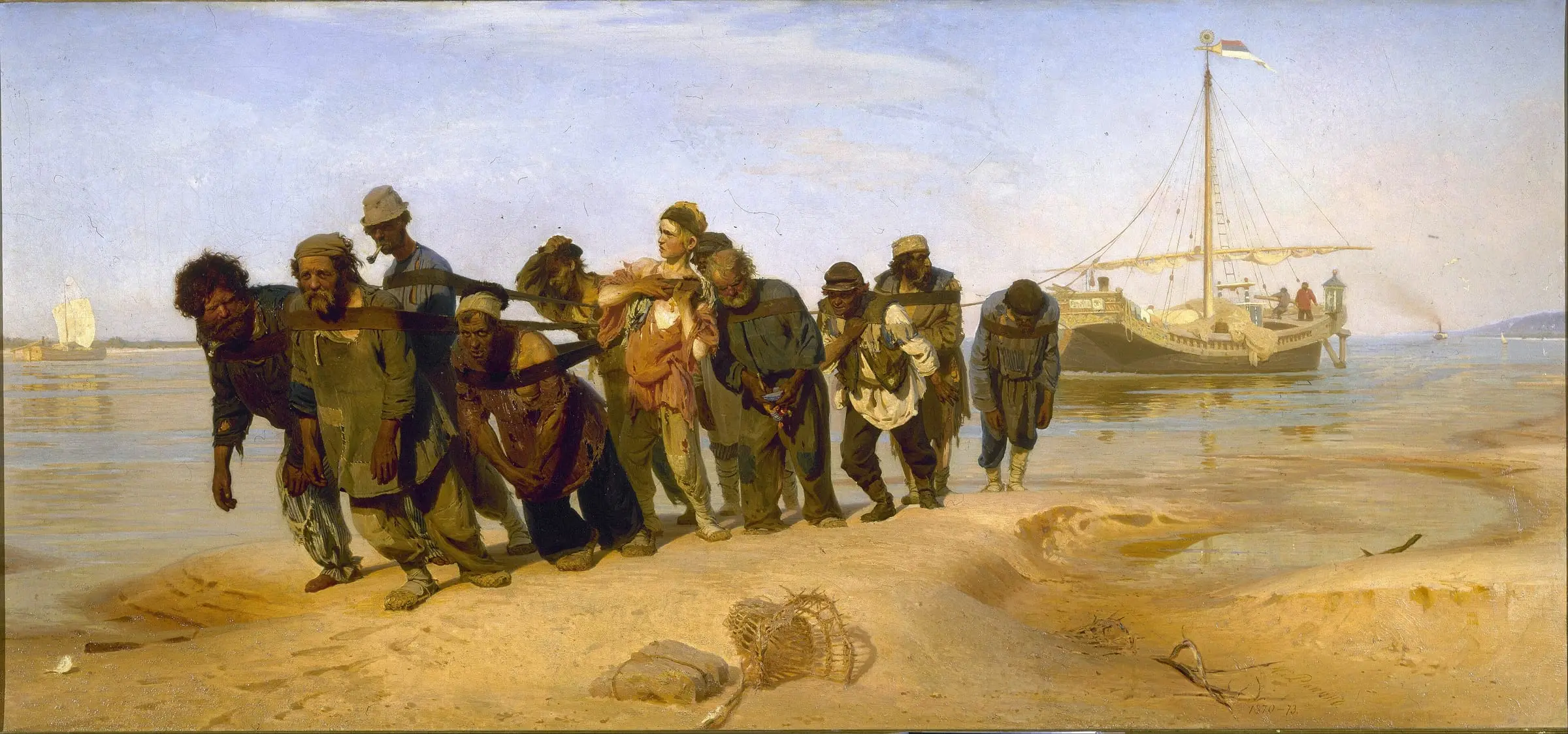
Eleven exhausted men drag a heavy barge along the bank of the Volga under a burning sun, harnessed to a long towrope. Ilya Repin painted Barge Haulers on the Volga between 1870 and 1873, and it made him the most famous painter in Russia.
In this article
The burlaki
In nineteenth-century Russia, barges on the great rivers were often pulled upstream by gangs of men, the burlaki, who walked along the bank harnessed to long ropes. It was one of the hardest forms of labour, done by the poorest people: landless peasants, former soldiers, vagrants. In 1868, as a young student, Ilya Repin saw a group of them near Saint Petersburg and was struck by the contrast between their misery and the elegant summer crowds on the river.
In 1870 he travelled to the Volga to study them, drawing the men and their faces in detail. He finished the painting in 1873, and it was a sensation. Grand Duke Vladimir Alexandrovich bought it for his palace.
The leader
At the head of the line walks the oldest hauler, bearded, his head bowed, his eyes steady. Repin knew him: his name was Kanin, a former priest who had been defrocked, and Repin described him as having the face of a sage or a philosopher. Despite his exhaustion, he walks with a calm, almost stoic dignity.
 Detail 1
Kanin, the leader
The first hauler, a former priest, walks with his head lowered and a calm, wise expression. Repin saw in him a figure of philosophical endurance.
The young Larka
In the middle of the line, a young man in a pink shirt raises his head and adjusts the strap across his chest, looking ahead as if refusing to give in. Repin called him Larka. He is the symbol of youth and rebellion, the one who still hopes for a different life.
Detail 2Larka in the pink shirt
The youngest hauler lifts his head and pulls at his strap. His upright posture contrasts with the bowed figures around him.
A procession of suffering
The men walk in a long line, each in a different pose: some bent almost double, some pulling with their whole weight, one lighting a pipe, one looking back. Repin painted each face individually, creating a gallery of characters and ages. Their ragged clothes and sunburnt skin are painted with uncompromising realism.
Detail 3The men at the back
Towards the end of the line, the haulers lean into the rope with their whole bodies. Each face and pose is individual.
The barge
Behind the men, the barge with its tall mast and Russian flag glides on the water, its weight suggested by the tension of the rope. In the distance, a steamboat passes on the horizon, a sign that this kind of labour was already becoming outdated.
Detail 4The barge and the flag
The heavy barge follows the men, the Russian flag at its mast. The rope pulled taut between them makes its weight visible.
A painting of social conscience
The painting was praised by critics such as Vladimir Stasov and the writer Fyodor Dostoevsky, who admired Repin for showing the men without turning them into political symbols. Today it is seen as a key work of Russian Realism and a deeply human image of labour. It measures about 1.3 by 2.8 metres and is in the State Russian Museum in Saint Petersburg.
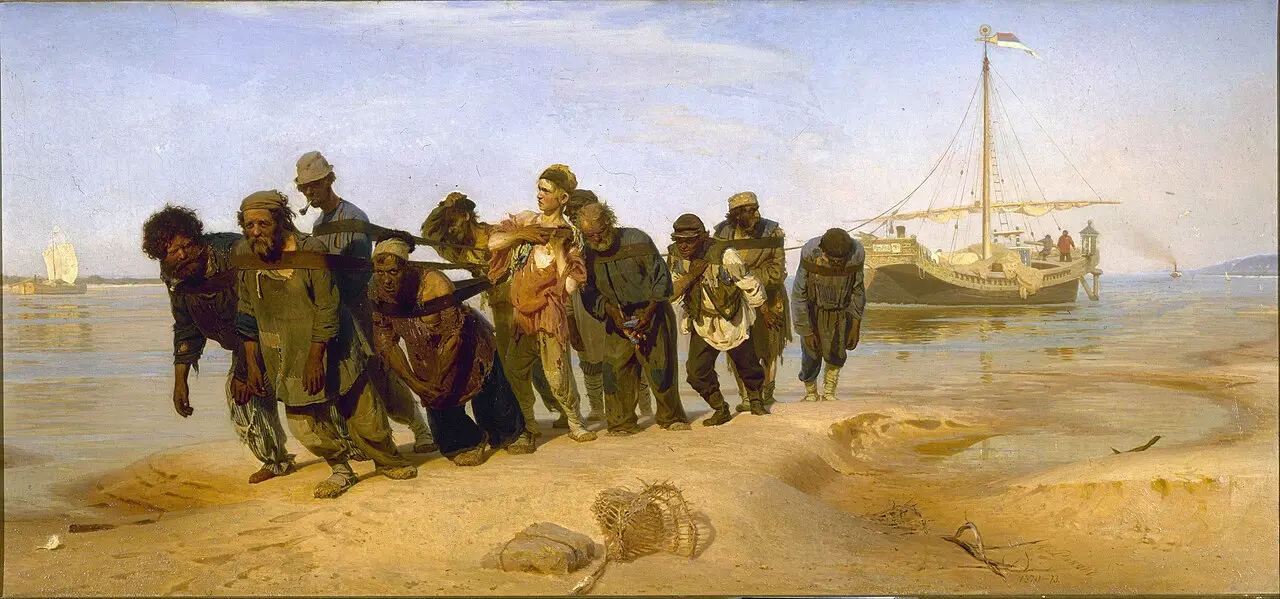
Own a hand-painted copy
Barge Haulers on the Volga
Painted by hand in oil on canvas, any size. Free worldwide shipping.
From $299 — Make it yours.Frequently asked questions
Who were the barge haulers?
The burlaki were labourers, often very poor, who pulled barges upstream along Russia's rivers using ropes and harnesses.
Who is the man at the front of the line?
He was Kanin, a former priest whom Repin met on the Volga and described as having the face of a philosopher.
When was Barge Haulers on the Volga painted?
Ilya Repin painted it between 1870 and 1873.
Where is Barge Haulers on the Volga?
It is in the State Russian Museum in Saint Petersburg.
Sources and further reading
- State Russian Museum, collection notes on Barge Haulers on the Volga
- Ilya Repin, Far and Near (memoirs, 1937)
- Elizabeth Kridl Valkenier, Ilya Repin and the World of Russian Art (1990)
