Listen to this article
0:00 / 3:13 · Read by ArtLogia
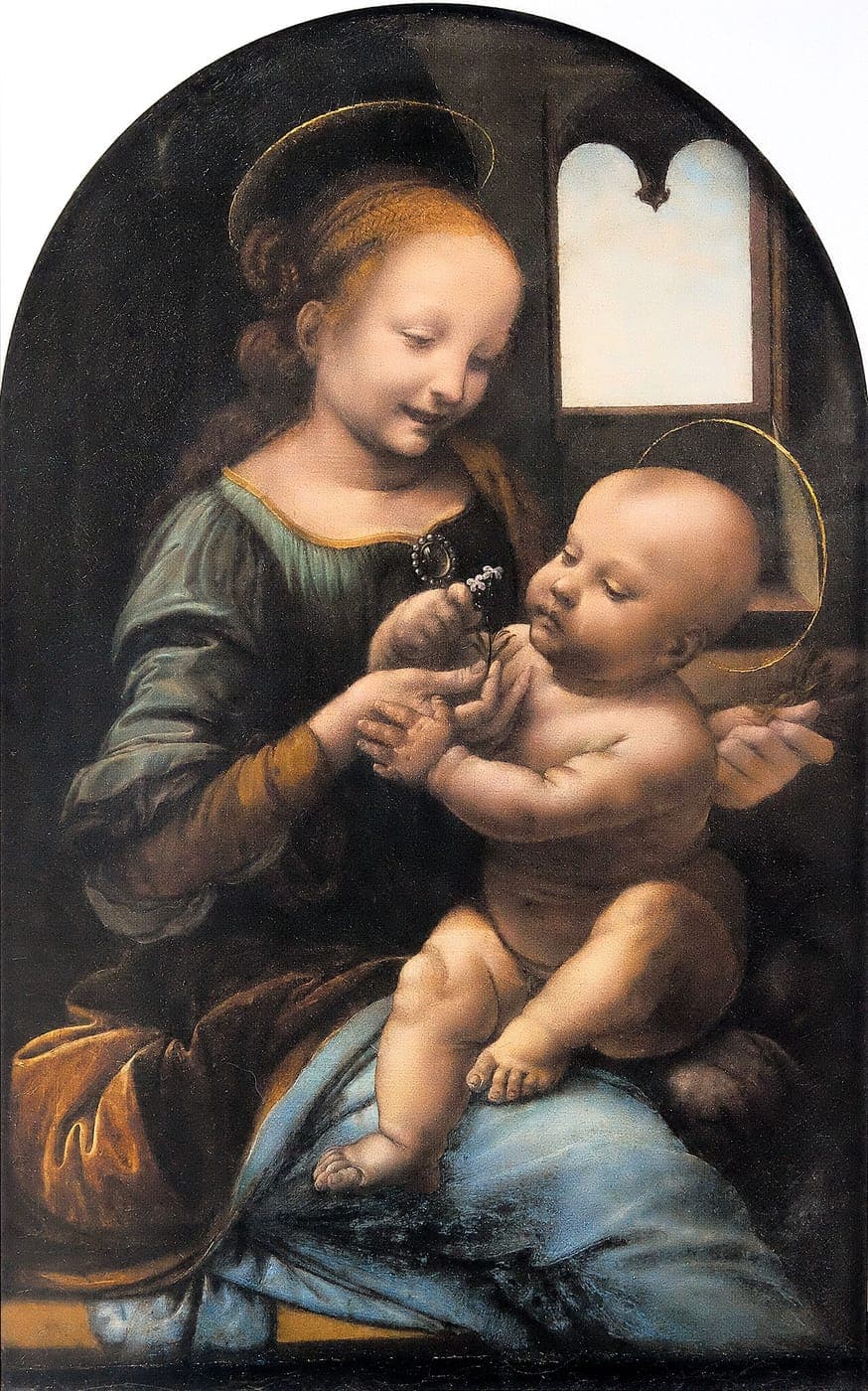
A very young Virgin Mary smiles as she holds out a small flower to her baby, who examines it with serious curiosity. Painted by Leonardo da Vinci around 1478–1480, the Benois Madonna is one of his earliest works and one of two Leonardo paintings in the Hermitage.
In this article
A young Leonardo in Florence
Around 1478, Leonardo da Vinci, in his mid-twenties, had just left the workshop of Verrocchio and set up on his own in Florence. A note in his hand from that year records that he had begun "two Virgin Marys". One of them is probably this painting, known as the Madonna with a Flower or the Benois Madonna, after the family who owned it in the nineteenth century.
It was one of the first paintings in which Leonardo used oil paint with real confidence, and it already shows his search for natural movement, expression and light.
A mother who laughs
Unlike the serene, distant Madonnas of earlier painting, Leonardo's Mary is a young girl, almost a child herself, who laughs as she plays with her baby. Her face is lit from the side, and her smile is open and spontaneous. Her hairstyle and dress are those of a young Florentine woman of the time.
 Detail 1

A young mother's smile
Mary smiles with simple joy as she plays with her son. Her youthful face is very different from the solemn Madonnas of earlier art.
The flower
Mary holds out a small flower with four petals, probably a crucifer such as wallflower, whose cross-shaped petals symbolise the Cross and the future sacrifice of Christ. The child takes her hand and studies the flower with an earnest, almost scientific concentration, as if he already understands its meaning. The contrast between the laughing mother and the serious child gives the painting its depth.
Detail 2The cross-shaped flower
The baby studies the four-petalled flower, a symbol of the Cross. His concentration contrasts with his mother's carefree smile.
The child
The baby is chubby and heavy, with rolls of fat and a large head, painted with realism rather than idealisation. Leonardo made many drawings of babies in movement for this kind of composition. The way the child grasps his mother's wrist and twists his body creates a dynamic, circular movement between the two figures.
Detail 3The baby's body
The infant twists in his mother's lap, his body round and solid. Leonardo studied babies from life to capture their natural movements.
The empty window
Behind the figures, an arched window opens onto a pale sky. Originally a landscape may have been planned for it, but it was left empty, or the view has been lost. Even so, the window adds depth and light to the composition, and it lights the figures from behind.
Detail 4The window
The arched window behind Mary opens onto empty sky. Its pale light outlines the figures and gives the room depth.
A painting rediscovered
The painting was transferred from wood to canvas in the nineteenth century, a common but risky practice. It belonged to the family of the architect Leon Benois in Saint Petersburg, and in 1914 the Hermitage bought it from them. For many years it was considered a lost work of Leonardo, and its attribution was debated before being widely accepted.
Seeing the Benois Madonna
The painting is small, about 50 by 32 centimetres. It hangs in the State Hermitage Museum in Saint Petersburg, near Leonardo's Madonna Litta.
Own a hand-painted copy
Benois Madonna
Painted by hand in oil on canvas, any size. Free worldwide shipping.
From $299 — Make it yours.Frequently asked questions
Why is it called the Benois Madonna?
It is named after the Benois family of Saint Petersburg, who owned it before selling it to the Hermitage in 1914.
What does the flower in the Benois Madonna mean?
The four-petalled flower forms a cross, symbolising the future Crucifixion of Christ.
When was the Benois Madonna painted?
Leonardo painted it around 1478–1480, early in his career in Florence.
Where is the Benois Madonna?
It is in the State Hermitage Museum in Saint Petersburg.
Sources and further reading
- State Hermitage Museum, collection notes on the Madonna with a Flower (Benois Madonna)
- Frank Zöllner, Leonardo da Vinci: The Complete Paintings (2003)
- Martin Kemp, Leonardo da Vinci: The Marvellous Works of Nature and Man (1981)
