

Listen to this article
0:00 / 3:34 · Read by ArtLogia
The Spanish royal family stands in a row in glittering costumes and jewels, the queen at the centre, the king in front, while Goya himself paints them from the shadows. Painted in 1800–1801, Charles IV and His Family is one of the most famous and debated royal portraits ever made.
In this article
A royal commission
In 1800 Francisco Goya, who had just been appointed first court painter, was asked to paint the family of King Charles IV of Spain. He made individual oil studies of the members of the family at the royal palace of Aranjuez, then composed the large group portrait in Madrid. The painting shows thirteen members of the royal family.
The composition was inspired by Velázquez's Las Meninas, which Goya admired and had copied in etching: like Velázquez, he included himself at an easel in the background.
The queen at the centre
At the centre stands Queen María Luisa of Parma, holding her youngest son, the Infante Francisco de Paula, by the hand, and embracing her daughter María Isabel. Her central position reflects her real power at court, where she was very influential, with the help of her favourite, the prime minister Manuel Godoy.
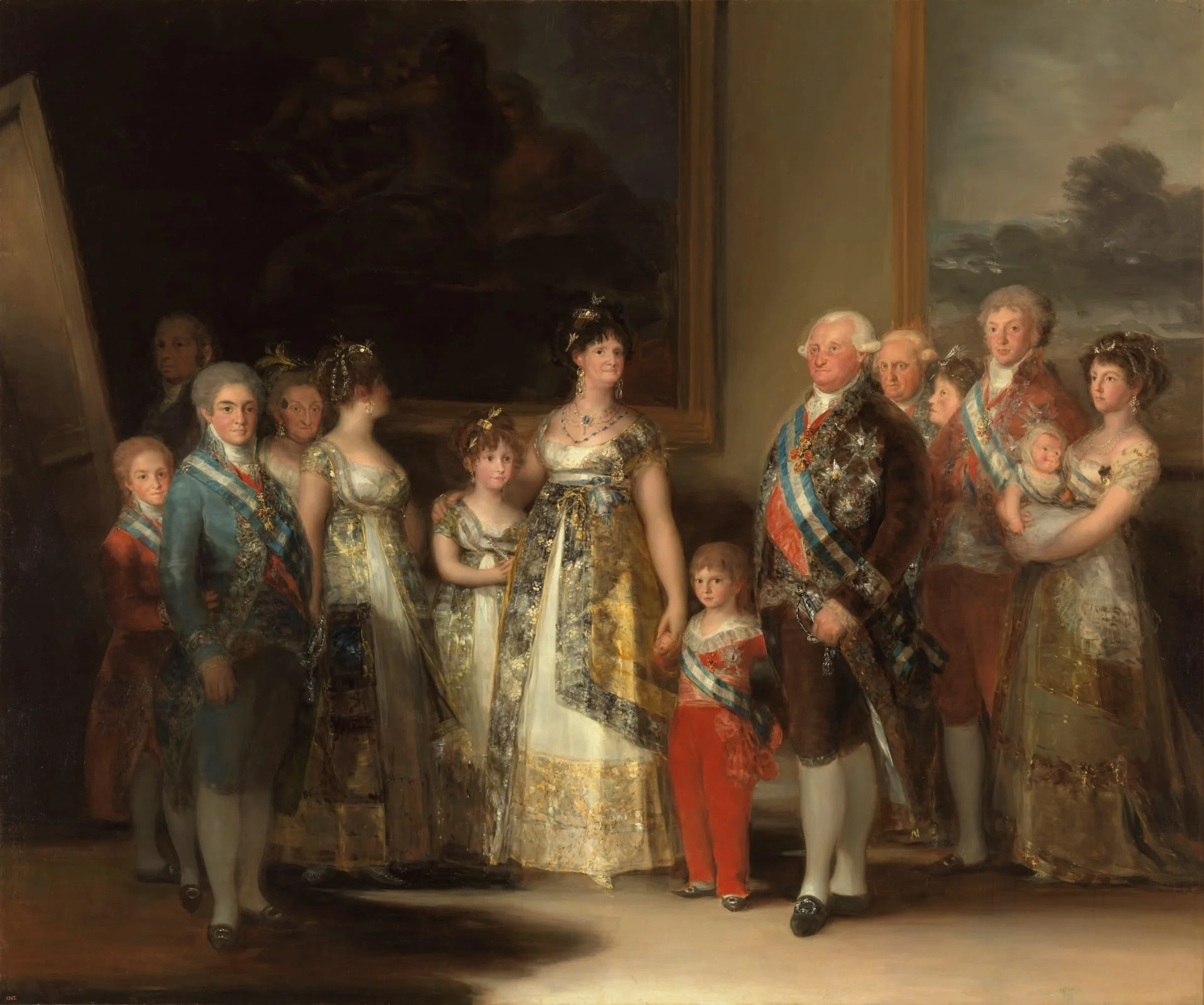 Detail 1
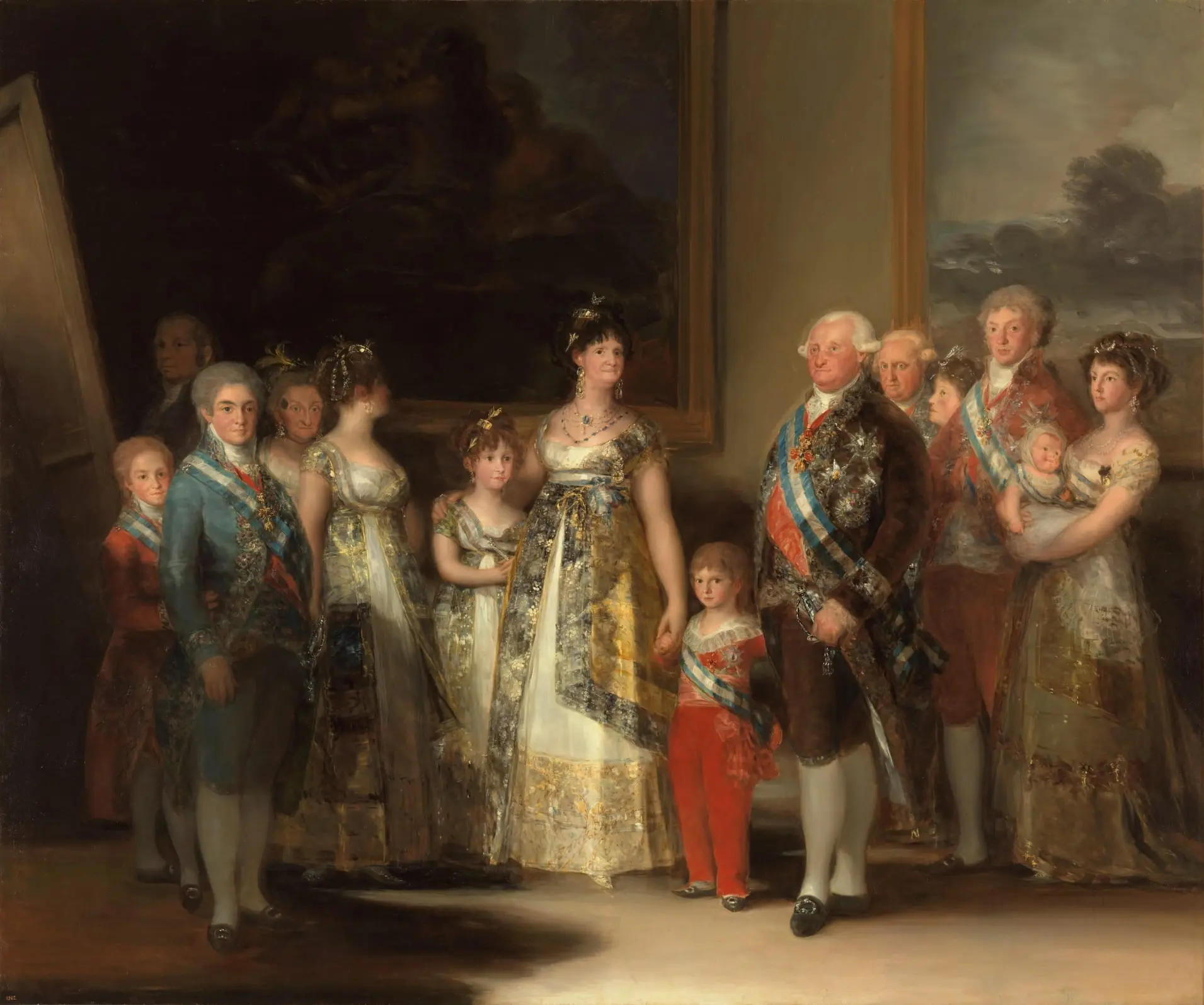
Queen María Luisa
The queen stands at the centre of the family, her arms around her two youngest children, the true focus of the composition.
The king
To the right of the queen, slightly in front, stands King Charles IV, his chest covered with orders and sashes, his face genial and placid. Goya painted the glittering decorations and fabrics with brilliant, loose brushwork.
Detail 2King Charles IV
The king wears the sashes and stars of his orders, painted with sparkling, rapid strokes. His face is calm and good-natured.
The heir
On the left, in blue, stands the young Prince Ferdinand, the future King Ferdinand VII, beside a woman whose face is turned away. She represents his future wife, who had not yet been chosen, so Goya could not paint her features.
Detail 3The bride without a face
Next to Prince Ferdinand, a young woman turns her head away. She stands for his future wife, not yet chosen when the painting was made.
Goya in the shadows
In the dark background on the left, Goya painted himself at a large canvas, looking out at the viewer. As in Las Meninas, the painter becomes part of the scene, a discreet witness to the royal family.
Detail 4Goya's self-portrait
In the shadows at the left, Goya stands at his canvas, observing the royal family and the viewer.
Flattery or satire?
In the nineteenth century, the French writer Théophile Gautier famously said the family looked like a baker and his wife who had just won the lottery. Many later critics read the painting as a cruel satire. But the royal family was pleased with it, and today historians see it as an honest, unflattering portrait painted with dazzling technique, not as a deliberate caricature.
Goya's brushwork
Goya was a virtuoso of the brush. In this portrait, the glittering fabrics, the jewels and the medals are not painted in detail but suggested with quick, loose strokes and dabs of light paint that come together when seen from a distance. This freedom of handling, inspired by Velázquez, would later be admired by Manet and the Impressionists. The light falls from the left, picking out the faces and costumes against the dark background, where paintings hang on the wall. Goya's honesty is also part of the painting's power: he painted the members of the royal family as they were, neither flattering nor caricaturing them, creating one of the most vivid group portraits in the history of art.
Seeing the painting
The painting measures about 2.8 by 3.4 metres and hangs in the Museo del Prado in Madrid.
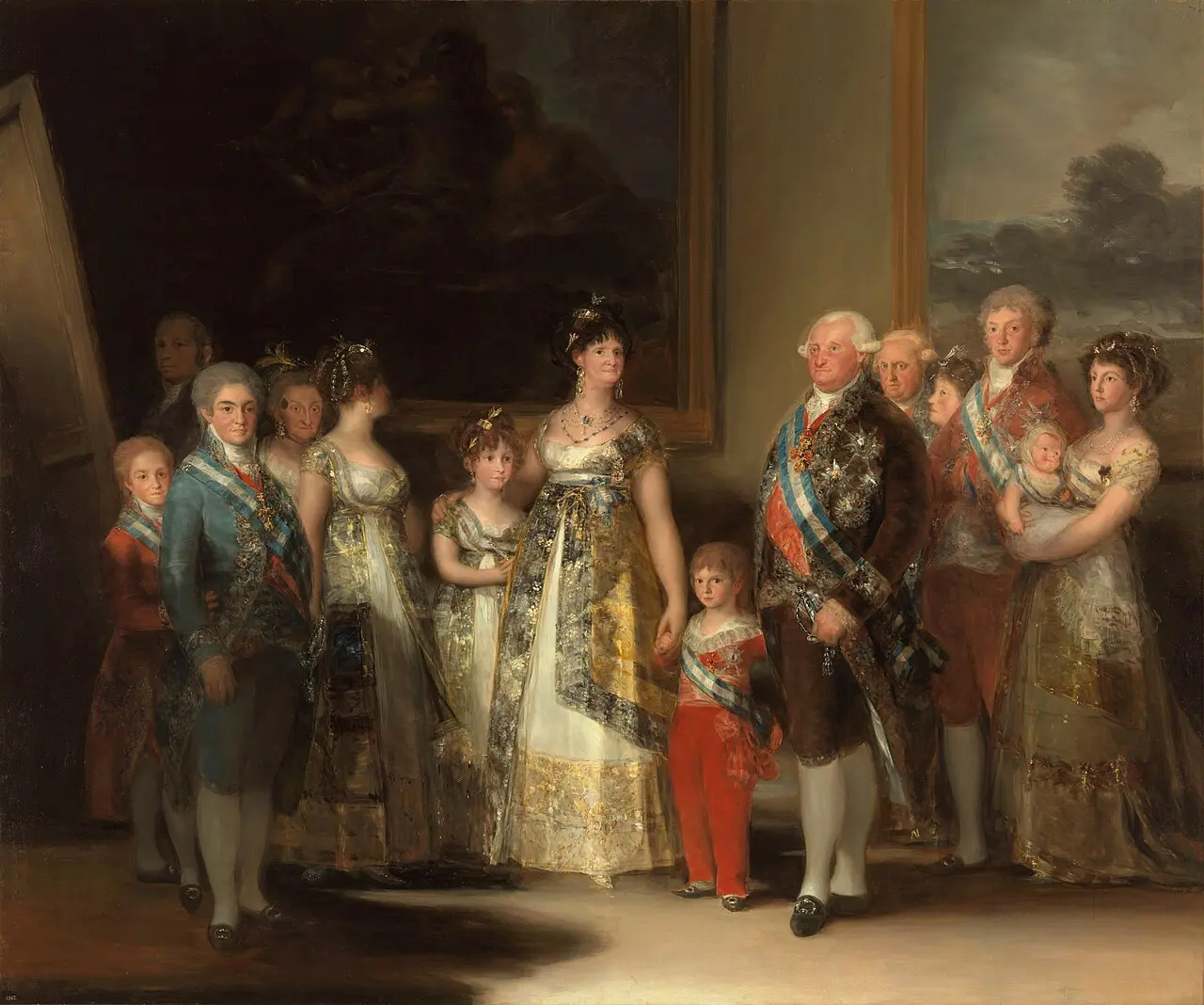
Own a hand-painted copy
Charles IV of Spain and His Family
Painted by hand in oil on canvas, any size. Free worldwide shipping.
From $299 — Make it yours.Frequently asked questions
Who is at the centre of Charles IV and His Family?
Queen María Luisa of Parma stands at the centre, reflecting her power at court.
Is Goya in the painting?
Yes. Goya painted himself at an easel in the shadows on the left, like Velázquez in Las Meninas.
Who is the woman with her face turned away?
She represents the future wife of Prince Ferdinand, who had not yet been chosen.
Where is Charles IV and His Family?
It is in the Museo del Prado in Madrid.
Sources and further reading
- Museo del Prado, collection notes on The Family of Charles IV
- Janis Tomlinson, Goya in the Twilight of Enlightenment (1992)
- Théophile Gautier, Voyage en Espagne (1845)
