
Listen to this article
0:00 / 3:41 · Read by ArtLogia
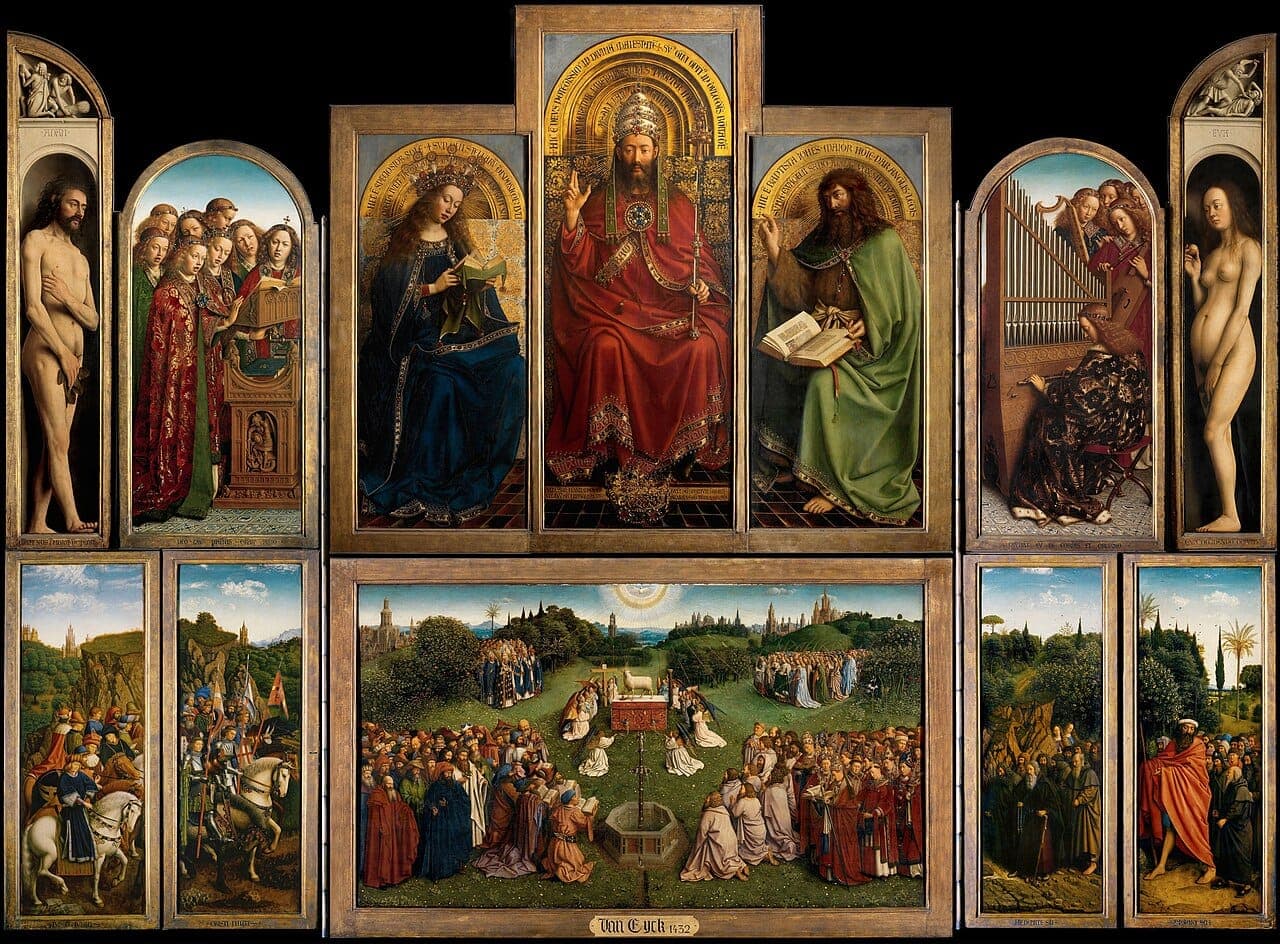
Twelve panels open to reveal God enthroned, the Virgin, John the Baptist, singing angels, Adam and Eve, and below, a crowd of saints adoring the Lamb of God in a flowering meadow. Completed in 1432 by Jan van Eyck, the Ghent Altarpiece is one of the foundations of European painting.
In this article
A masterpiece for Ghent
The Ghent Altarpiece was commissioned by Joos Vijd and his wife Elisabeth Borluut for their chapel in the church of Saint John, now Saint Bavo's Cathedral, in Ghent. An inscription on the frame says it was begun by Hubert van Eyck, "greater than whom no one was found", and completed by his brother Jan in 1432. How much Hubert painted remains debated.
The polyptych is made of twelve oak panels, about 3.5 by 4.6 metres when open. Closed, the outer wings show the Annunciation and portraits of the donors kneeling before statues of the two Saint Johns. Opened on feast days, it revealed a dazzling world of colour.
God, the Virgin and John
In the upper centre sits a majestic figure in a red robe with a jewelled crown at his feet, usually identified as God the Father or Christ as King of Heaven. On either side sit the Virgin Mary, reading, and John the Baptist. Their faces, robes and jewels are painted with a precision never seen before, made possible by Van Eyck's mastery of oil glazes.
 Detail 1

The enthroned figure
God, or Christ the King, sits in a red robe embroidered with gold, a crown at his feet. Every pearl and jewel catches the light.
The singing angels
To the left, a choir of angels sings around a lectern; to the right, angels play an organ, a harp and a viol. Their faces show the effort of singing, with mouths open on different notes, so precisely that musicians have tried to identify the voices. Beyond them, at the outer edges, stand Adam and Eve, the first near life-size nudes in Northern European painting.
Detail 2Angels singing
The angels' faces show the strain of singing, their mouths shaped to different notes. Van Eyck painted their brocade robes with astonishing detail.
The Mystic Lamb
The lower central panel shows the Adoration of the Lamb, from the Book of Revelation. On an altar in a flowering meadow stands the Lamb of God, symbol of Christ, blood flowing from its chest into a chalice. Angels kneel around it, and groups of prophets, apostles, martyrs, virgins and pilgrims approach from all sides. Over a hundred species of plants have been identified in the meadow.
Detail 3The Lamb on the altar
The Lamb of God stands on the altar, its blood flowing into a golden chalice. The 2019 restoration revealed the Lamb's original, strikingly human face.
The fountain of life
In front of the altar, the Fountain of Life pours water into a channel that flows towards the viewer, its bed lined with jewels. It symbolises the grace and salvation that flow from Christ to the world.
Detail 4The Fountain of Life
Water flows from the fountain into a stream paved with jewels, a symbol of salvation flowing towards the faithful.
The most stolen artwork in history
The altarpiece has been stolen, damaged or seized many times. Calvinist iconoclasts threatened it in 1566; Napoleon's troops took the central panels to Paris; parts were sold and ended up in Berlin; and the Nazis took it in the Second World War, hiding it in a salt mine at Altaussee in Austria, where it was recovered by the Allied "Monuments Men". In 1934 the panel of the Just Judges was stolen and has never been found; the panel in place today is a copy.
Seeing the Ghent Altarpiece
The altarpiece is displayed in Saint Bavo's Cathedral in Ghent, Belgium, in a new visitor centre opened after a major restoration that began in 2012 and revealed much of Van Eyck's original painting.
Own a hand-painted copy
Ghent Altarpiece
Painted by hand in oil on canvas, any size. Free worldwide shipping.
From $299 — Make it yours.Frequently asked questions
Who painted the Ghent Altarpiece?
It was begun by Hubert van Eyck and completed by his brother Jan van Eyck in 1432.
What is the Mystic Lamb?
The Lamb of God on the altar in the central lower panel symbolises Christ's sacrifice, as described in the Book of Revelation.
Why is the Ghent Altarpiece called the most stolen artwork?
It has been stolen or seized many times, by Napoleon, by dealers and by the Nazis; one panel stolen in 1934 is still missing.
Where is the Ghent Altarpiece?
It is in Saint Bavo's Cathedral in Ghent, Belgium.
Sources and further reading
- Saint Bavo's Cathedral, Ghent, and KIK-IRPA, Closer to Van Eyck research project
- Noah Charney, Stealing the Mystic Lamb (2010)
- Till-Holger Borchert, Van Eyck (2008)
