Listen to this article
0:00 / 3:18 · Read by ArtLogia
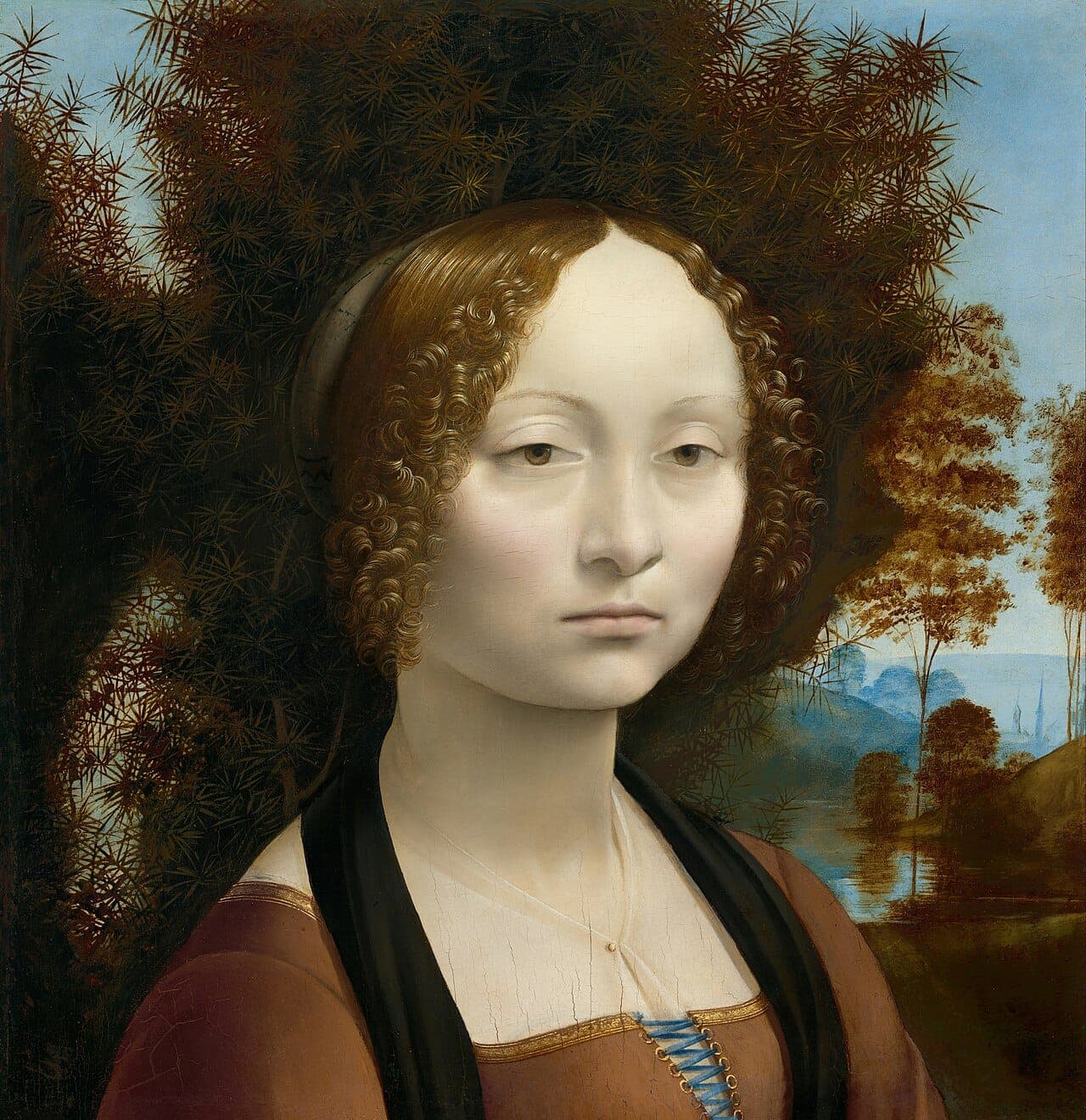
A pale young woman with a serious face is set against a dark juniper bush and a misty landscape. Painted in Florence around 1474–1478, Ginevra de' Benci is Leonardo da Vinci's earliest surviving portrait and the only painting by him in the Americas.
In this article
A portrait of a young woman of Florence
Ginevra de' Benci was the daughter of a wealthy banking family of Florence, closely linked to the Medici. Educated and admired, she wrote poetry; one line survives, in which she asks forgiveness and describes herself as a mountain tiger. Leonardo da Vinci, then in his early twenties and still working in the studio of Andrea del Verrocchio, painted her portrait around 1474–1478.
The portrait may have been made for her marriage in 1474 to Luigi Niccolini, or, more likely according to recent research, for Bernardo Bembo, the Venetian ambassador to Florence, who admired her in a platonic, poetic friendship.
The face
Ginevra looks out with a pale, serious, almost melancholy expression. Her face is lit softly, with delicate modelling that already shows Leonardo's interest in the transitions between light and shadow. Her skin seems to glow against the dark foliage behind her.
 Detail 1

A serious young face
Ginevra's pale face, her eyes slightly heavy-lidded, has a calm, reserved expression. Leonardo's soft modelling already hints at his later sfumato.
The curls
Her hair is parted in the middle and pulled back, with fine ringlets falling around her face. Leonardo painted each curl with great delicacy, and some of them catch the light like threads of gold. He even used his fingers to blend the paint in places: his fingerprints can be seen in the surface.
Detail 2Fine ringlets
The tight curls around Ginevra's face are painted with precise, delicate strokes. Close examination has revealed Leonardo's fingerprints in the paint.
The juniper
Behind her rises a dark juniper bush, whose spiky leaves frame her head like a halo. The juniper, ginepro in Italian, is a pun on her name, Ginevra. It was also a symbol of chastity, an appropriate virtue for a young woman of her rank.
Detail 3The juniper bush
The spiky juniper behind Ginevra is a play on her name and a symbol of virtue. Its dark green makes her pale face shine.
The landscape
On the right, the dark foliage opens onto a misty landscape with trees and water, painted in soft blues and greens that fade into the distance. It is one of the first landscape backgrounds in Italian portraiture to suggest atmosphere and depth so convincingly.
Detail 4A misty landscape
Through the trees opens a landscape of water and hills in hazy blue. Leonardo was already exploring atmospheric perspective.
The painted reverse
The back of the panel is also painted: a wreath of laurel and palm surrounding a sprig of juniper, with a scroll bearing the Latin motto Virtutem forma decorat, "Beauty adorns virtue". The laurel and palm were the emblem of Bernardo Bembo, which supports the idea that he commissioned the portrait. The bottom of the panel was cut off at some point, probably removing Ginevra's hands; a drawing by Leonardo of hands at Windsor may be a study for them.
Seeing Ginevra de' Benci
The portrait is small, about 39 by 37 centimetres, painted in oil and tempera on wood. It was bought in 1967 from the Princes of Liechtenstein by the National Gallery of Art in Washington, D.C., for a then-record price. It is the only painting by Leonardo da Vinci in the Americas.
Own a hand-painted copy
Ginevra de' Benci
Painted by hand in oil on canvas, any size. Free worldwide shipping.
From $299 — Make it yours.Frequently asked questions
Who was Ginevra de' Benci?
She was a young woman from a wealthy Florentine banking family, known for her learning and poetry.
Why is there a juniper behind her?
The juniper, ginepro in Italian, is a pun on her name, Ginevra, and a symbol of chastity.
When was Ginevra de' Benci painted?
Leonardo da Vinci painted it around 1474–1478 in Florence.
Where is Ginevra de' Benci?
It is in the National Gallery of Art in Washington, D.C., the only Leonardo painting in the Americas.
Sources and further reading
- National Gallery of Art, Washington, collection notes on Ginevra de' Benci
- David Alan Brown, Virtue and Beauty: Leonardo's Ginevra de' Benci and Renaissance Portraits of Women (2001)
- Frank Zöllner, Leonardo da Vinci: The Complete Paintings (2003)
