Listen to this article
0:00 / 3:35 · Read by ArtLogia
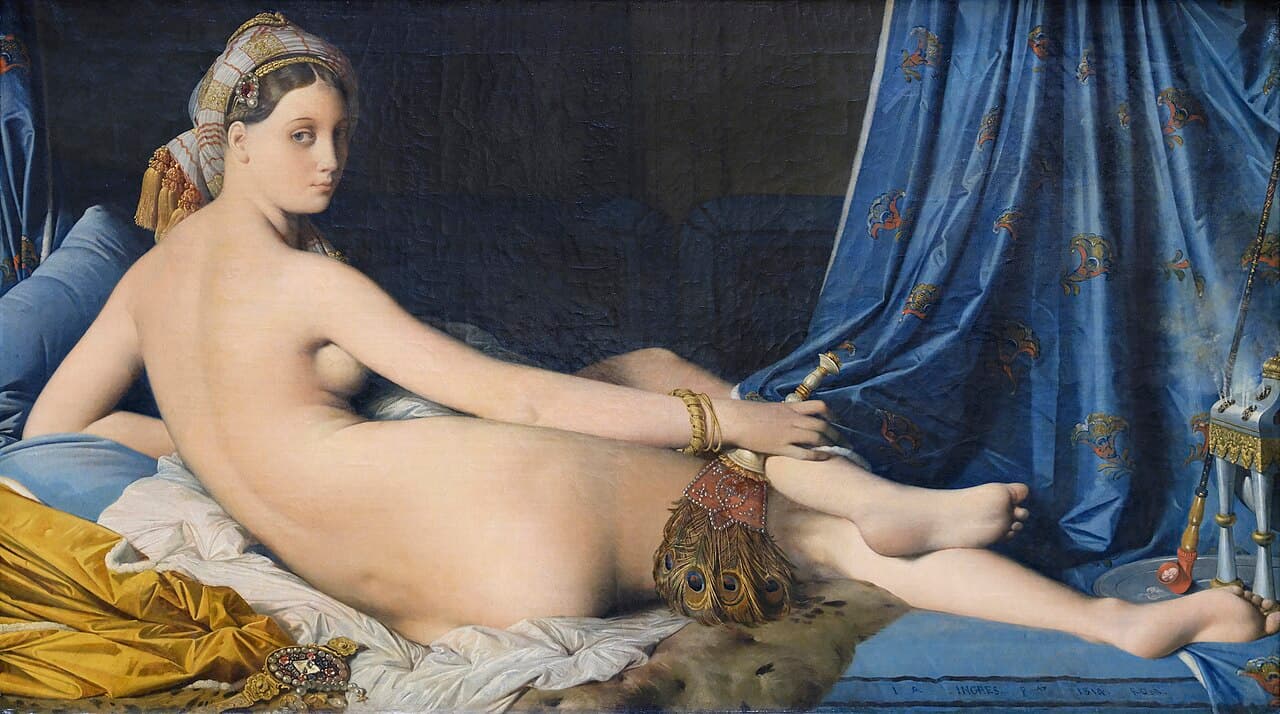
A woman reclines on a divan in an imaginary harem, her back turned, glancing over her shoulder, a peacock fan in her hand. Painted in 1814, Jean-Auguste-Dominique Ingres's Grande Odalisque was criticised for her elongated body, now its most famous feature.
In this article
A commission from a queen
Jean-Auguste-Dominique Ingres painted the Grande Odalisque in Rome in 1814 for Caroline Murat, Queen of Naples and sister of Napoleon. The fall of Napoleon and of the Murats the following year meant that the painting was never delivered. It was shown at the Paris Salon of 1819, where critics attacked it, and the French state bought it in 1899 for the Louvre.
An odalisque was a female servant or concubine in an Ottoman harem. European painters of the nineteenth century were fascinated by this imagined Orient, which few of them had ever seen, and they filled it with their own fantasies.
The famous back
The woman lies with her back to us, her head turned over her shoulder. Her back is extraordinarily long, and her arm and hip are stretched in ways that are anatomically impossible. A study in 2004 calculated that she has two or three more vertebrae than a real woman. Critics of 1819 said she had too many vertebrae. Ingres, a passionate admirer of Raphael and of Mannerist painters like Parmigianino, deliberately distorted the body to create a long, flowing line of beauty.
The face and the turban
The woman's face, turned towards us, is cool and expressionless, with a small mouth and large almond eyes, in the classical ideal Ingres learned from Raphael. She wears a turban of patterned silk with a jewelled brooch and a tassel, part of the Orientalist costume.
 Detail 1

A cool glance
The odalisque looks over her shoulder with a calm, impenetrable gaze. Her face follows the classical ideal of Raphael.
Detail 2The silk turban
Her head is wrapped in a turban of striped silk with a jewelled pin and a tassel, painted with exquisite precision.
The peacock fan
In her right hand she holds a fan of peacock feathers, its iridescent eyes painted with meticulous detail. The fan, like the luxurious fabrics, the furs and the jewels, belongs to the exotic world of the harem imagined by European artists.
Detail 3The peacock fan
The fan of peacock feathers is painted feather by feather, a sign of the luxury of the imagined harem.
The hookah
On the right, beside the blue curtain, stands a hookah or incense burner, a reference to the pleasures of the Orient. The cool blue of the curtain and the warm gold of the fabric below frame the pale body.
Detail 4The incense burner
A hookah and incense burner stand beside the blue curtain, an exotic detail that sets the scene in an imaginary harem.
Ingres and the idea of beauty
Ingres believed that drawing was the probity of art, and he was the champion of the classical tradition against the Romanticism of Delacroix. Yet in the Grande Odalisque he took liberties with anatomy that no academic painter would accept. For him, the beauty of the line came before realism: the long curve of the back, the arm and the leg create a single flowing arabesque across the canvas. The cool blues of the curtain and the pale skin, set against the warm gold of the fabric, show his refined sense of colour. The painting inspired later artists who rejected strict realism, from Degas to Picasso and Matisse, and it remains one of the most recognisable images of the Orientalist fantasy of the nineteenth century.
Seeing the Grande Odalisque
The painting measures about 91 by 162 centimetres and hangs in the Musée du Louvre in Paris, among the French paintings of the early nineteenth century.
Own a hand-painted copy
Grande Odalisque
Painted by hand in oil on canvas, any size. Free worldwide shipping.
From $349 — Make it yours.Frequently asked questions
What is an odalisque?
An odalisque was a female servant or concubine in an Ottoman harem, a popular subject of 19th-century Orientalist painting.
Why is the back of the Grande Odalisque so long?
Ingres deliberately lengthened the back to create a more elegant line; a study suggested she has two or three extra vertebrae.
Who commissioned the Grande Odalisque?
Caroline Murat, Queen of Naples and sister of Napoleon, commissioned it in 1814.
Where is the Grande Odalisque?
It is in the Musée du Louvre in Paris.
Sources and further reading
- Musée du Louvre, collection notes on La Grande Odalisque
- Robert Rosenblum, Jean-Auguste-Dominique Ingres (1967)
- Linda Nochlin, "The Imaginary Orient", Art in America (1983)
