Listen to this article
0:00 / 3:57 · Read by ArtLogia
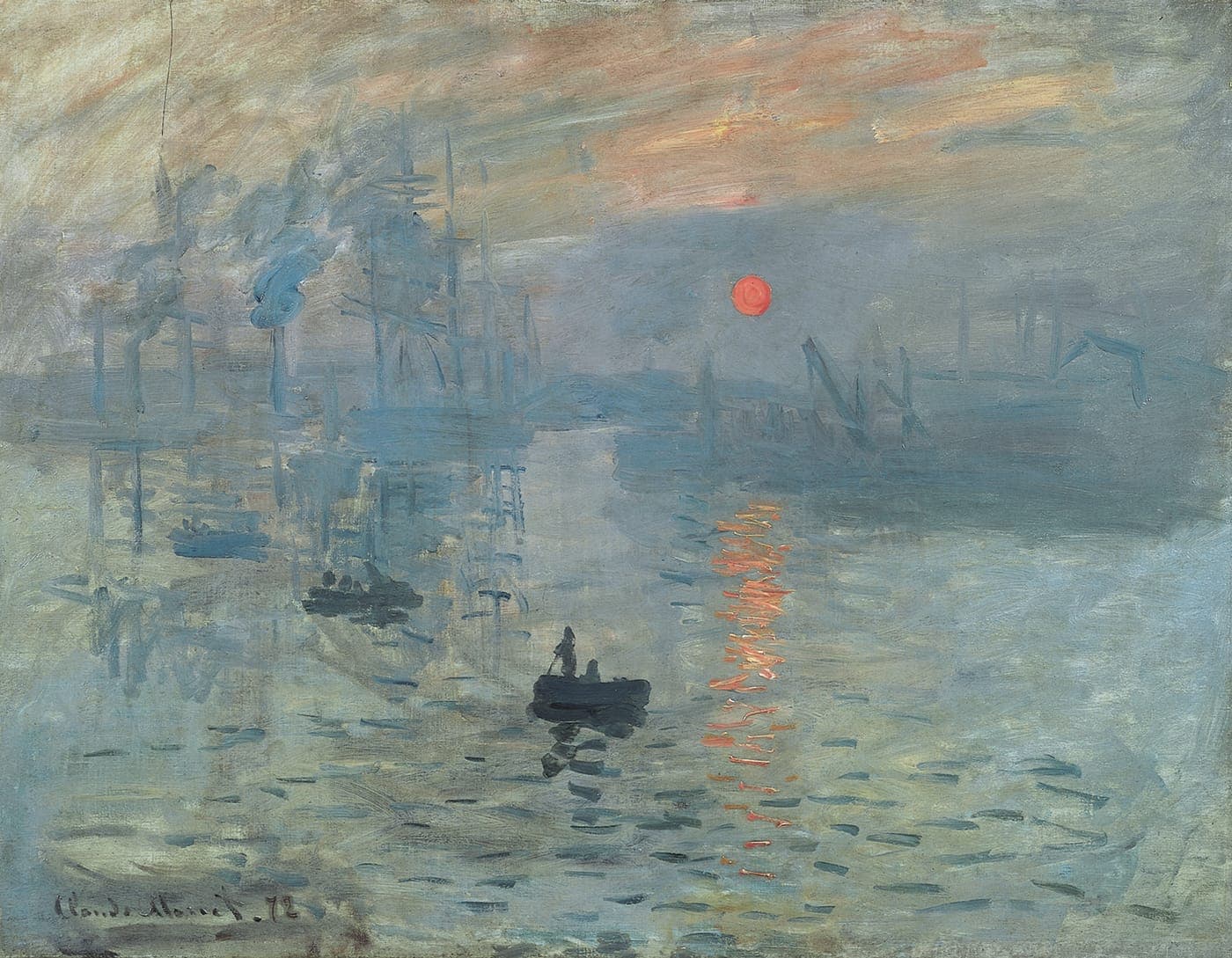
An orange sun rises over the port of Le Havre, its reflection broken on the water, while small boats drift through the morning mist. Claude Monet painted it quickly in 1872, and a critic's sneer at its title named a whole movement.
In this article
A morning in Le Havre
Claude Monet grew up in Le Havre, the great port at the mouth of the Seine in Normandy. In November 1872 he stayed in a hotel overlooking the harbour and painted the view from his window at dawn. The canvas shows the outer harbour in the mist, with the cranes and chimneys of the port in the background, small boats in the foreground, and the sun rising like a red-orange disc.
It was painted fast, probably in one session, and it looks it. The sky and water are laid in with thin, quick strokes of blue-grey and orange; the boats are just a few dark marks. Monet was not trying to describe the port. He wanted to capture a fleeting effect of light and atmosphere, the impression of a single moment.
The name of a movement
In April 1874 Monet and his friends, including Renoir, Degas, Pissarro, Sisley and Berthe Morisot, held their own exhibition in the former studio of the photographer Nadar in Paris, outside the official Salon. When asked for a title for this painting, Monet said to call it "Impression". The critic Louis Leroy wrote a mocking review titled "The Exhibition of the Impressionists", joking that wallpaper in its first state was more finished. The painters took up the name, and Impressionism was born.
The sun
The sun is the brightest point of the painting, yet scientists have found something surprising: in black and white it almost disappears. The orange disc has nearly the same brightness as the grey-blue sky around it. Our eyes see it as glowing because of the colour contrast, not because it is lighter. This is part of the painting's strange, vibrating effect.
 Detail 1

The orange sun
The sun is a small disc of pure orange laid over the grey sky. Its brightness comes from colour contrast rather than lightness, which makes it seem to shimmer.
The reflection on the water
Below the sun, its reflection breaks into short horizontal strokes of orange on the dark water. Monet painted them with a loaded brush, leaving the marks visible. The reflection leads the eye down into the picture and towards the boats.
Detail 2The broken reflection
A column of orange dashes reflects the sun on the ripples. Each stroke is a single movement of the brush.
The boats
In the foreground, a rowing boat with two figures glides through the water, and two more boats fade into the mist behind it. They are painted as dark silhouettes, without any detail, yet we read them immediately. The further away they are, the paler and bluer they become, a simple way of creating depth.
Detail 3Boats in the mist
The rowing boat in front is a dark silhouette; the boats behind it fade into blue-grey. Monet suggests distance with colour alone.
The industrial port
In the background, through the haze, rise the masts of ships, the cranes of the docks and the smoking chimneys of factories. Le Havre was a modern industrial port, and Monet did not hide it. Steam and smoke mix with the morning mist, so that nature and industry blend into a single atmosphere.
Detail 4Cranes and chimneys
Barely visible in the mist, the cranes and chimneys show that this is a working port. Smoke and fog merge into the same soft colours.
The later history
The painting was bought by the collector Ernest Hoschedé and later by Georges de Bellio, a doctor and friend of the Impressionists. His daughter gave it to the Musée Marmottan in 1940. In 1985 it was stolen from the museum in an armed robbery and was recovered in Corsica in 1990. Today it is the most famous work in the largest Monet collection in the world.
Seeing Impression, Sunrise
The painting is modest in size, about 48 by 63 centimetres. It is in the Musée Marmottan Monet in Paris.
Own a hand-painted copy
Impression, Sunrise
Painted by hand in oil on canvas, any size. Free worldwide shipping.
From $299 — Make it yours.Frequently asked questions
Why is it called Impression, Sunrise?
Monet gave it the title Impression for the 1874 exhibition, saying the view could not pass for a picture of Le Havre. A critic's review then named the whole group Impressionists.
Where was Impression, Sunrise painted?
It shows the port of Le Havre in Normandy, painted from a hotel window in November 1872.
Was Impression, Sunrise stolen?
Yes. It was stolen from the Musée Marmottan in 1985 and recovered in Corsica in 1990.
Where is Impression, Sunrise today?
It is in the Musée Marmottan Monet in Paris.
Sources and further reading
- Musée Marmottan Monet, collection notes on Impression, Sunrise
- Musée Marmottan Monet, Monet's Impression, Sunrise: The Biography of a Painting (2014)
- Paul Hayes Tucker, Claude Monet: Life and Art (1995)
