Listen to this article
0:00 / 3:20 · Read by ArtLogia
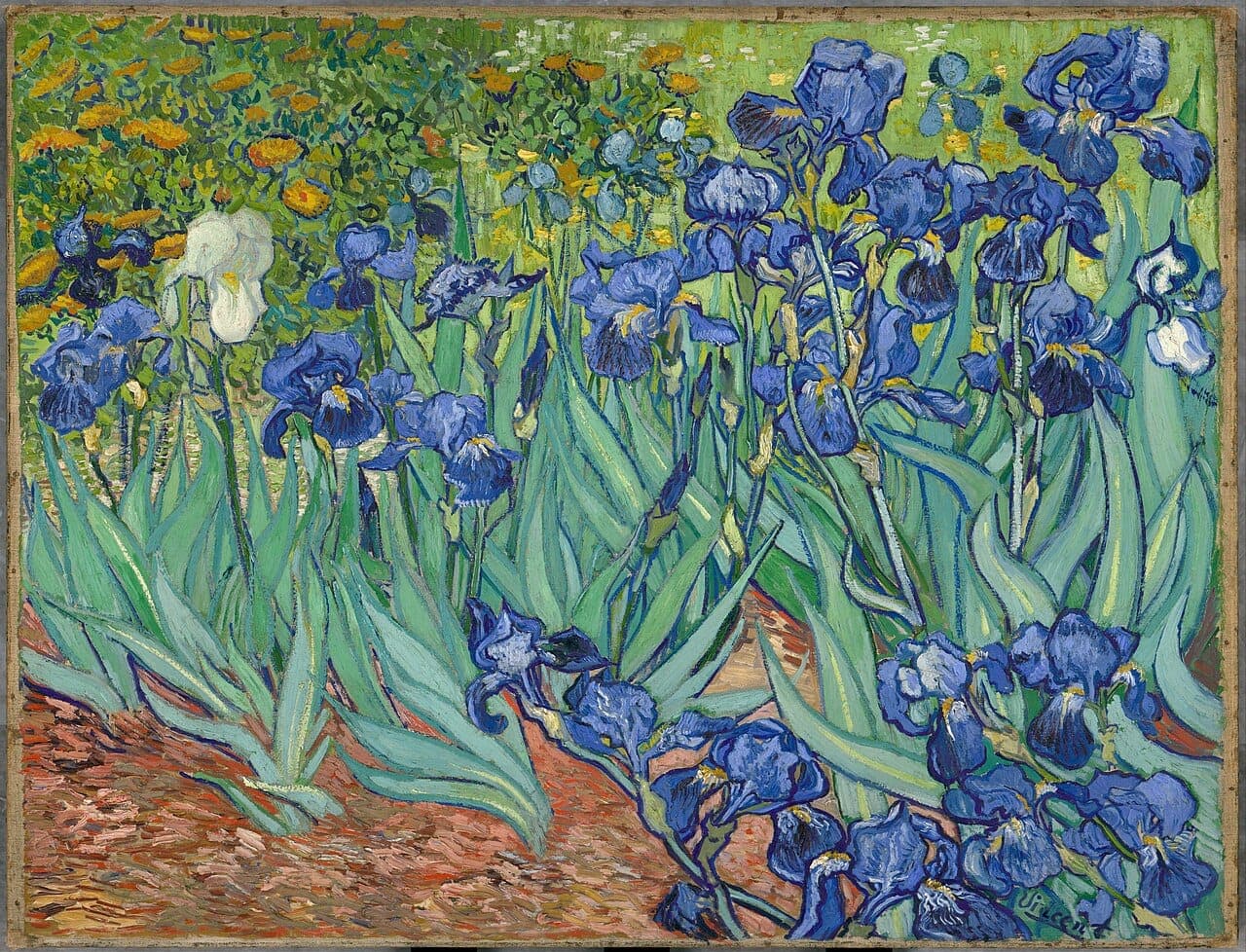
A bed of blue irises with sword-like leaves, one white flower among them, against red earth and a band of orange marigolds. Van Gogh painted Irises in May 1889, in his first week at the asylum of Saint-Rémy, calling it a "lightning conductor" for his illness.
In this article
A garden in the asylum
On 8 May 1889 Vincent van Gogh entered the asylum of Saint-Paul-de-Mausole near Saint-Rémy-de-Provence. In the first days he was not allowed to leave the grounds, so he painted the overgrown garden of the asylum. Irises was one of the first paintings he made there. He called his work at this time "the lightning conductor for my illness": painting kept him steady.
Irises bloom in Provence in May, and Van Gogh painted them in full flower, close up, as if he were kneeling among them.
The influence of Japanese prints
The composition is cropped tightly, with no horizon and no sky, and the flowers fill the whole canvas. The strong outlines, flat areas of colour and close-up view come from Japanese woodblock prints, which Van Gogh collected and admired. He believed that the Japanese saw nature more clearly and simply than Europeans.
The white iris
Among the blue flowers, a single white iris stands out on the left. It draws the eye immediately and gives the composition a point of focus. Some viewers have seen it as a symbol of Van Gogh himself, alone among others; others see simply a natural variation in the flower bed. Either way, its brightness lifts the whole painting.
 Detail 1

The single white iris
One white flower stands out among the blue. It gives the dense composition a focal point and a sense of quiet individuality.
Blue blooms
The irises are painted in shades of blue and violet, with curling petals outlined in darker blue. Originally they were more purple: the red pigment Van Gogh mixed into the blue has faded, so the flowers now look bluer than he painted them. Each flower is different, twisting and opening in its own way.
Detail 2Curling petals
The blue petals curl and twist, each outlined with darker strokes. The red in the original violet has faded, leaving the flowers bluer than they were.
Leaves like swords
The long green leaves rise from the ground in rhythmic, sword-like shapes, painted with long, sweeping strokes. Their movement gives the painting energy, as if a wind were blowing through the garden.
Detail 3Sword-like leaves
The leaves rise and cross in long strokes of green and blue, creating a rhythm that flows across the canvas.
At the bottom, the red-brown earth and, at the top left, a band of orange marigolds provide warm contrasts to the cool blues and greens.
Detail 4Red earth
The warm red-brown soil, painted with short strokes, makes the blues and greens of the leaves and flowers more intense.
A record-breaking sale
Van Gogh sent the painting to his brother Theo, who exhibited it at the Salon des Indépendants in Paris in September 1889. It was one of the first paintings by Van Gogh to be bought by a collector, the critic Octave Mirbeau. In November 1987 it was sold at auction for 53.9 million dollars, then the highest price ever paid for a painting. In 1990 it was acquired by the J. Paul Getty Museum in Los Angeles, where it is displayed today.
The original measures about 71 by 93 centimetres. A hand-painted reproduction can bring back the thick, sculpted paint of the petals and leaves that makes this flower painting so alive.
Own a hand-painted copy
Irises
Painted by hand in oil on canvas, any size. Free worldwide shipping.
From $299 — Make it yours.Frequently asked questions
When did Van Gogh paint Irises?
He painted Irises in May 1889, during his first week at the asylum of Saint-Paul-de-Mausole in Saint-Rémy-de-Provence.
Why is one iris white?
The white iris stands out as a focal point among the blue flowers; some see it as a symbol of solitude, though it may simply reflect the garden.
How much did Irises sell for?
It sold for 53.9 million dollars in 1987, then a world record price for a painting.
Where is Irises?
It is in the J. Paul Getty Museum in Los Angeles.
Sources and further reading
- J. Paul Getty Museum, collection notes on Irises
- Vincent van Gogh, letters to Theo van Gogh, May 1889
- Ronald Pickvance, Van Gogh in Saint-Rémy and Auvers (1986)
