

Listen to this article
0:00 / 3:00 · Read by ArtLogia
In a palace room, Tsar Ivan IV holds his dying son in his arms, clutching the wound he has just inflicted, his eyes wide with horror. Painted in 1883–1885, Ilya Repin's painting of the murder of 1581 is one of the most powerful and controversial works of Russian art.
In this article
A murder in the Kremlin
On 16 November 1581, Tsar Ivan IV of Russia, known as Ivan the Terrible, quarrelled with his eldest son and heir, also called Ivan. According to the most common account, the tsar struck his son on the head with his iron-tipped staff, and the young man died a few days later. The death of the heir contributed to the crisis that followed the end of Ivan's dynasty.
Ilya Repin began the painting in 1883 after the assassination of Tsar Alexander II and the bloody repression that followed. He said that a bloody streak ran through the year and that he wanted to express the horror of violence.
The father's horror
The tsar kneels on the floor and holds his son in his arms, pressing his hand on the wound in a desperate attempt to stop the bleeding. His eyes are wide open, staring with madness and horror at what he has done. Repin painted not the act of violence but the moment of realisation and regret.
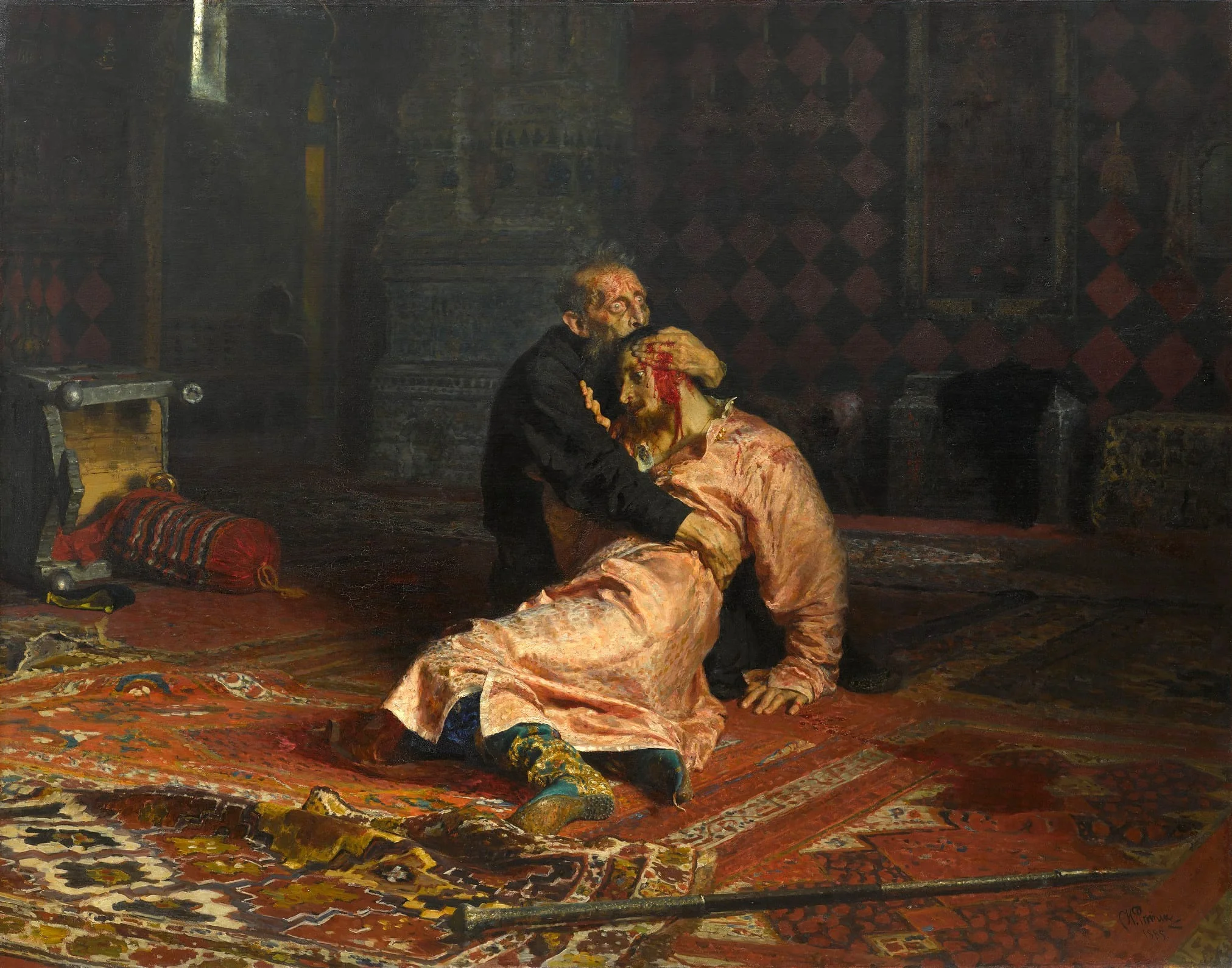 Detail 1
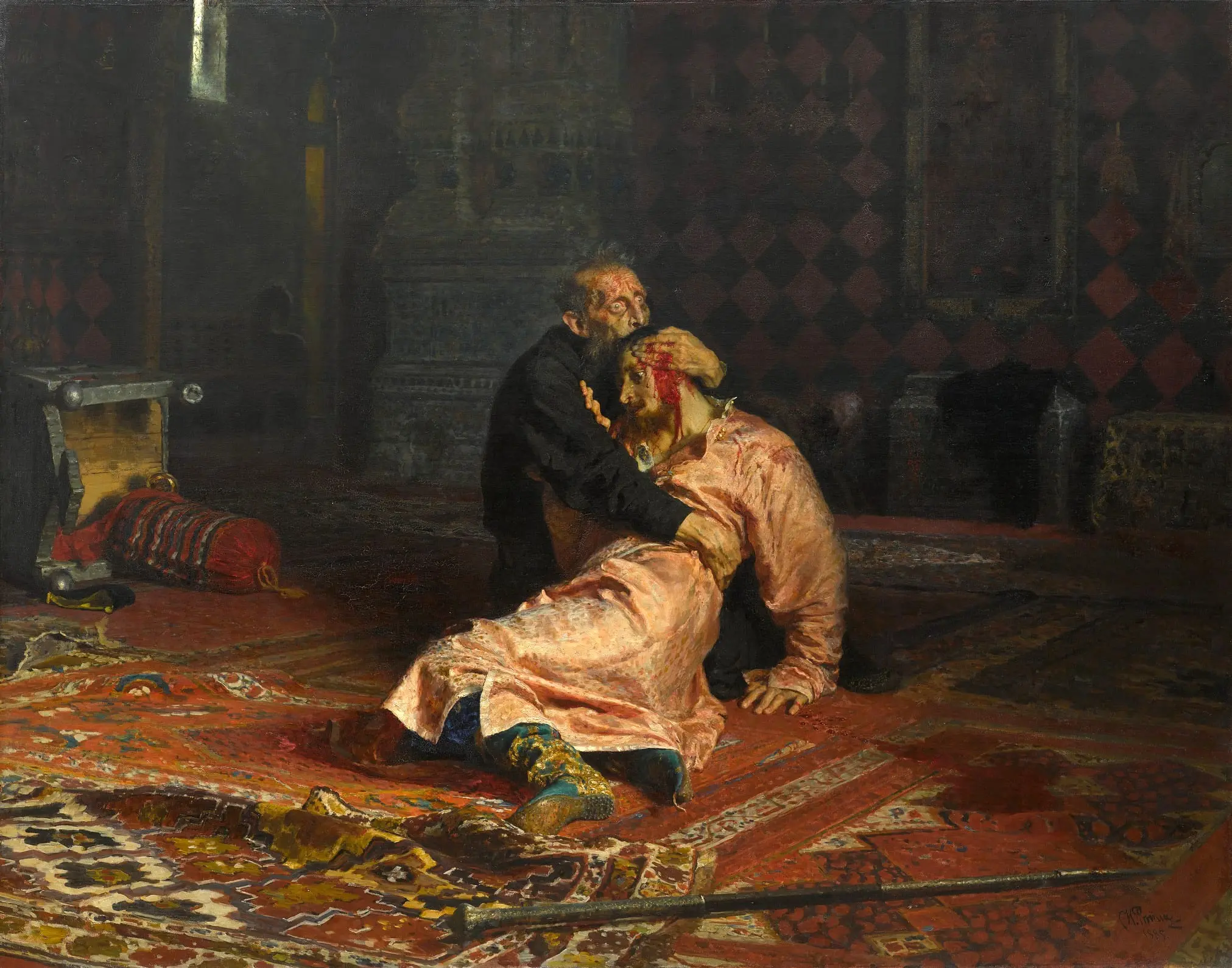
The tsar's eyes
Ivan stares with terrified, bulging eyes. The terrible ruler has become a horrified old man holding his dying son.
The dying son
The young tsarevich lies in his father's arms, his face pale, blood running from his temple. His expression is surprisingly gentle, and one of his hands rests on the floor, as if he were forgiving his father. Repin used the painter Vsevolod Garshin, a writer, as the model for the son.
Detail 2The dying tsarevich
The son's pale face is calm, almost forgiving, while blood flows from his temple. The writer Vsevolod Garshin posed for him.
Blood on the carpet
Blood stains the rich oriental carpet on which the figures lie. Repin painted it with great realism, which shocked many viewers. The red of the blood merges with the red patterns of the carpet and the dark red of the room.
Detail 3Blood on the carpet
Pools of blood spread across the patterned carpet, merging with its red designs. The realism of the scene disturbed the public.
The fallen staff
Near the figures, on the carpet, lies the staff with which the tsar struck his son, along with an overturned chair. These details tell us what happened in the seconds before.
Detail 4The fallen staff
The heavy staff and an overturned stool lie on the floor, silent evidence of the violent moment just passed.
A painting under attack
When the painting was exhibited in 1885, it was so disturbing that Tsar Alexander III had it banned from public exhibition for a time. In 1913 a visitor slashed it with a knife, and in 2018 a man attacked it with a metal pole, breaking the glass and damaging the canvas. It has been restored each time.
Seeing the painting
The painting measures about 2 by 2.5 metres and is in the State Tretyakov Gallery in Moscow.
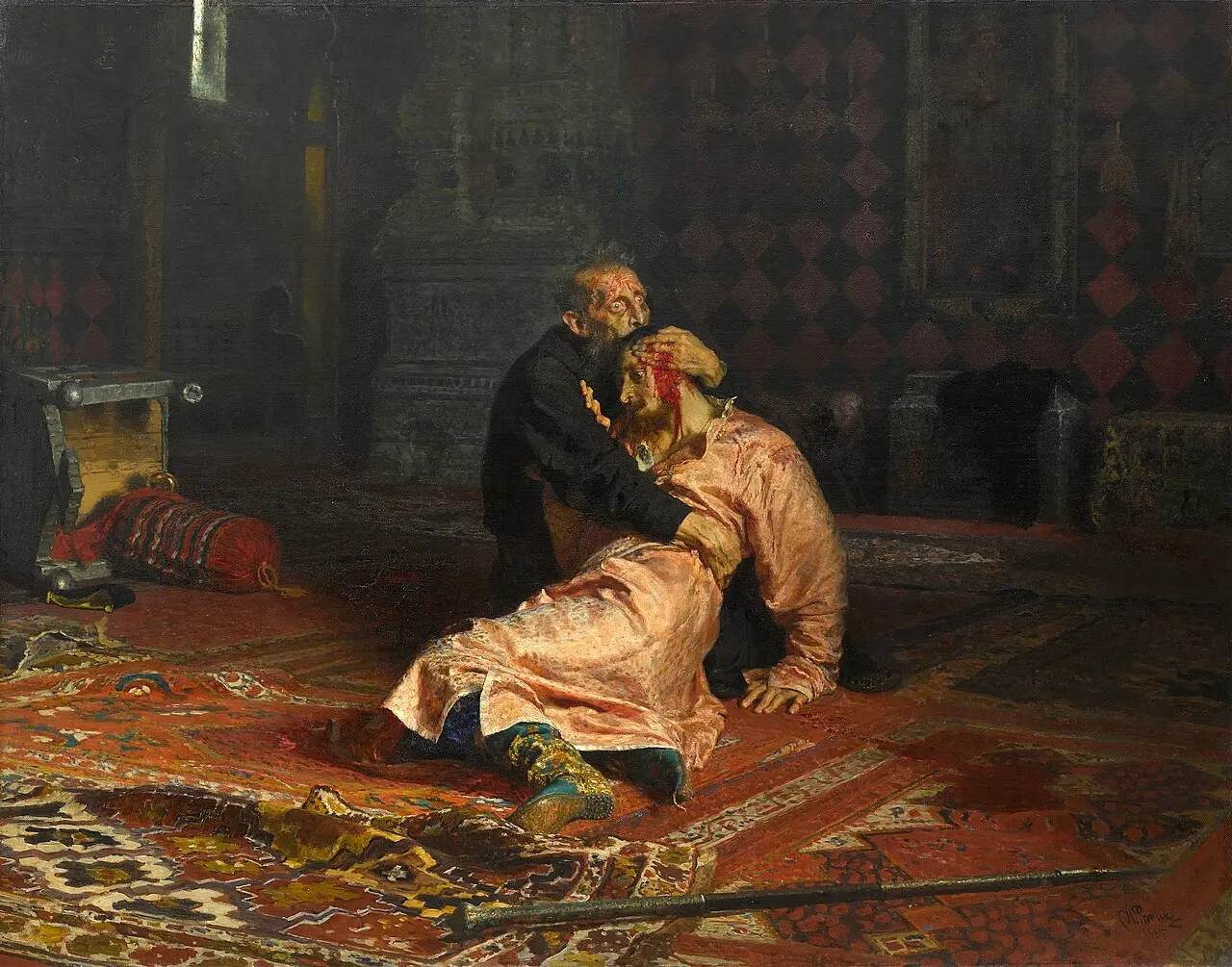
Own a hand-painted copy
Ivan the Terrible and his son Ivan on November 16, 1581
Painted by hand in oil on canvas, any size. Free worldwide shipping.
From $349 — Make it yours.Frequently asked questions
What does Ivan the Terrible and His Son Ivan show?
It shows Tsar Ivan IV holding his dying son, whom he had struck on the head with his staff in 1581.
When did Repin paint it?
Ilya Repin painted it between 1883 and 1885.
Has the painting been attacked?
Yes. It was slashed with a knife in 1913 and damaged with a metal pole in 2018, and restored both times.
Where is Ivan the Terrible and His Son Ivan?
It is in the State Tretyakov Gallery in Moscow.
Sources and further reading
- State Tretyakov Gallery, collection notes on Ivan the Terrible and His Son Ivan
- Elizabeth Kridl Valkenier, Ilya Repin and the World of Russian Art (1990)
- Ilya Repin, Far and Near (memoirs, 1937)
