


Listen to this article
0:00 / 3:20 · Read by ArtLogia
A young woman with a silk turban looks to the side with a faint smile, one hand at her breast, a band on her arm bearing the words "Raphael of Urbino". Painted around 1518–1520, La Fornarina is traditionally believed to be a portrait of the woman Raphael loved.
In this article
A portrait of love
La Fornarina was painted by Raphael in Rome around 1518–1520, in the last years of his short life; he died in 1520 at thirty-seven. It shows a young woman, half undressed, seated before a dark background of myrtle and quince leaves, plants sacred to Venus and symbols of love and fertility.
The name La Fornarina means "the little baker", from a legend that the woman was Margherita Luti, the daughter of a baker in the Trastevere district of Rome, and Raphael's lover. Vasari wrote that Raphael loved a woman so much that he could not work without her by his side. Whether the sitter is that woman is not certain, but the painting is deeply personal.
The face
The woman looks to the side with large dark eyes and a faint, knowing smile. Her face is painted with great softness and warmth, and her black hair is gathered under a turban of striped silk, decorated with a jewel.
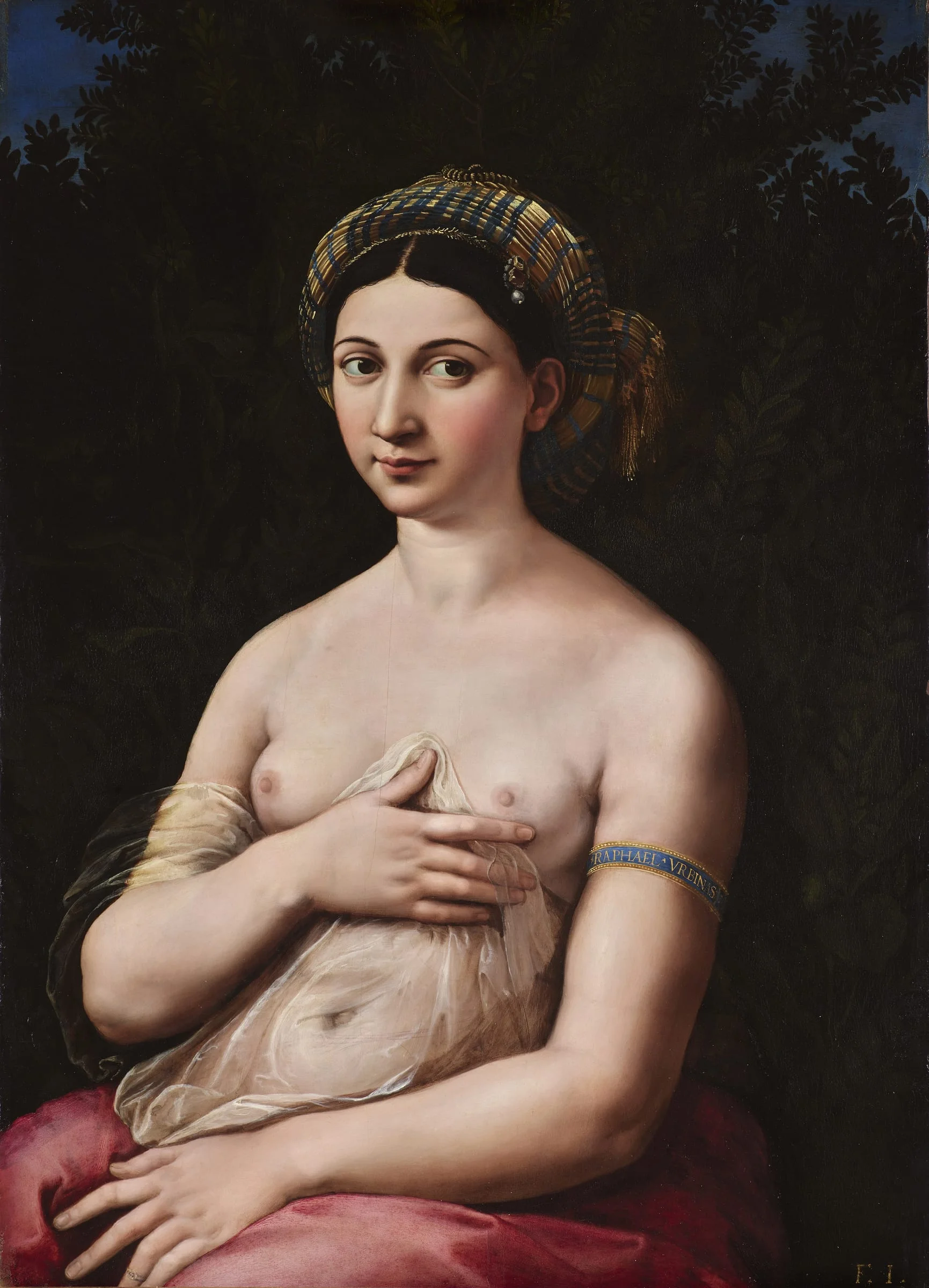 Detail 1
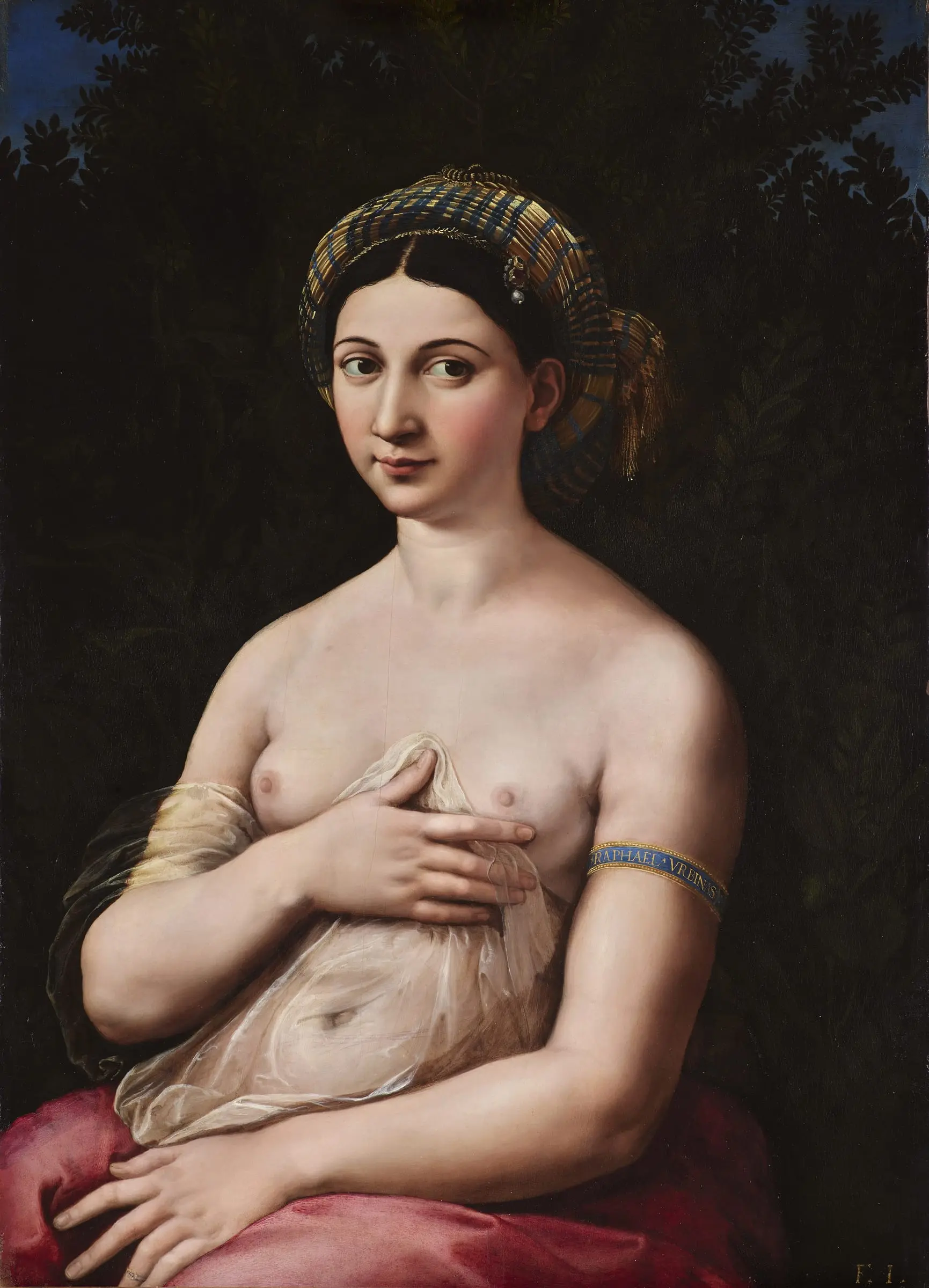
A knowing look
The woman glances to the side with dark eyes and a slight smile, her face modelled with soft, warm light.
Detail 2The silk turban
Her hair is wrapped in a turban of golden striped silk fastened with a jewel, a fashion of the time.
The armband
On her left arm she wears a blue armband inscribed in gold letters RAPHAEL URBINAS, "Raphael of Urbino". It is both the painter's signature and, many believe, a declaration that she belongs to him. X-ray analysis has shown that she originally wore a ring on her left hand, later painted over, which some interpret as a sign of a secret marriage.
Detail 3Raphael's name on the armband
The blue armband bears the inscription RAPHAEL URBINAS in gold letters, the painter's signature on the body of his beloved.
The gesture
Her right hand rests at her breast and holds a veil of transparent gauze, a pose derived from the classical Venus Pudica, the modest Venus. The gesture mixes modesty and intimacy.
The myrtle and quince
Behind her, dark leaves of myrtle and a branch of quince fill the background. Myrtle was the plant of Venus, and quince was a fruit associated with marriage and fertility, supporting the reading of the painting as an image of love.
Detail 4Myrtle and quince
The dark leaves behind her are myrtle and quince, plants of Venus and of marriage, which frame her like a bower.
Raphael's portraits
Raphael was one of the great portrait painters of the Renaissance. His portraits of Pope Julius II, Baldassare Castiglione and Pope Leo X set the standard for centuries. La Fornarina is more intimate than these official portraits. The warm flesh tones, the soft modelling and the sitter's direct, slightly mischievous gaze create a sense of personal connection between the painter and his subject. The painting may have remained in Raphael's studio at his death, which supports the idea that it was a private work. It was later admired by many artists, and the nineteenth-century painter Ingres made several paintings imagining Raphael with his beloved, helping to build the romantic legend that still surrounds this portrait.
Seeing La Fornarina
The painting measures about 85 by 60 centimetres and is in the Gallerie Nazionali di Arte Antica in Palazzo Barberini, Rome.
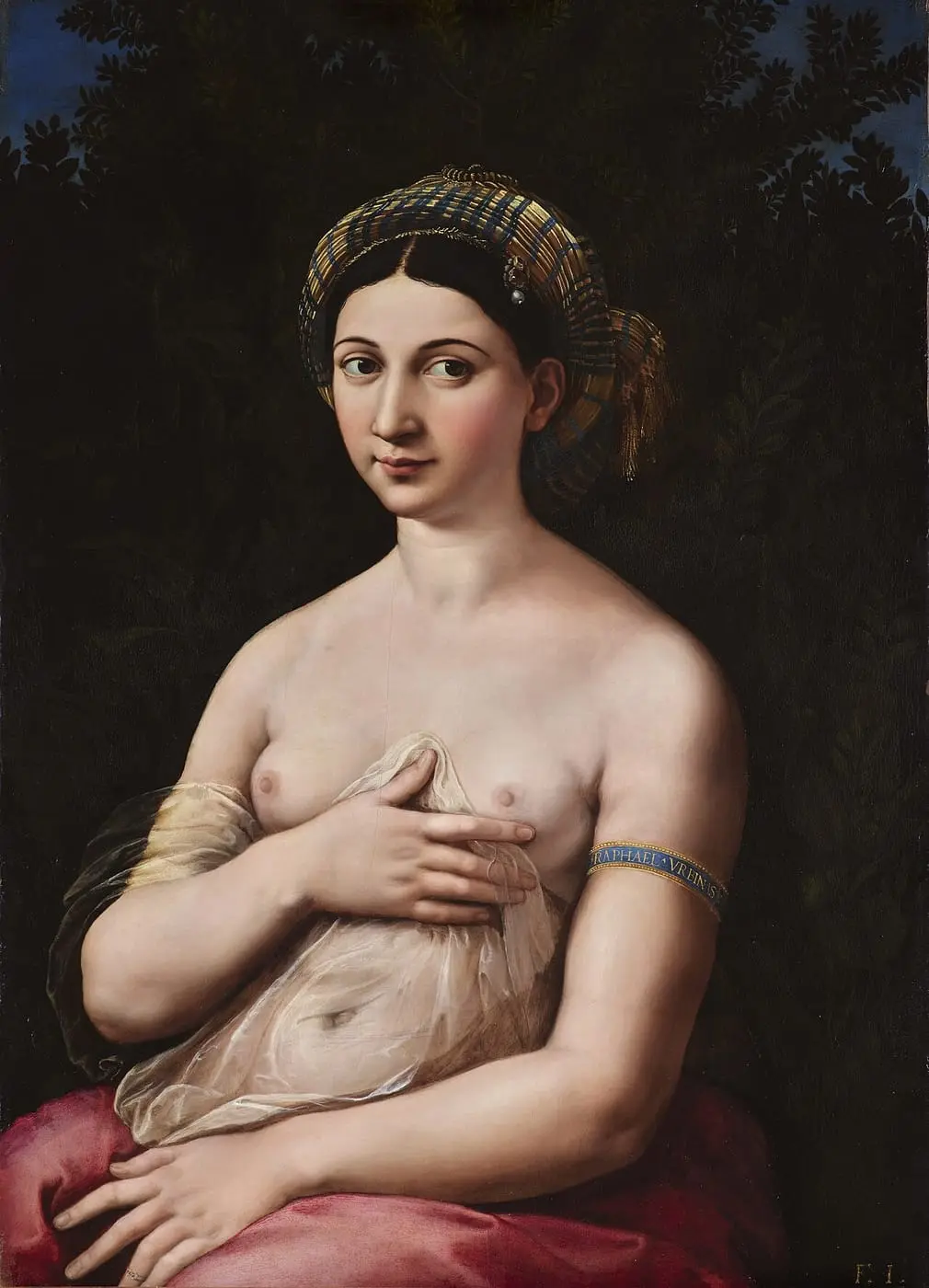
Own a hand-painted copy
La fornarina
Painted by hand in oil on canvas, any size. Free worldwide shipping.
From $299 — Make it yours.Frequently asked questions
Who was La Fornarina?
Legend identifies her as Margherita Luti, a baker's daughter in Rome and Raphael's lover, but this is not certain.
What is written on her armband?
The armband reads RAPHAEL URBINAS, meaning Raphael of Urbino, the painter's signature.
When was La Fornarina painted?
Raphael painted it around 1518–1520, shortly before his death.
Where is La Fornarina?
It is in the Gallerie Nazionali di Arte Antica in Palazzo Barberini, Rome.
Sources and further reading
- Gallerie Nazionali di Arte Antica, Palazzo Barberini, collection notes on La Fornarina
- Giorgio Vasari, Lives of the Artists (1550)
- Roger Jones and Nicholas Penny, Raphael (1983)
