Listen to this article
0:00 / 3:45 · Read by ArtLogia
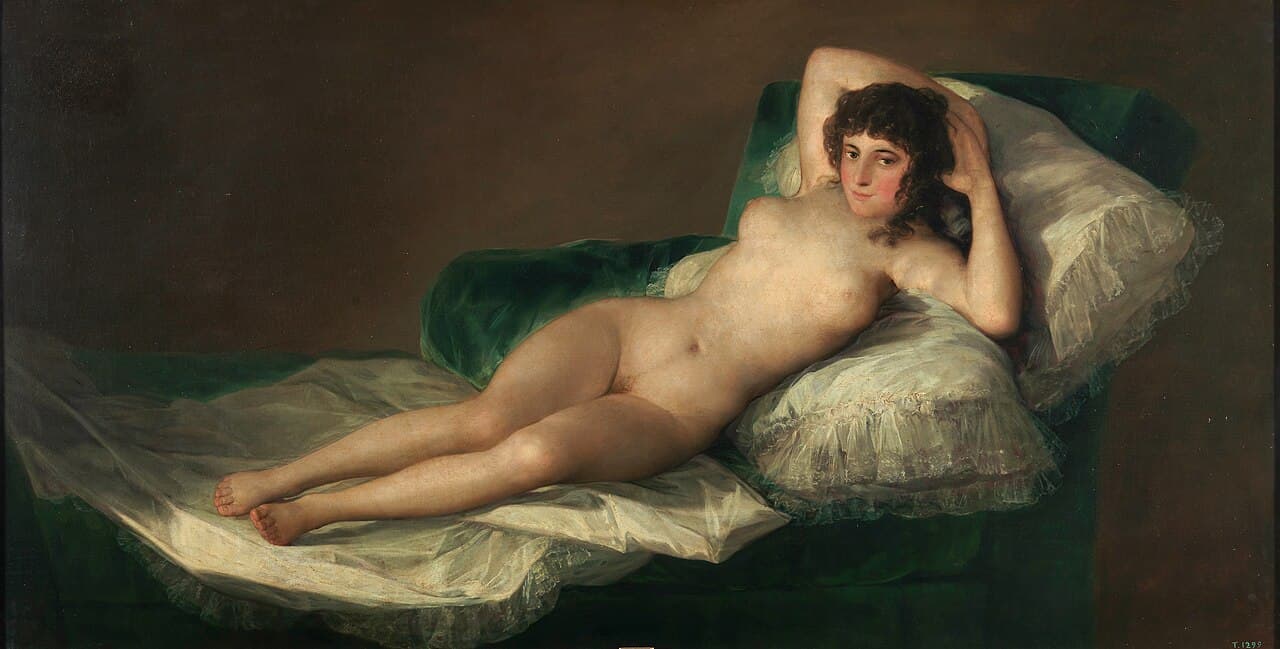
A young woman reclines on a green couch, her arms behind her head, gazing directly at us. Francisco Goya's La maja desnuda, painted around 1797–1800, is one of the first nudes in Western art of a real, contemporary woman rather than a goddess, and it brought the painter before the Inquisition.
In this article
A woman, not a goddess
For centuries, European painters showed the female nude under the cover of mythology or history: Venus, Danaë or a nymph. Francisco Goya's La maja desnuda breaks with this tradition. The woman is a maja, a stylish young woman of the popular classes of Madrid, and nothing in the painting suggests a goddess. She lies on a green velvet couch with white cushions, looking straight at the viewer with self-assurance.
The painting was made around 1797–1800, when Goya was principal painter to the Spanish court. It is one of very few female nudes in Spanish art of the time, because the Catholic Church strongly discouraged them.
Godoy's secret cabinet
The painting first appears in the collection of Manuel Godoy, the powerful prime minister of King Charles IV, who owned a private room of nudes that included Velázquez's Rokeby Venus. Godoy also owned a second version, La maja vestida, showing the same woman in the same pose wearing a white dress and a short jacket. According to a story that cannot be proved, the clothed version hung in front of the nude and could be moved aside with a mechanism.
In 1808, after Godoy's fall, the paintings were seized, and in 1815 Goya was summoned by the Inquisition to explain who had commissioned these "obscene" works. The outcome of the inquiry is not known, and Goya kept his post as court painter.
The gaze
What makes the painting so striking is the woman's direct gaze. She looks at us calmly, with a faint smile, as if aware of being watched and untroubled by it. Her face is painted with soft modelling and a slight flush on the cheeks. This confident look would later inspire Manet's Olympia.
 Detail 1

A direct gaze
The maja's eyes meet ours without shyness. Her calm self-assurance, rather than her nudity alone, is what made the painting so daring.
The pose
The woman's arms are folded behind her head, a pose that opens her body to the viewer and suggests relaxation and confidence. Goya painted her body with smooth, pale tones that stand out against the dark green of the couch. Critics have noticed that the head seems slightly too large for the body and is set at an unusual angle, which has led to the theory that the face was painted separately to hide the model's identity.
Detail 2Arms behind the head
Her raised arms and the soft white cushions frame the face. The pose, borrowed from classical sculpture, becomes intimate and modern.
The cushions and the lace
Goya was a virtuoso painter of fabrics. The white pillows and the thin lace-edged sheet are painted with quick, loose brushstrokes and touches of silvery grey, contrasting with the deep green velvet of the couch.
Detail 3Lace and white cushions
The cushions are painted with free, flickering strokes of white and grey. Up close they are almost abstract; from a distance they become soft linen and lace.
Detail 4Crossed feet
At the far end of the couch, her feet rest one over the other on the white sheet, closing the long diagonal of the figure.
Who was the maja?
The identity of the model is unknown. A long-standing legend says she was the Duchess of Alba, with whom Goya had a close friendship, but there is no evidence for it, and her family has always denied it. Some historians suggest Pepita Tudó, Godoy's companion. The face, as noted, may not be a portrait at all.
Seeing the two majas
La maja desnuda and La maja vestida hang side by side in the Museo del Prado in Madrid, allowing visitors to compare them. Each measures about 97 by 190 centimetres.
Own a hand-painted copy
La maja desnuda
Painted by hand in oil on canvas, any size. Free worldwide shipping.
From $299 — Make it yours.Frequently asked questions
What does maja mean?
A maja was a fashionable young woman from the popular classes of Madrid in the late 18th century, known for her confident style.
Who commissioned La maja desnuda?
It is first recorded in the collection of Manuel Godoy, prime minister of Spain, who also owned La maja vestida.
Is the woman the Duchess of Alba?
This is a popular legend, but there is no evidence for it, and her identity remains unknown.
Where is La maja desnuda?
It is in the Museo del Prado in Madrid, next to La maja vestida.
Sources and further reading
- Museo del Prado, collection notes on La maja desnuda and La maja vestida
- Janis Tomlinson, Goya in the Twilight of Enlightenment (1992)
- Robert Hughes, Goya (2003)
