Listen to this article
0:00 / 3:35 · Read by ArtLogia
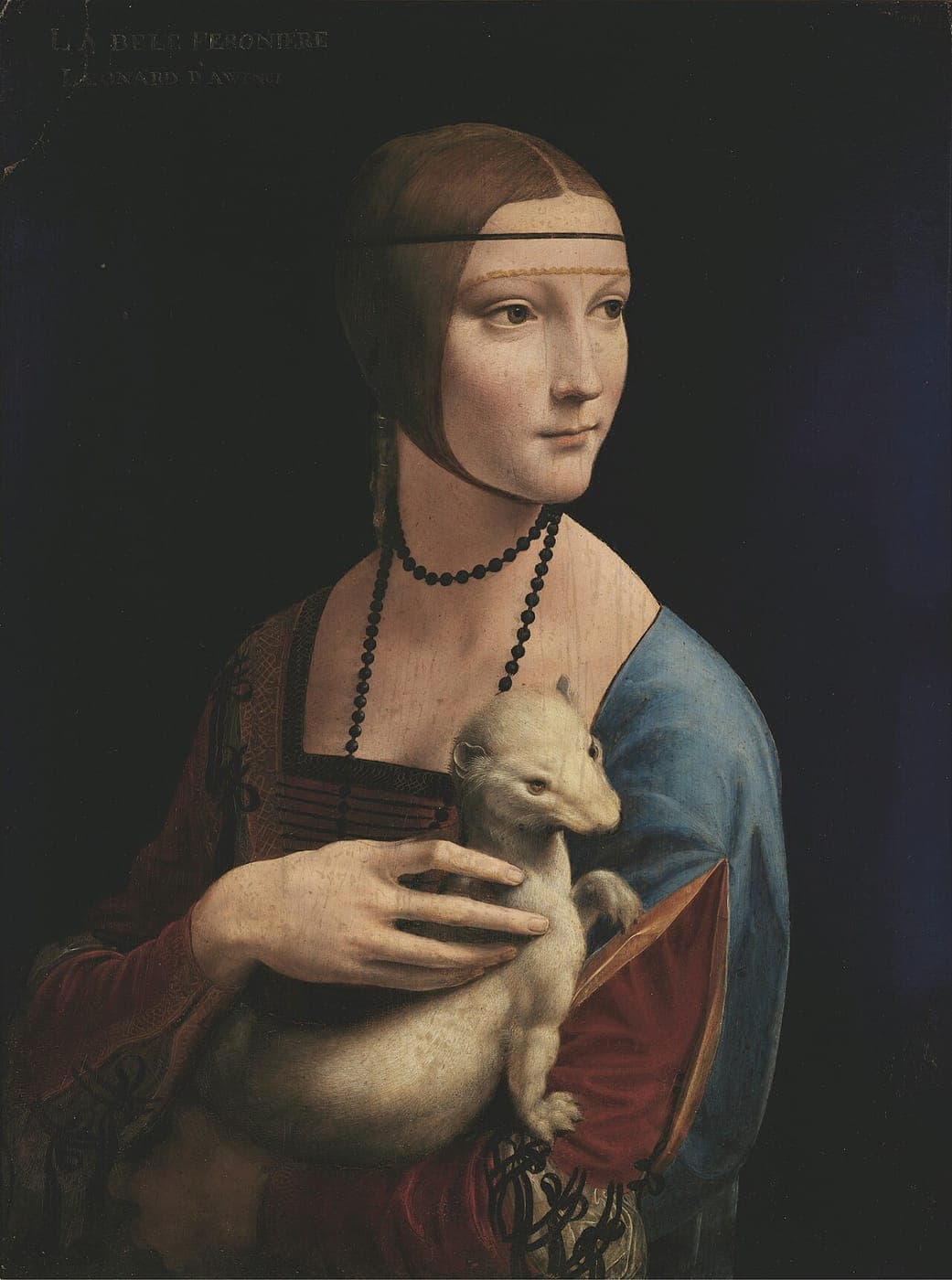
A young woman turns her head as if called from the side, holding a white ermine that turns with her. Painted by Leonardo da Vinci in Milan around 1490, Lady with an Ermine is one of only four portraits of women by Leonardo, and a revolution in the art of portraiture.
In this article
A portrait at the court of Milan
Around 1489–1491 Leonardo da Vinci was working in Milan for Ludovico Sforza, known as Il Moro, the ruler of the city. There he painted the portrait of a young woman of the court holding an ermine. She is generally identified as Cecilia Gallerani, a cultivated and highly educated young woman, then about sixteen years old, who was Ludovico's mistress and later bore him a son.
Portraits of women in the fifteenth century were usually shown in profile, as still as a coin. Leonardo broke that convention completely. Cecilia turns her shoulders one way and her head the other, as if responding to someone who has just entered the room. The ermine in her arms makes the same movement. It is a portrait of a living moment and of a mind at work.
The face
Cecilia's face is lit from the left, the light falling softly across her forehead, cheek and the line of her jaw. Leonardo modelled it with subtle transitions of shadow, and her eyes look out to the side with an alert, intelligent expression. A fine band holds a transparent veil over her hair, and a long necklace of dark beads hangs around her neck.
 Detail 1

Cecilia's gaze
The young woman looks away to the light, her eyes focused on something outside the painting. Her expression is attentive and thoughtful, not posed.
Detail 2The black bead necklace
A long string of dark beads hangs in loops on her chest, catching small highlights. Leonardo used it to follow the turn of her neck and body.
The ermine
The ermine, a stoat in its white winter coat, was a symbol of purity and moderation: legend said it would rather die than soil its white fur. It was also a personal emblem of Ludovico Sforza, who had been made a knight of the Order of the Ermine by the King of Naples. And the Greek word for ermine, galê, plays on the name Gallerani. The animal is a portrait in itself, linking the sitter, her lover and her virtue.
Detail 3The ermine's head
The ermine's alert head and narrowed eyes echo the young woman's pose. Leonardo, a passionate student of animals, painted its muscular body with great realism.
The hand
Cecilia's right hand rests on the ermine's back, the long fingers bent and relaxed. It is one of the most beautiful hands in Renaissance painting. Leonardo studied anatomy in depth, and you can almost feel the bones and tendons beneath the skin, and the soft fur under her fingers.
Detail 4The long-fingered hand
Her right hand strokes the ermine, the fingers drawn with anatomical precision. The hand repeats the elegant curve of the animal's body.
A survivor of history
The painting was bought around 1800 by Prince Adam Jerzy Czartoryski for his mother, Princess Izabela Czartoryska, who founded one of the first museums in Poland. During the nineteenth century the dark background was overpainted, and an inscription was added in the upper left. In the Second World War it was taken by the Nazis and hung in the office of the governor general of occupied Poland, Hans Frank. It was recovered in Germany in 1946 and returned to Kraków.
Seeing Lady with an Ermine
The portrait is small, about 54 by 39 centimetres, painted in oil on a walnut panel. It is in the Czartoryski Museum in Kraków, part of the National Museum in Kraków, where it is displayed in a room of its own.
Own a hand-painted copy
Lady with an Ermine
Painted by hand in oil on canvas, any size. Free worldwide shipping.
From $299 — Make it yours.Frequently asked questions
Who is the Lady with an Ermine?
She is generally identified as Cecilia Gallerani, a young woman at the court of Ludovico Sforza in Milan.
What does the ermine symbolise?
The ermine symbolised purity, was an emblem of Ludovico Sforza, and its Greek name, galê, plays on the name Gallerani.
When was Lady with an Ermine painted?
Leonardo da Vinci painted it around 1489–1491 in Milan.
Where is Lady with an Ermine?
It is in the Czartoryski Museum in Kraków, Poland.
Sources and further reading
- National Museum in Kraków, Czartoryski Museum, collection notes on Lady with an Ermine
- Frank Zöllner, Leonardo da Vinci: The Complete Paintings (2003)
- Martin Kemp, Leonardo da Vinci: The Marvellous Works of Nature and Man (1981)
