Listen to this article
0:00 / 4:36 · Read by ArtLogia
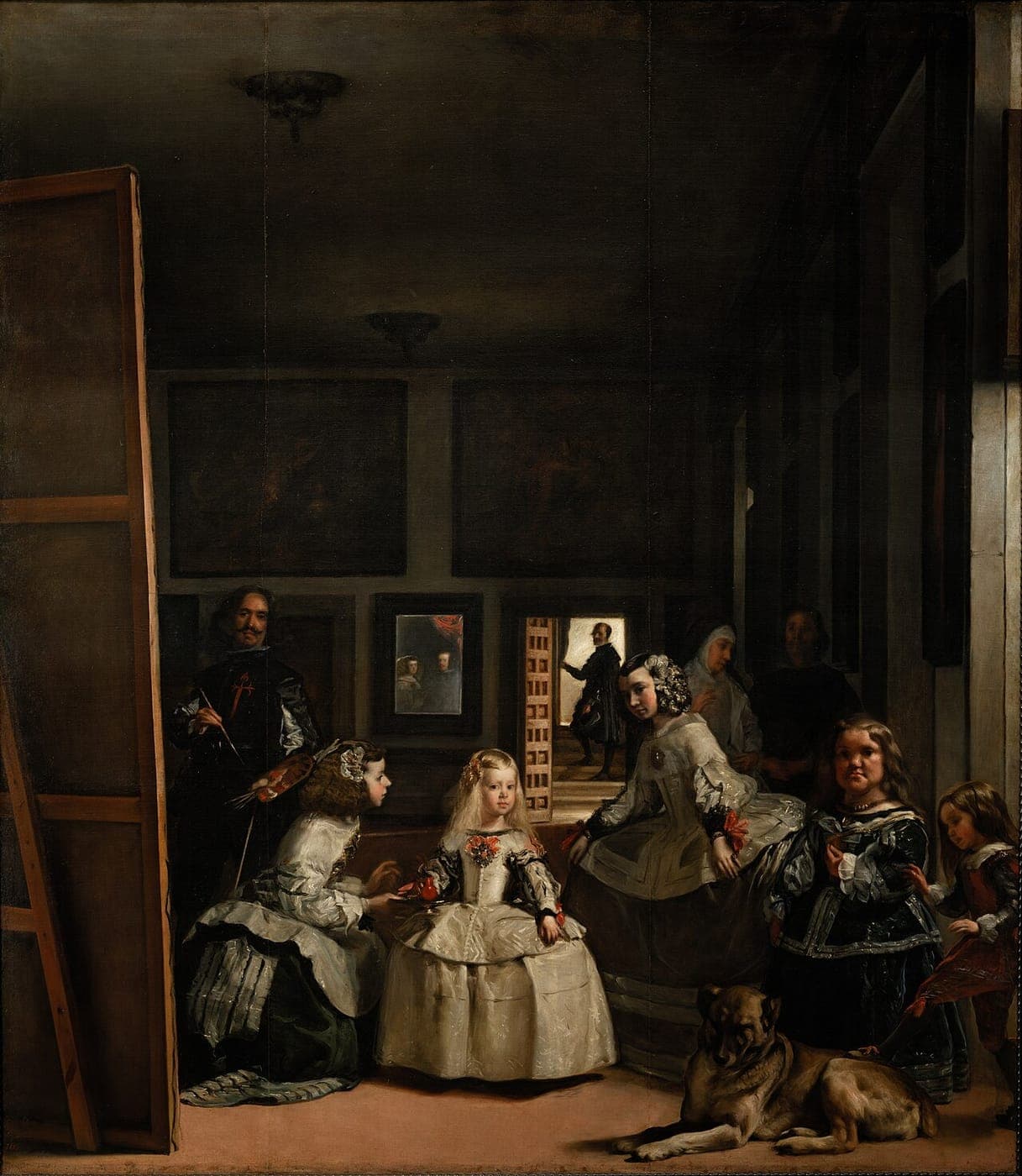
Las Meninas looks like a snapshot of court life in Madrid in 1656: a little princess, her maids, a dwarf, a dog, and the painter himself at his easel. But every figure is part of a puzzle about who is watching whom.
In this article
A room in the royal palace
Las Meninas was painted in 1656 by Diego Velázquez, court painter to King Philip IV of Spain. The scene takes place in a large room of the Alcázar, the royal palace of Madrid, that served as the painter's studio. Its title means "the ladies-in-waiting", a name it received in the nineteenth century; earlier inventories called it simply the family of Philip IV.
At first sight it is a moment caught by chance. The five-year-old Infanta Margarita Teresa stands in the centre, attended by two young maids of honour. On the right are two court dwarfs and a sleepy mastiff. Behind them, a chaperone talks to a guard in the shadows, and a man pauses on the stairs in a bright doorway at the back. On the left, Velázquez himself steps back from a huge canvas, brush in hand, and looks straight out at us.
The princess at the centre
The Infanta is the brightest point of the painting. Her pale dress and fair hair catch the light from a window on the right, and her small, serious face is turned towards us. One maid, María Agustina Sarmiento, kneels to offer her a red cup of water on a tray; the other, Isabel de Velasco, bows slightly on the other side.
 Detail 1

The Infanta Margarita
The little princess is painted with loose, shimmering strokes. Seen up close her dress dissolves into dabs of grey, white and pink; from a distance it becomes silk.
The painter in the picture
Velázquez gave himself a prominent place. He stands at his easel, palette in hand, wearing on his chest the red cross of the Order of Santiago, a high honour he received only in 1659, three years after the painting was finished. The cross was added later, perhaps by the painter himself, perhaps on the king's order. Placing himself beside the royal family was a bold claim for the dignity of painting as a noble art.
Detail 2Velázquez at his easel
The painter looks out at us as if we were his models. The red cross of Santiago on his doublet was painted after he joined the order in 1659.
The mirror on the back wall
The key to the puzzle hangs on the back wall: a small mirror reflecting the half-length figures of King Philip IV and Queen Mariana. They seem to stand where we stand, in front of the scene. Is Velázquez painting their portrait? Have they just walked in, causing everyone to look up? Or does the mirror reflect the canvas he is working on? The painting never answers, and the viewer is drawn into the space of the room.
Detail 3The king and queen in the mirror
The blurred reflection shows Philip IV and Queen Mariana. Their position puts them where the viewer stands, making us part of the scene.
The man in the doorway
At the back, José Nieto Velázquez, the queen's chamberlain, stands on the steps in an open doorway, holding back a curtain. Light floods behind him. He gives the painting its deepest point and frames the room like a stage set. He was probably a relative of the painter and was in charge of the royal tapestries.
Detail 4José Nieto in the doorway
The chamberlain pauses on the stairs, outlined against a bright light. He seems to have stopped to watch the scene, as we do.
The dwarfs and the dog
On the right stand Maribárbola, a German dwarf at the court, and the young Italian Nicolasito Pertusato, who playfully rests his foot on the back of the great dog. The mastiff lies calm and half asleep. Velázquez painted these members of the household with the same respect and naturalism as the royal family, a striking choice for the time.
Why painters call it the greatest painting
Las Meninas fascinated later painters. Goya made an etching after it, and Picasso painted 58 variations on it in 1957, now in the Museu Picasso in Barcelona. The nineteenth-century critic Théophile Gautier asked, standing in front of it, "Where is the painting?", so convincing was the space. Its secret is the light, which falls softly from the windows and fades into the high, dark ceiling, and the brushwork, which is free and sketchy up close yet completely real from a few steps back.
Seeing Las Meninas
The original is huge, about 3.2 by 2.8 metres, and hangs in Room 12 of the Museo del Prado in Madrid, the heart of the Velázquez galleries.
Own a hand-painted copy
Las Meninas
Painted by hand in oil on canvas, any size. Free worldwide shipping.
From $349 — Make it yours.Frequently asked questions
What does Las Meninas mean?
Las Meninas means "the ladies-in-waiting", referring to the two young maids of honour who attend the Infanta Margarita.
Who is in the mirror in Las Meninas?
The mirror reflects King Philip IV of Spain and Queen Mariana of Austria, who appear to stand where the viewer stands.
Is Velázquez in Las Meninas?
Yes. Velázquez painted himself at the left, standing at his easel with a brush and palette.
Where is Las Meninas?
Las Meninas is in the Museo del Prado in Madrid.
Sources and further reading
- Museo del Prado, collection notes on Las Meninas
- Jonathan Brown, Velázquez: Painter and Courtier (1986)
- Antonio Palomino, El Museo pictórico y escala óptica (1724)
