

Listen to this article
0:00 / 3:37 · Read by ArtLogia
In July 1830 Paris rose against King Charles X. Within months Eugène Delacroix turned those three days of street fighting into a modern myth: a bare-breasted Liberty leading workers, students and a boy with pistols over the barricades.
In this article
Three glorious days
On 27, 28 and 29 July 1830, Parisians built barricades and fought the troops of King Charles X, who had suspended freedom of the press and dissolved the newly elected chamber. The king fled and was replaced by Louis-Philippe, the "citizen king". The French remember these days as Les Trois Glorieuses.
Eugène Delacroix, the leading painter of French Romanticism, did not fight, but he witnessed the revolt. In October he wrote to his brother that if he had not fought for his country, at least he would paint for her. He finished the painting that autumn and showed it at the Salon of 1831.
Liberty herself
At the top of a pyramid of figures strides Liberty, an allegory and a woman of the people at the same time. She wears the Phrygian cap, symbol of freedom since antiquity and of the French Revolution of 1789, and she raises the tricolour flag in one hand and a bayonet musket in the other. Her profile is classical, like a Greek statue, but her bare feet and the dust on her skin make her very real.
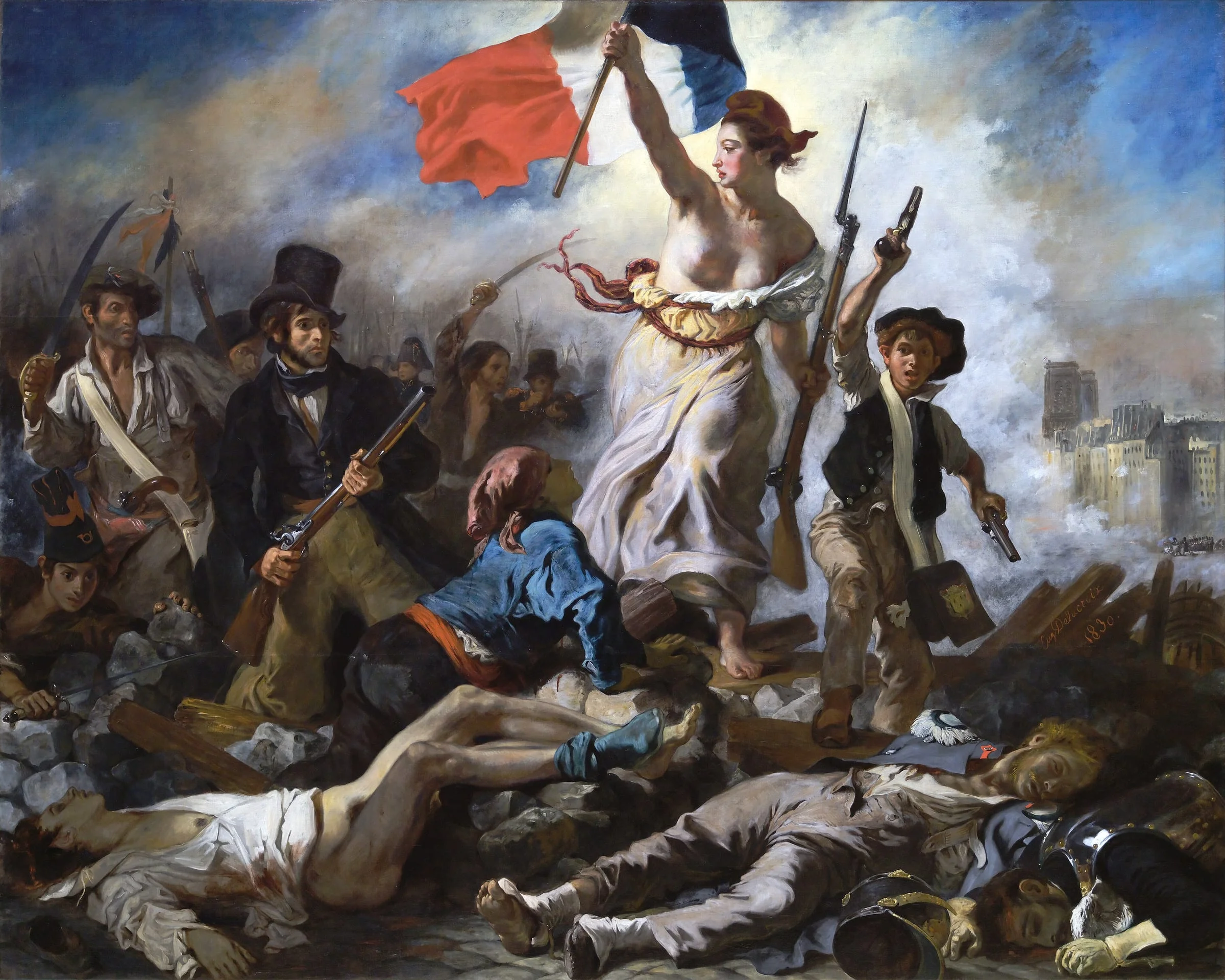 Detail 1
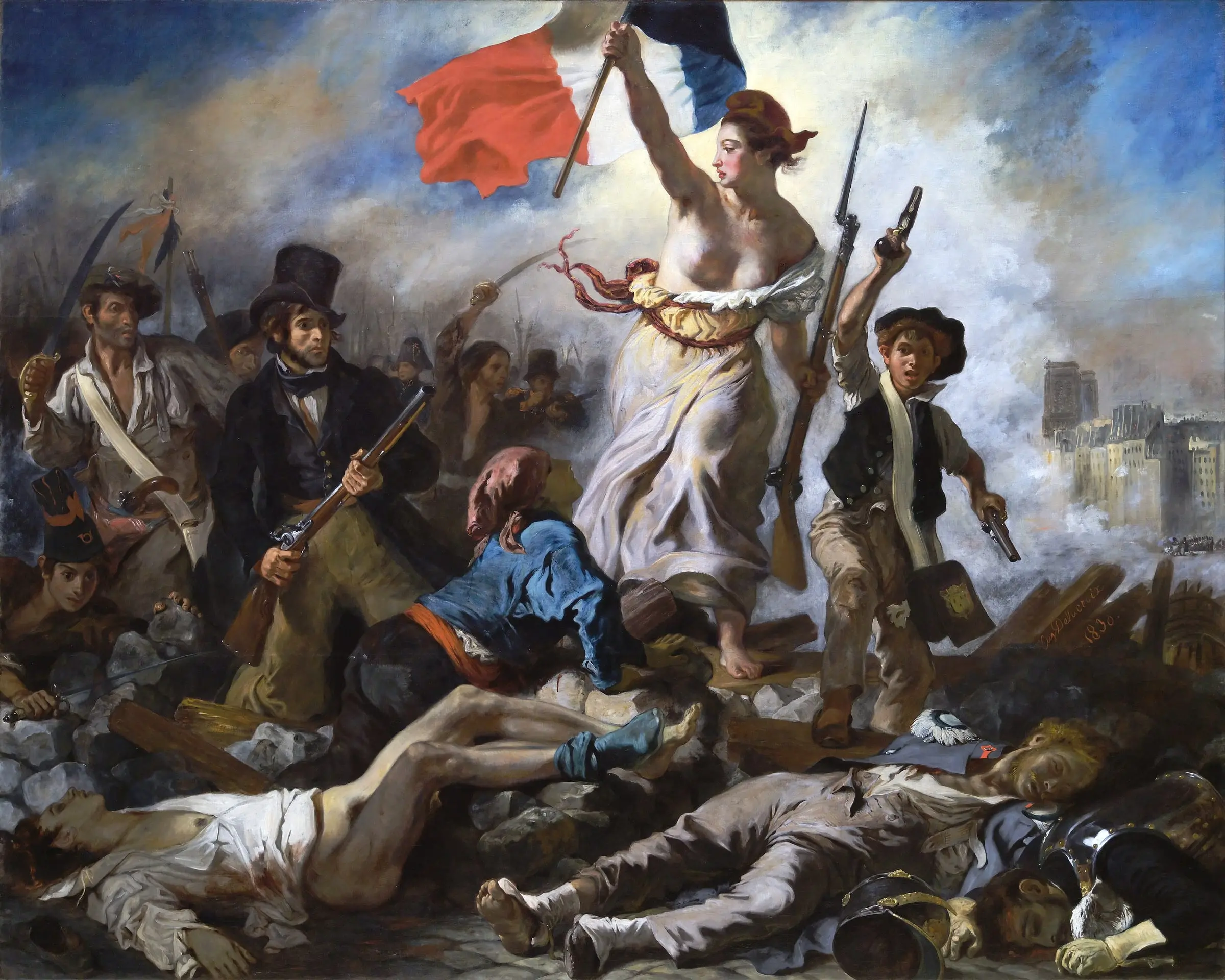
The Phrygian cap and the flag
Liberty's red cap and the tricolour flag, the only bright colours at the top of the picture, repeat the red, white and blue that run through the whole composition.
The people of Paris
Around her, Delacroix gathered the different classes of the revolution. On the left a man in a top hat holds a hunting gun; he has often been called a self-portrait of the painter, though this is uncertain. Beside him a worker with a sabre wears a beret and an apron. On the right, a boy waves two pistols and shouts. He is often seen as the model for Gavroche in Victor Hugo's novel Les Misérables, written decades later.
Detail 2The man in the top hat
The figure in the top hat and black coat represents the middle class who joined the uprising. Delacroix may have given him some of his own features.
Detail 3The boy with the pistols
The boy, a Parisian street child, charges forward with a pistol in each hand. His energy makes him one of the most memorable figures in the painting.
The dead on the barricade
At the bottom of the painting lie the dead: a half-naked man on the left and a soldier in uniform on the right. Their bodies form the base of the pyramid and remind us of the price of the victory. A wounded man raises himself towards Liberty, his eyes on her, wearing the same blue, white and red colours as the flag.
Notre-Dame in the smoke
Through the smoke on the right rise the towers of Notre-Dame, with a small tricolour flag flying from one of them. The detail sets the scene firmly in Paris and turns a street battle into a national event.
Detail 4The towers of Notre-Dame
The cathedral appears through the gunsmoke, with the tricolour on its tower. It anchors the allegory in a real place and a real day.
A painting too dangerous to show
The state bought the painting in 1831, but it was soon judged too revolutionary and was taken down. It was returned to Delacroix and kept out of sight for years, before entering the Louvre in 1874. Since then it has become a symbol of France and of freedom, appearing on banknotes, stamps and album covers. Its frank, dusty realism and its Romantic energy remain as powerful as when it shocked the Salon.
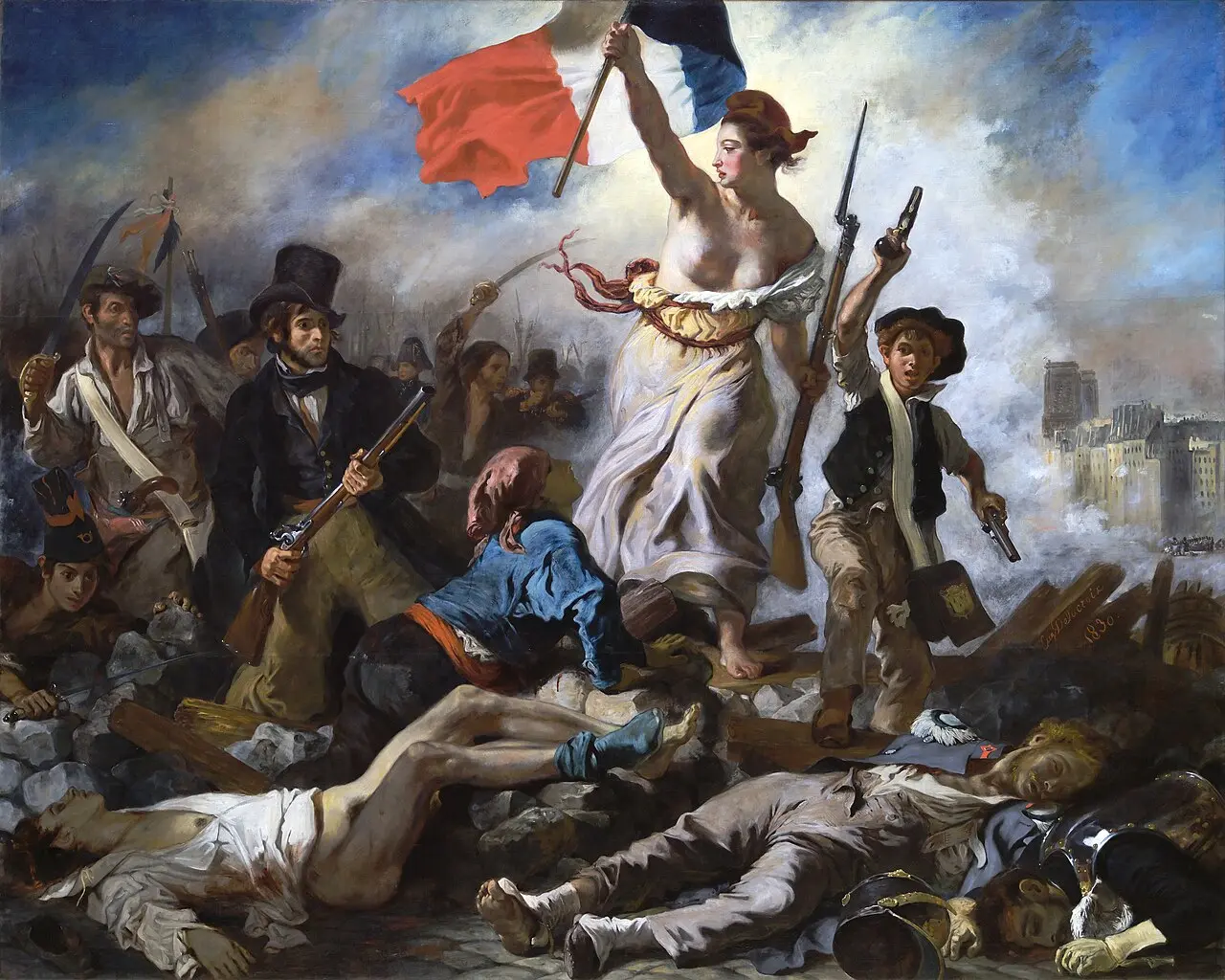
Own a hand-painted copy
Liberty Leading the People
Painted by hand in oil on canvas, any size. Free worldwide shipping.
From $299 — Make it yours.Frequently asked questions
What event does Liberty Leading the People show?
It commemorates the July Revolution of 1830 in Paris, when citizens overthrew King Charles X.
Who is the woman in Liberty Leading the People?
She is an allegory of Liberty, wearing the Phrygian cap. In France she is often linked with Marianne, the symbol of the Republic.
Is Delacroix in the painting?
The man in the top hat is often described as a self-portrait, but this is not certain.
Where is Liberty Leading the People?
It is in the Musée du Louvre in Paris, in the galleries of large French paintings.
Sources and further reading
- Musée du Louvre, collection notes on Liberty Leading the People
- Eugène Delacroix, Journal
- Hélène Toussaint, La Liberté guidant le peuple de Delacroix (Louvre, 1982)
