Listen to this article
0:00 / 3:49 · Read by ArtLogia
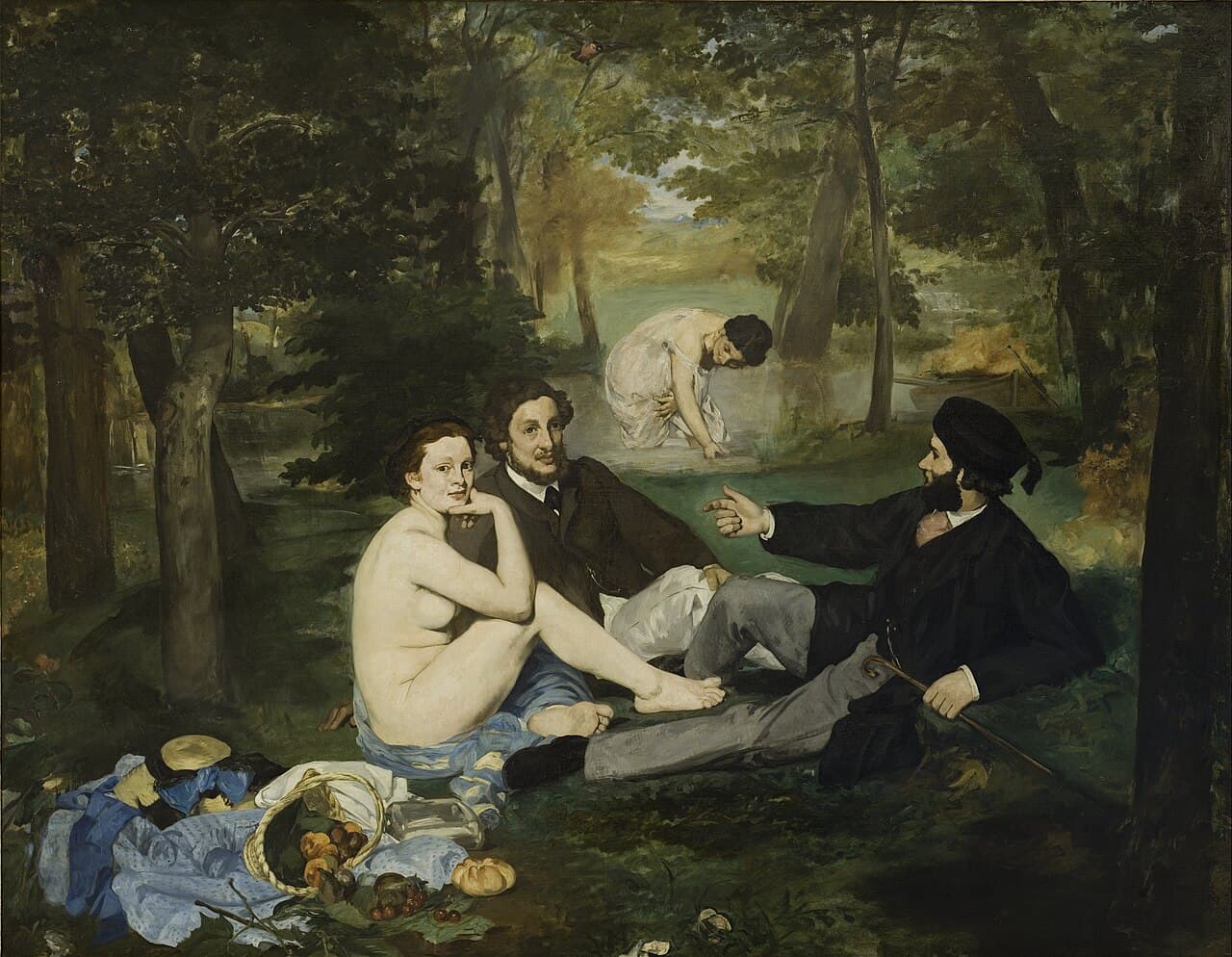
Two fully dressed young men sit in a wood beside a naked woman who looks straight out at us, while another woman bathes in a stream behind them. When Édouard Manet showed Le Déjeuner sur l'herbe in 1863, the public laughed and critics were outraged.
In this article
The Salon of the Rejected
In 1863 the jury of the official Paris Salon rejected more than three thousand works. The protests were so loud that Emperor Napoleon III ordered a separate exhibition of the rejected paintings, the Salon des Refusés. Édouard Manet's large canvas, then titled Le Bain (The Bath), was its sensation. Crowds came to mock it, and critics called it shameless.
What shocked them was not the nude itself. The Salon was full of naked goddesses and nymphs. What shocked them was that this woman was clearly a modern Parisian, sitting beside two young men in contemporary clothes, in a scene without any mythological excuse.
Old masters, modern people
Manet knew the tradition well. The composition comes from a Renaissance source: the three seated figures copy a group of river gods in an engraving by Marcantonio Raimondi after a lost design by Raphael, The Judgment of Paris. The idea of clothed men with nude women in a landscape recalls The Pastoral Concert in the Louvre, then attributed to Giorgione and now often to Titian. Manet took these noble models and replaced the gods with his friends.
The woman's gaze
The nude woman is Victorine Meurent, Manet's favourite model, who also posed for Olympia and later became a painter herself. She sits with her chin on her hand and looks directly at the viewer, calm and unembarrassed. Her gaze breaks the convention of the nude who is looked at without looking back, and makes the viewer part of the scene.
 Detail 1

Victorine's gaze
The model looks straight out of the painting. Her direct, almost questioning look turns the viewer from an onlooker into a participant.
The two men
The man on the right, wearing a tasselled cap and gesturing as he talks, is thought to be Manet's future brother-in-law, the Dutch sculptor Ferdinand Leenhoff, combined with features of Manet's brothers Eugène and Gustave. The man beside the nude, in a dark jacket, seems lost in the conversation. Neither seems to notice that their companion has no clothes.
Detail 2The conversation
The man on the right gestures as he talks, absorbed in conversation. His casual modern dress makes the nude beside him all the more startling.
The bather
In the background, a second woman in a white shift bends to wash in a stream. She is too large for her position in the distance, as if she were floating above the others. The flattened perspective, with the space rising rather than receding, was one of the things critics attacked, but it announced the modern art to come.
Detail 3The bather in the stream
The woman in white is out of scale with the figures in front. Manet ignored classical perspective, flattening the space like a stage backdrop.
The still life
In the lower left corner lies a still life of the picnic: the woman's blue dress and straw hat thrown on the grass, an overturned basket of fruit, a loaf of bread and a flask. Manet painted it with brilliant, free brushwork. It is a masterpiece within the masterpiece, and it tells us that the woman has undressed here, in the wood.
Detail 4The overturned basket
Cherries, figs and bread spill from the basket beside the discarded dress. Manet's loose, confident handling of paint is at its best in this corner.
Why it matters
Luncheon on the Grass became a symbol of the break between official art and the avant-garde. The young painters who would become the Impressionists admired Manet's courage; Monet painted his own Luncheon on the Grass in response, and later Cézanne and Picasso created their own versions. The painting measures about 2.1 by 2.7 metres and is in the Musée d'Orsay in Paris.
Own a hand-painted copy
Luncheon on the Grass
Painted by hand in oil on canvas, any size. Free worldwide shipping.
From $349 — Make it yours.Frequently asked questions
Why was Luncheon on the Grass so scandalous?
It showed a nude woman not as a goddess but as a modern Parisian, beside two men in contemporary clothes, which the public of 1863 found indecent.
Who is the woman in Luncheon on the Grass?
She is Victorine Meurent, Manet's favourite model, who also posed for Olympia.
Where was Luncheon on the Grass first shown?
It was shown in 1863 at the Salon des Refusés, the exhibition of works rejected by the official Paris Salon.
Where is Luncheon on the Grass?
It is in the Musée d'Orsay in Paris.
Sources and further reading
- Musée d'Orsay, collection notes on Le Déjeuner sur l'herbe
- T. J. Clark, The Painting of Modern Life: Paris in the Art of Manet and His Followers (1985)
- Françoise Cachin et al., Manet 1832–1883 (exhibition catalogue, 1983)
