


Listen to this article
0:00 / 3:25 · Read by ArtLogia
The Virgin Mary holds a red carnation towards her plump child, who reaches for it, while through two arched windows behind them a fantastic landscape of mountains rises. Painted around 1478–1480, the Madonna of the Carnation is one of Leonardo da Vinci's earliest works.
In this article
A young Leonardo in Florence
The Madonna of the Carnation was painted around 1478–1480, when Leonardo da Vinci was in his twenties and close to his master Verrocchio. It was rediscovered in the nineteenth century and was attributed to Leonardo in the early twentieth century. Today it is generally accepted as one of his earliest independent works.
The painting shows the Virgin Mary seated in an interior, holding the infant Christ on a cushion, with a landscape visible through two windows behind her.
The carnation
Mary holds a red carnation towards her son. The carnation was a symbol of the Passion of Christ: its red colour evokes the blood of the Crucifixion, and a legend said carnations first grew where the Virgin's tears fell on the way to Calvary. The child reaches for the flower with both hands, as if accepting his destiny.
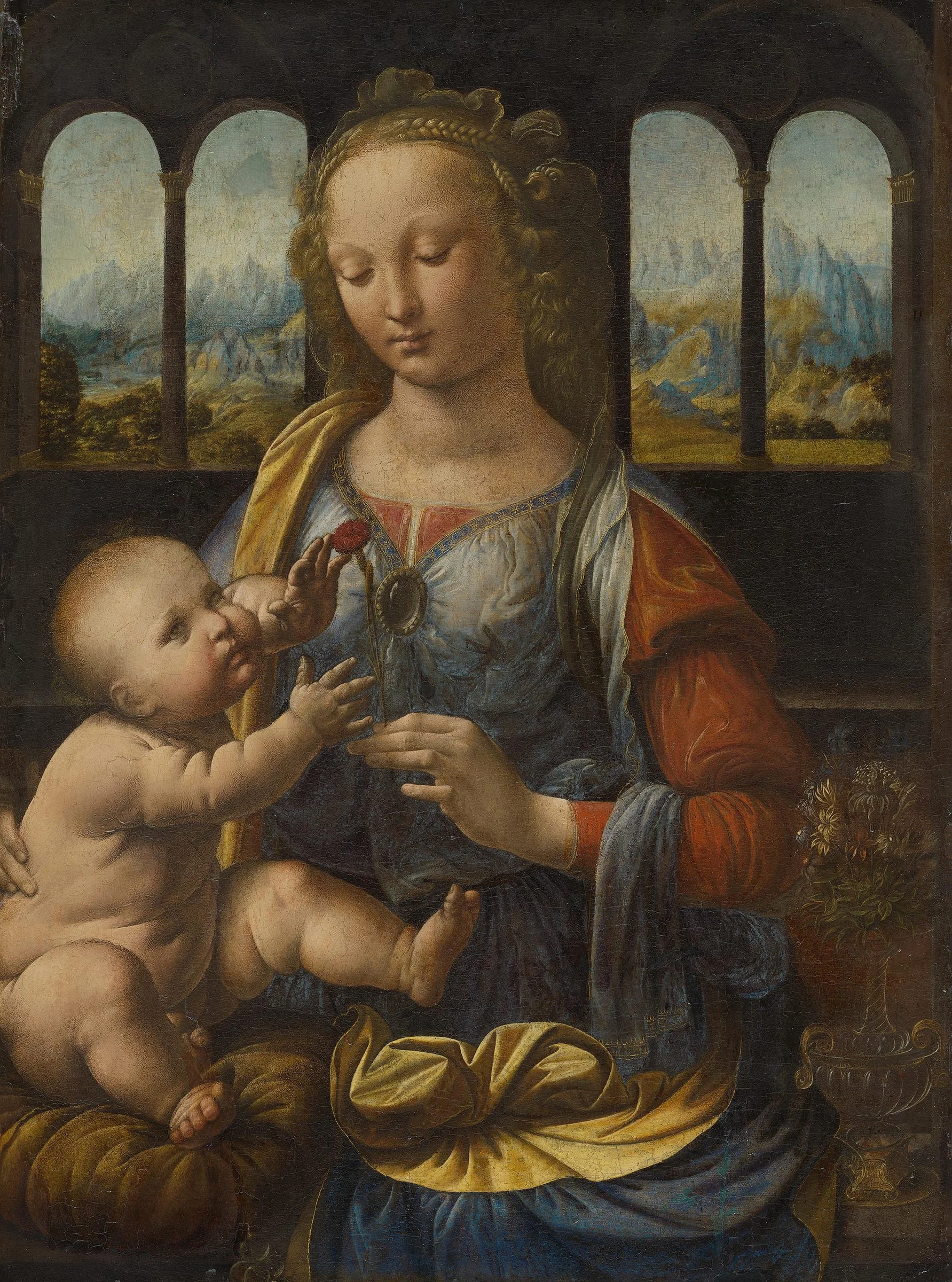 Detail 1
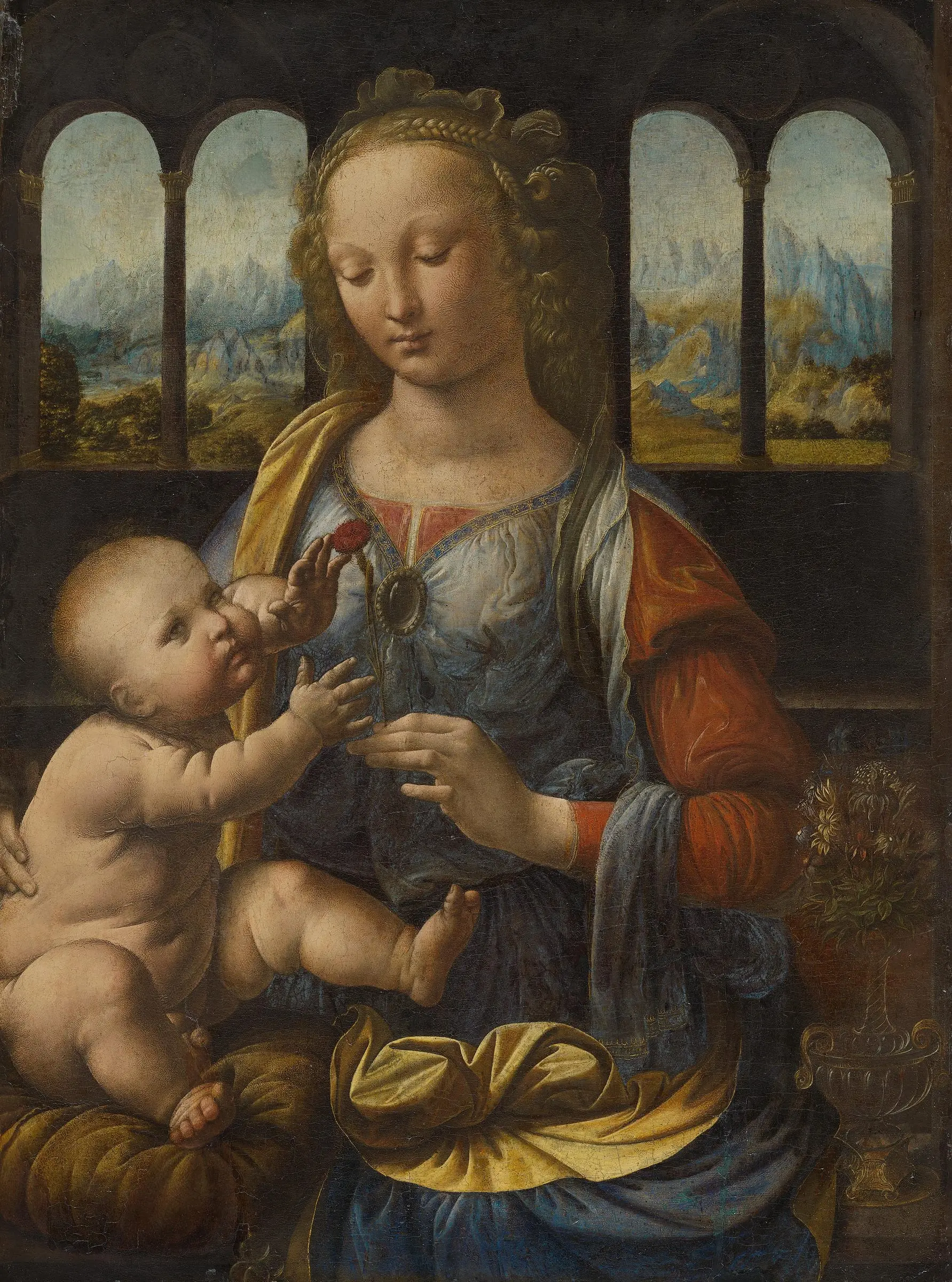
The red carnation
Mary holds the red carnation, a symbol of the Passion, while the child reaches for it with both hands.
The Virgin
Mary's face is calm and gentle, framed by curls of golden hair and a jewelled brooch at her breast. Her face is painted with the soft modelling that would become Leonardo's sfumato.
Detail 2The Virgin's face
Mary looks down at her son with a calm, pensive expression, her golden curls painted with great delicacy.
The child
The infant sits on a cushion, his chubby body twisting as he reaches for the flower. Leonardo studied babies from life, and the weight and movement of the child are convincingly natural.
Detail 3The reaching child
The plump child twists and reaches up for the flower, his movement captured with lifelike observation.
The crystal vase
In the lower right, a glass vase of flowers stands on a ledge. Leonardo painted the transparent glass and the reflections with great care, influenced by the Flemish paintings then admired in Florence.
Detail 4The glass vase
A transparent vase of flowers stands on the ledge, its reflections painted with a precision inspired by Flemish art.
Windows on a fantastic world
Through two arched windows, a landscape of jagged blue mountains rises against the sky. These fantastic peaks anticipate the landscapes of the Mona Lisa and the Virgin of the Rocks, and show Leonardo's fascination with geology and atmosphere.
Detail 5Mountains through the window
Jagged blue mountains rise beyond the windows, an early example of Leonardo's fascination with geology and atmospheric perspective.
Leonardo's early experiments
The Madonna of the Carnation shows the young Leonardo experimenting with oil paint, which was still new in Florence, where most painters used egg tempera. In some areas, such as the Virgin's face, the paint has wrinkled as it dried, a sign that Leonardo was testing thick layers of oil. The painting also shows the influence of Flemish art, which was admired in Florence for its precise detail and luminous colour, visible in the glass vase and the jewels. At the same time, the windows opening onto a misty landscape and the soft modelling of the faces announce the great works to come. The painting is a precious record of the moment when Leonardo was finding his own path.
Seeing the Madonna of the Carnation
The painting measures about 62 by 47 centimetres and hangs in the Alte Pinakothek in Munich, the only painting by Leonardo in Germany.
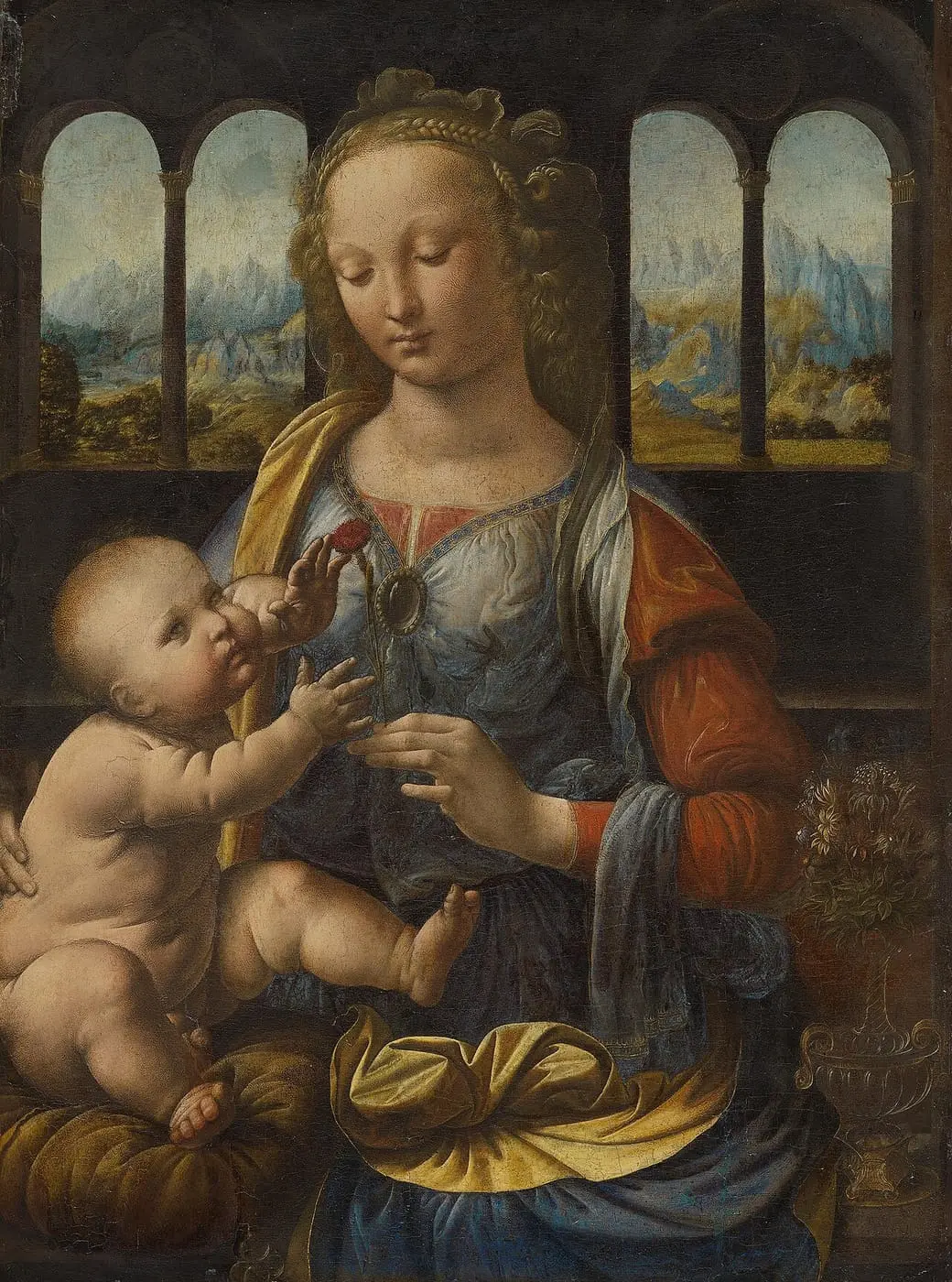
Own a hand-painted copy
Madonna of the Carnation
Painted by hand in oil on canvas, any size. Free worldwide shipping.
From $299 — Make it yours.Frequently asked questions
What does the carnation symbolise?
The red carnation symbolises the Passion of Christ; its red colour evokes the blood of the Crucifixion.
When was the Madonna of the Carnation painted?
Leonardo painted it around 1478–1480, early in his career.
Is the Madonna of the Carnation by Leonardo?
It is generally accepted as one of Leonardo's earliest works, though it was long attributed to Verrocchio's workshop.
Where is the Madonna of the Carnation?
It is in the Alte Pinakothek in Munich.
Sources and further reading
- Bayerische Staatsgemäldesammlungen, Alte Pinakothek, collection notes on the Madonna of the Carnation
- Frank Zöllner, Leonardo da Vinci: The Complete Paintings (2003)
- Martin Kemp, Leonardo da Vinci: The Marvellous Works of Nature and Man (1981)
