


Listen to this article
0:00 / 3:19 · Read by ArtLogia
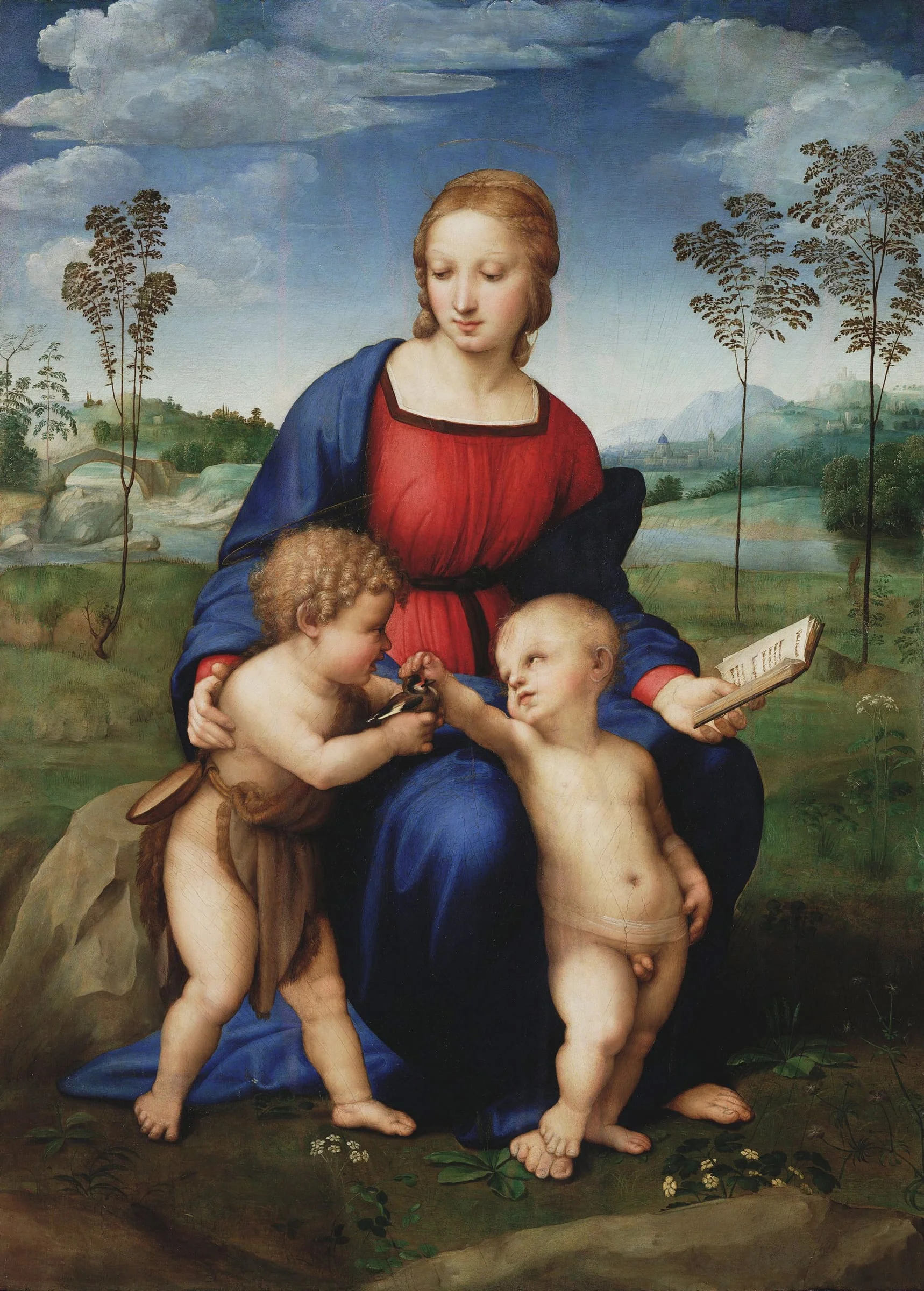
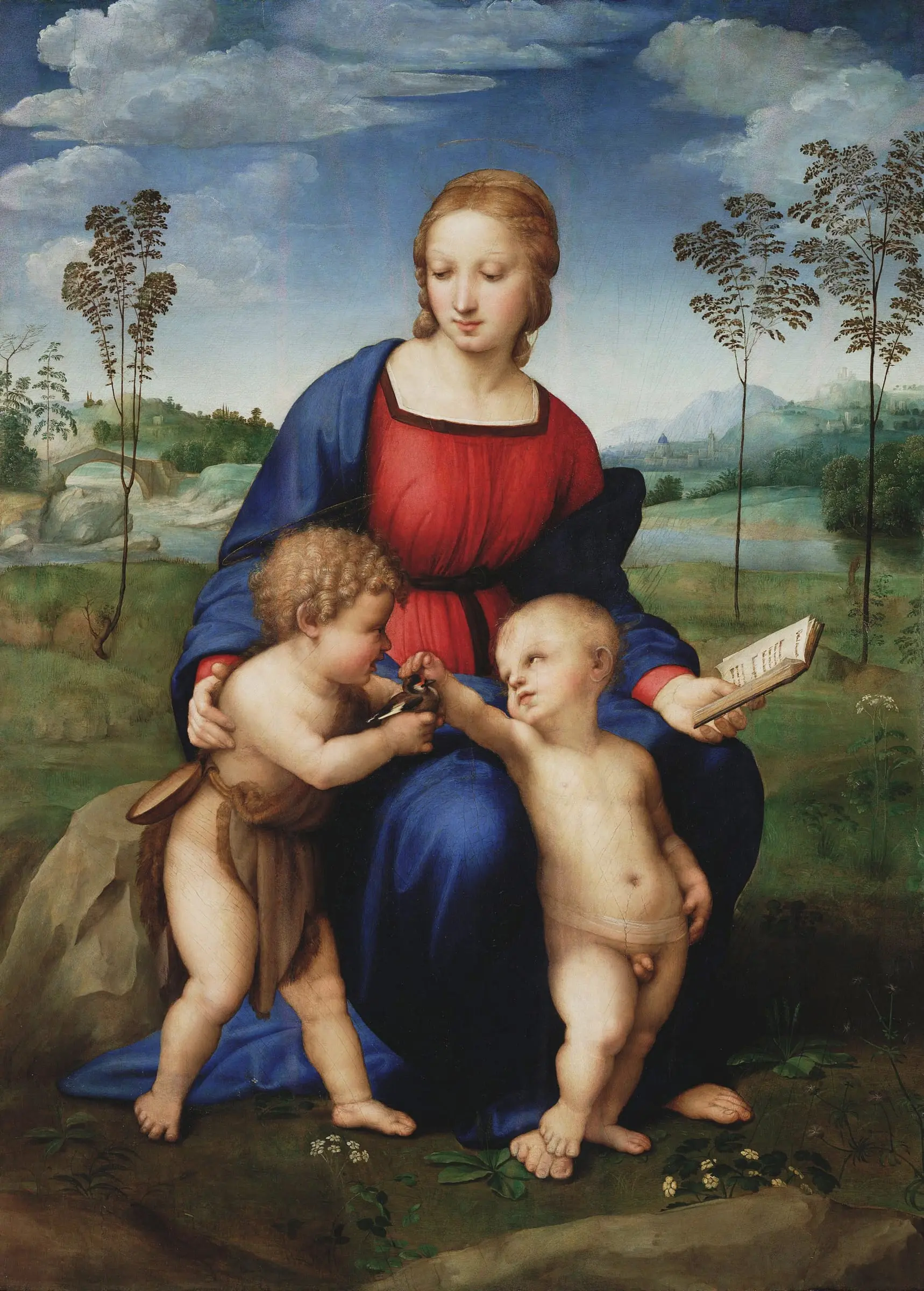
In a gentle landscape, the Virgin Mary sits on a rock, a book in her hand, as the infant John the Baptist offers a goldfinch to the young Christ. Painted around 1505–1506, the Madonna of the Goldfinch was shattered when a house collapsed in 1547 and was pieced back together.
In this article
A wedding gift in Florence
Around 1505–1506 the young Raphael, then in Florence, painted the Madonna of the Goldfinch, the Madonna del Cardellino, for his friend Lorenzo Nasi, a wealthy merchant, as a gift for his wedding. In Florence Raphael studied the works of Leonardo da Vinci and Michelangelo, and their influence can be seen in the harmonious, pyramidal composition.
The goldfinch
The young John the Baptist, on the left, offers a goldfinch to the infant Christ, who strokes its head. The goldfinch, said to feed among thorns, was a symbol of the Passion: legend told that it got its red spot when it tried to pull a thorn from Christ's crown. The tender childish game thus foreshadows the Crucifixion.
 Detail 1
The goldfinch
The infant John offers a goldfinch to Christ, who strokes it. The bird foreshadows the Passion.
Mary
The Virgin sits on a rock, holding a book, and looks down at John with gentle seriousness. Her face is calm and idealised, framed by a thin veil. She is reading, a symbol of wisdom, and she has just interrupted her reading to watch the children.
Detail 2The Virgin's gaze
Mary looks down at the young John with a calm, gentle expression, her face framed by a fine veil.
Detail 3The open book
Mary holds a small book, the book of wisdom, which she has just stopped reading.
The children
The two children stand at the Virgin's feet, the young Christ leaning against his mother's knee, his foot resting on hers. Their soft, rounded bodies and natural poses show Raphael's study of Leonardo.
Detail 4Christ and John
The two children stand at Mary's knees, Christ resting his foot on his mother's foot in a natural, tender pose.
The landscape
Behind the figures stretches a peaceful landscape of trees, meadows, a river and distant hills fading into blue, an idealised view of the Tuscan countryside.
Detail 5The Tuscan landscape
A calm landscape of trees, a river and blue hills opens behind the group, bathed in soft light.
A painting broken and restored
Vasari reports that on 17 November 1547, the house of Lorenzo Nasi collapsed in a landslide, and the painting was broken into seventeen pieces. Lorenzo's son had the fragments joined together, but the repairs were visible. After a ten-year restoration completed in 2008 by the Opificio delle Pietre Dure in Florence, the painting regained much of its original brightness.
Raphael in Florence
Raphael arrived in Florence in 1504, aged twenty-one, and stayed for about four years. There he discovered the work of Leonardo da Vinci and Michelangelo and transformed his style. The Madonna of the Goldfinch is one of a series of Florentine Madonnas, including the Madonna of the Meadow in Vienna and La Belle Jardinière in the Louvre, in which he explored the pyramidal composition and the soft modelling he learned from Leonardo. These paintings combine tenderness, harmony and clarity in a way that made Raphael the model of classical perfection for centuries. In 1508 he left for Rome, where Pope Julius II commissioned him to decorate the rooms of the Vatican palace.
Seeing the Madonna of the Goldfinch
The painting measures about 107 by 77 centimetres and hangs in the Uffizi Gallery in Florence.
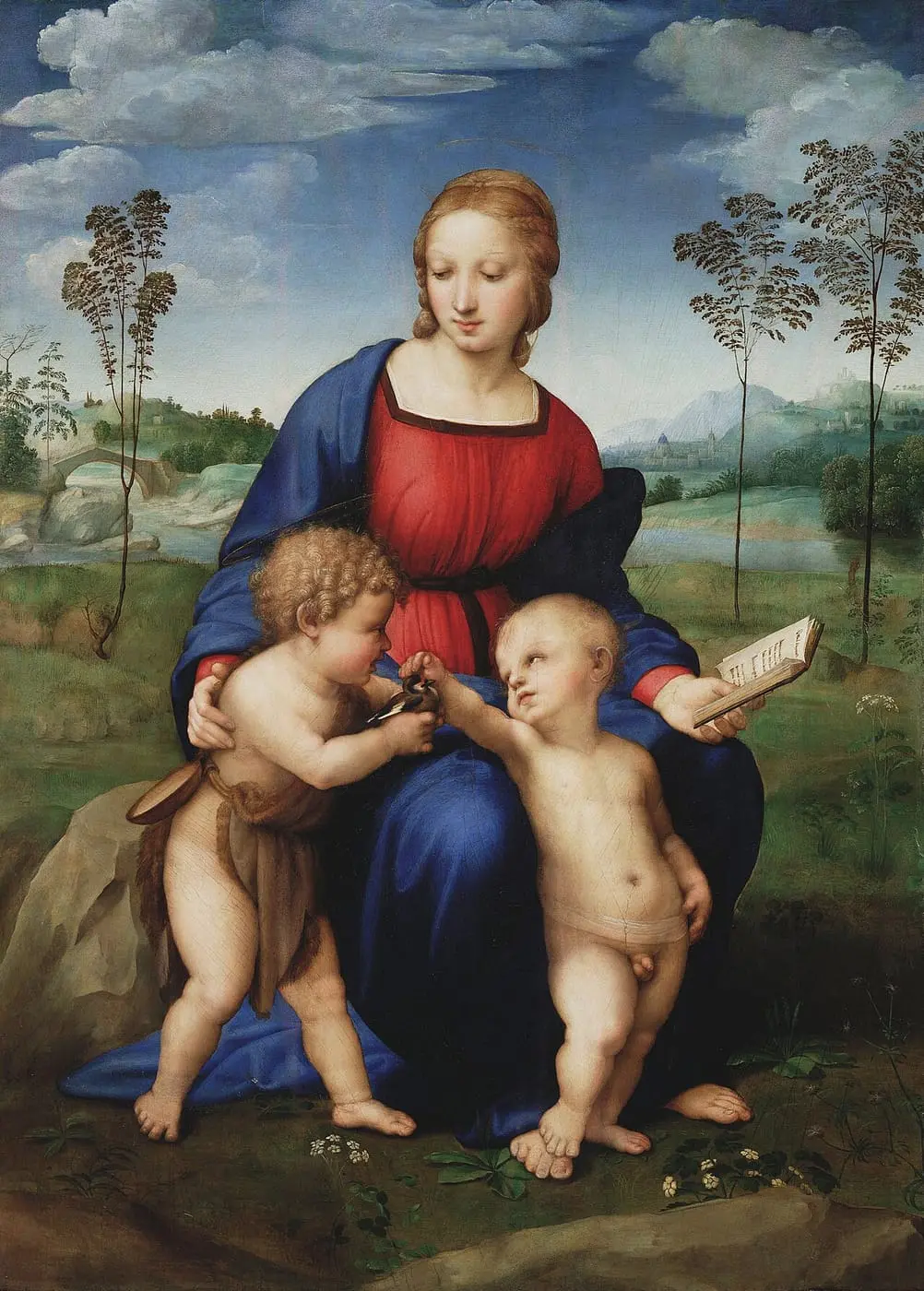
Own a hand-painted copy
Madonna of the Goldfinch
Painted by hand in oil on canvas, any size. Free worldwide shipping.
From $299 — Make it yours.Frequently asked questions
What does the goldfinch symbolise?
The goldfinch symbolises the Passion of Christ; legend says it got its red spot pulling a thorn from Christ's crown.
Who are the children in the Madonna of the Goldfinch?
They are the infant Christ and the young John the Baptist.
What happened to the painting in 1547?
It was broken into seventeen pieces when the owner's house collapsed, and was later pieced together.
Where is the Madonna of the Goldfinch?
It is in the Uffizi Gallery in Florence.
Sources and further reading
- Uffizi Galleries, collection notes and restoration report on the Madonna del Cardellino (2008)
- Giorgio Vasari, Lives of the Artists (1550)
- Roger Jones and Nicholas Penny, Raphael (1983)
