Listen to this article
0:00 / 3:32 · Read by ArtLogia
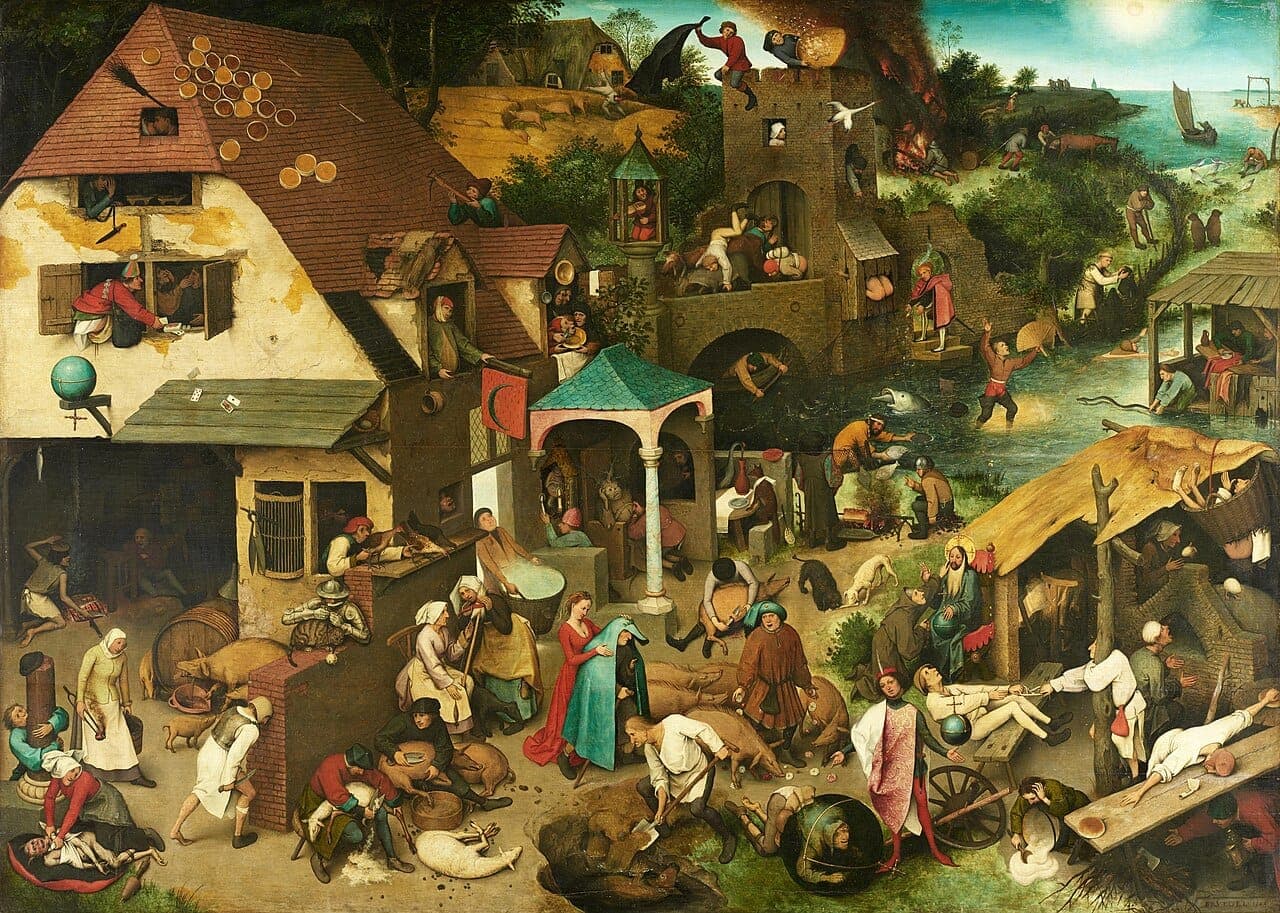
In a busy Flemish village, people bang their heads against walls, fill in wells after the calf has drowned and put blue cloaks on their husbands. Painted in 1559, Pieter Bruegel the Elder's Netherlandish Proverbs illustrates more than a hundred proverbs and idioms about human foolishness.
In this article
A world upside down
Pieter Bruegel the Elder painted the Netherlandish Proverbs in 1559 in Antwerp. The original title was probably The Blue Cloak or The Folly of the World. It shows a village crowded with people, animals and houses, and every figure acts out a proverb or idiom used in the Low Countries in the sixteenth century. Scholars have identified more than a hundred of them.
The painting belongs to a popular tradition of books and prints collecting proverbs, a fashion encouraged by the humanist Erasmus. But no one had ever brought so many together in a single, coherent landscape. The overall message is that the world is full of foolishness, and that people act against reason and their own interests.
The roof covered with pies
At the top left, the roof of a house is tiled with tarts or flat cakes. The saying "the roof is tiled with tarts" meant a land of plenty, a place of abundance and excess, which in Bruegel's moralising eyes is also a sign of gluttony.
 Detail 1

Pies on the roof
The roof covered with tarts illustrates a land of plenty and gluttony. Bruegel painted proverbs as literal images.
The upside-down globe
On the wall of a house hangs a globe turned upside down, with its cross pointing down. It illustrates "the world turned upside down", the theme of the whole painting: a world where everything is the reverse of what it should be.
Detail 2The world upside down
An inverted globe hangs from the wall, the cross at the bottom. It sums up the painting's theme of a topsy-turvy world.
The blue cloak
Near the centre, a young woman in red places a blue cloak on an older man. To "hang the blue cloak" on one's husband meant to deceive him, to be unfaithful. This scene gave the painting one of its old names, The Blue Cloak.
Detail 3The blue cloak
A woman puts a blue cloak on her husband's shoulders, meaning she is deceiving him. The scene gave the painting its early title.
Proverbs everywhere
Look carefully and the proverbs are everywhere. A man bangs his head against a brick wall, attempting the impossible. Another fills in the well after the calf has drowned, acting only after disaster. A man throws roses before swine, wasting good things on the unworthy. A woman carries fire in one hand and water in the other, a two-faced person. Two men are led by the nose. Someone shears a sheep while another shears a pig, one getting the profit and the other only the noise.
The distant landscape
Beyond the village, the painting opens at the upper right onto a river and the sea, with ships under sail and a bright sky. Even here, proverbs continue: a man shoots one arrow after another, wasting good money after bad. The landscape gives breathing space to the crowded scene.
Detail 4The river and the sea
At the top right the village opens onto water and ships. Bruegel's sweeping view balances the crowded proverbs in the foreground.
A game for viewers
Bruegel's contemporaries would have recognised most of the proverbs immediately and enjoyed finding them, a game that viewers still play today. Many of these sayings, like "banging your head against a brick wall" or "armed to the teeth", are still used in English and Dutch. The painting is about 1.17 by 1.63 metres and is in the Gemäldegalerie in Berlin.
Own a hand-painted copy
Netherlandish Proverbs
Painted by hand in oil on canvas, any size. Free worldwide shipping.
From $299 — Make it yours.Frequently asked questions
How many proverbs are in Netherlandish Proverbs?
Scholars have identified more than a hundred proverbs and idioms in the painting.
What does the blue cloak mean?
Putting a blue cloak on one's husband meant deceiving him, being unfaithful.
What is the main theme of the painting?
It shows the folly of the world: people acting against reason, in a "world turned upside down".
Where is Netherlandish Proverbs?
It is in the Gemäldegalerie in Berlin.
Sources and further reading
- Gemäldegalerie, Staatliche Museen zu Berlin, collection notes on the Netherlandish Proverbs
- Mark Meadow, Pieter Bruegel the Elder's Netherlandish Proverbs and the Practice of Rhetoric (2002)
- Manfred Sellink, Bruegel: The Complete Paintings, Drawings and Prints (2007)
