Listen to this article
0:00 / 3:27 · Read by ArtLogia
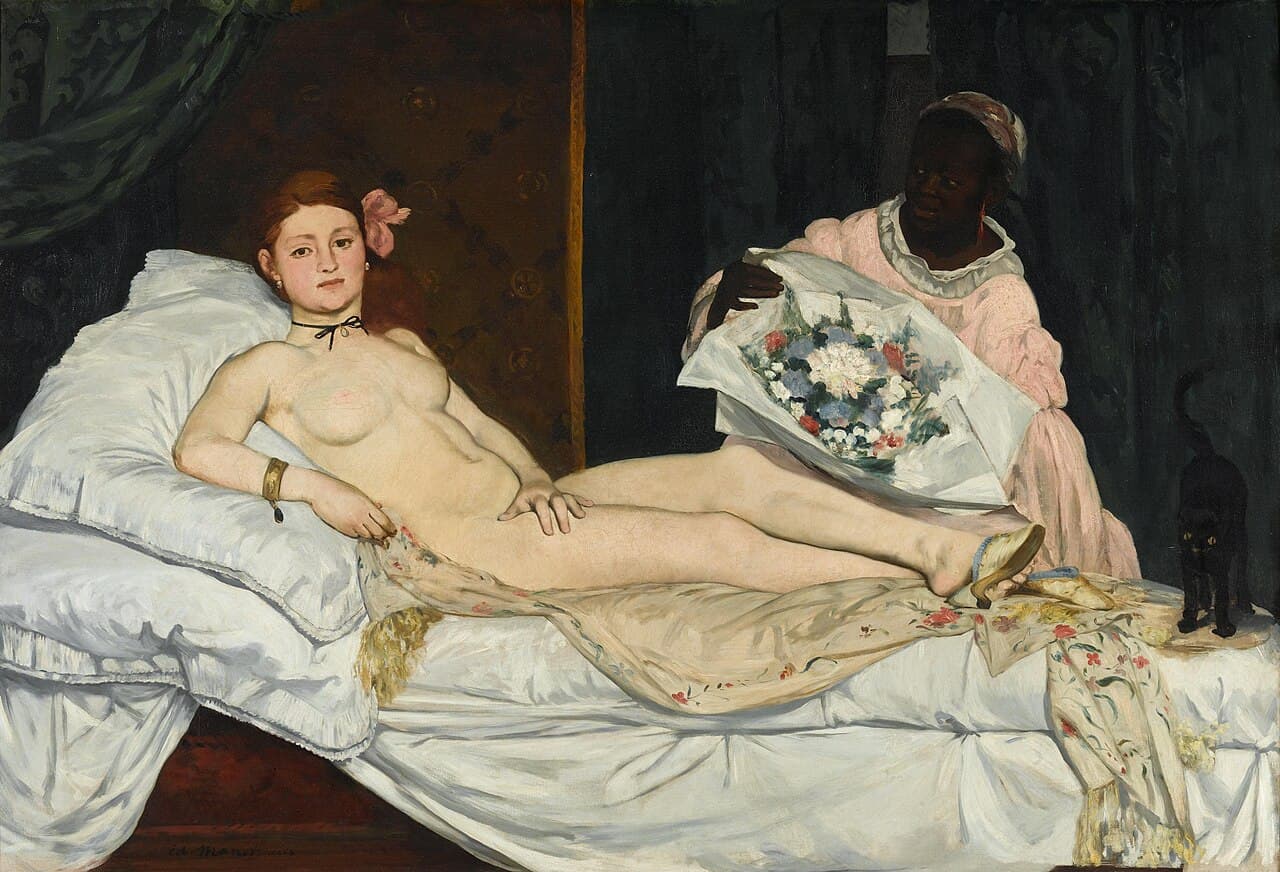
A young woman lies on a white bed, wearing only a black ribbon, a bracelet and a slipper, while her maid brings a bouquet and a black cat arches its back. Shown at the Salon of 1865, Édouard Manet's Olympia caused one of the greatest scandals in the history of art.
In this article
A Venus for modern Paris
Édouard Manet painted Olympia in 1863, the same year as Luncheon on the Grass, but he waited two years before exhibiting it. When it was hung at the Salon of 1865, crowds gathered in outrage, and guards had to protect it from visitors who wanted to strike it with umbrellas. It was moved high on the wall, out of reach.
The painting's composition comes directly from Titian's Venus of Urbino of 1538, which Manet had copied in Florence: a reclining nude on a bed, a maid in the background, an animal at her feet. But Manet turned the Renaissance goddess into a contemporary Parisian woman, and that was the scandal.
The face and the gaze
The model is Victorine Meurent, who also posed for Luncheon on the Grass. She looks directly and coolly at the viewer, with neither shyness nor seduction. Her name, Olympia, was commonly used by courtesans in Paris at the time, and many visitors understood the painting as a portrait of a high-class prostitute receiving a client, represented by the viewer.
 Detail 1

The direct gaze
Olympia looks at us calmly and appraisingly. A pink orchid in her hair and a black ribbon around her neck are her only ornaments.
The maid and the bouquet
Behind the bed, a Black maid in a pink dress brings a large bouquet of flowers wrapped in paper, presumably a gift from an admirer. The model was Laure, a woman who lived in Paris and posed for Manet several times. Recent scholarship has drawn attention to her role: she is not a decorative accessory but a modern working woman of Paris, painted with care and individuality.
Detail 2Laure and the bouquet
The maid holds a bouquet wrapped in white paper. Manet painted the flowers with loose, vivid strokes against her pink dress.
The black cat
At the foot of the bed, where Titian painted a sleeping dog, symbol of fidelity, Manet painted a black cat with its back arched and tail raised. The cat was traditionally associated with sensuality and independence, and its presence was read as a provocative joke. Caricaturists of the time loved to exaggerate it.
Detail 3The arched black cat
Almost invisible in the dark background, the cat stares out with yellow eyes. It replaces the faithful dog of Titian's Venus.
The slipper
One satin slipper is still on Olympia's foot; the other has fallen. The detail is tiny but revealing: a sign of intimacy and of a moment interrupted. It also emphasises that she is not a timeless goddess but a woman in a real room.
Detail 4The dangling slipper
A single slipper hangs from her foot. Such everyday details anchor the scene firmly in modern life.
A new way of painting
Critics also attacked the technique. Manet painted the body with flat, pale tones and strong outlines, with little of the soft modelling that academic painters used to make flesh look rounded. To his contemporaries this looked crude and unfinished; to later artists it was a revolution. The flatness of the image and its frank modernity opened the way to Impressionism and modern art.
Seeing Olympia
Olympia measures about 1.3 by 1.9 metres. After Manet's death, Claude Monet organised a subscription to buy it for the French state in 1890. It entered the Louvre in 1907 and is now in the Musée d'Orsay in Paris.
Own a hand-painted copy
Olympia
Painted by hand in oil on canvas, any size. Free worldwide shipping.
From $299 — Make it yours.Frequently asked questions
Why was Olympia so scandalous?
It presented a nude woman not as a goddess but as a contemporary Parisian, probably a courtesan, who stares at the viewer without shame.
Who posed for Olympia?
Victorine Meurent posed for Olympia, and a woman named Laure posed for the maid.
What painting inspired Olympia?
Manet based its composition on Titian's Venus of Urbino (1538).
Where is Olympia?
It is in the Musée d'Orsay in Paris.
Sources and further reading
- Musée d'Orsay, collection notes on Olympia
- T. J. Clark, The Painting of Modern Life (1985)
- Denise Murrell, Posing Modernity: The Black Model from Manet and Matisse to Today (2018)
