Listen to this article
0:00 / 3:09 · Read by ArtLogia
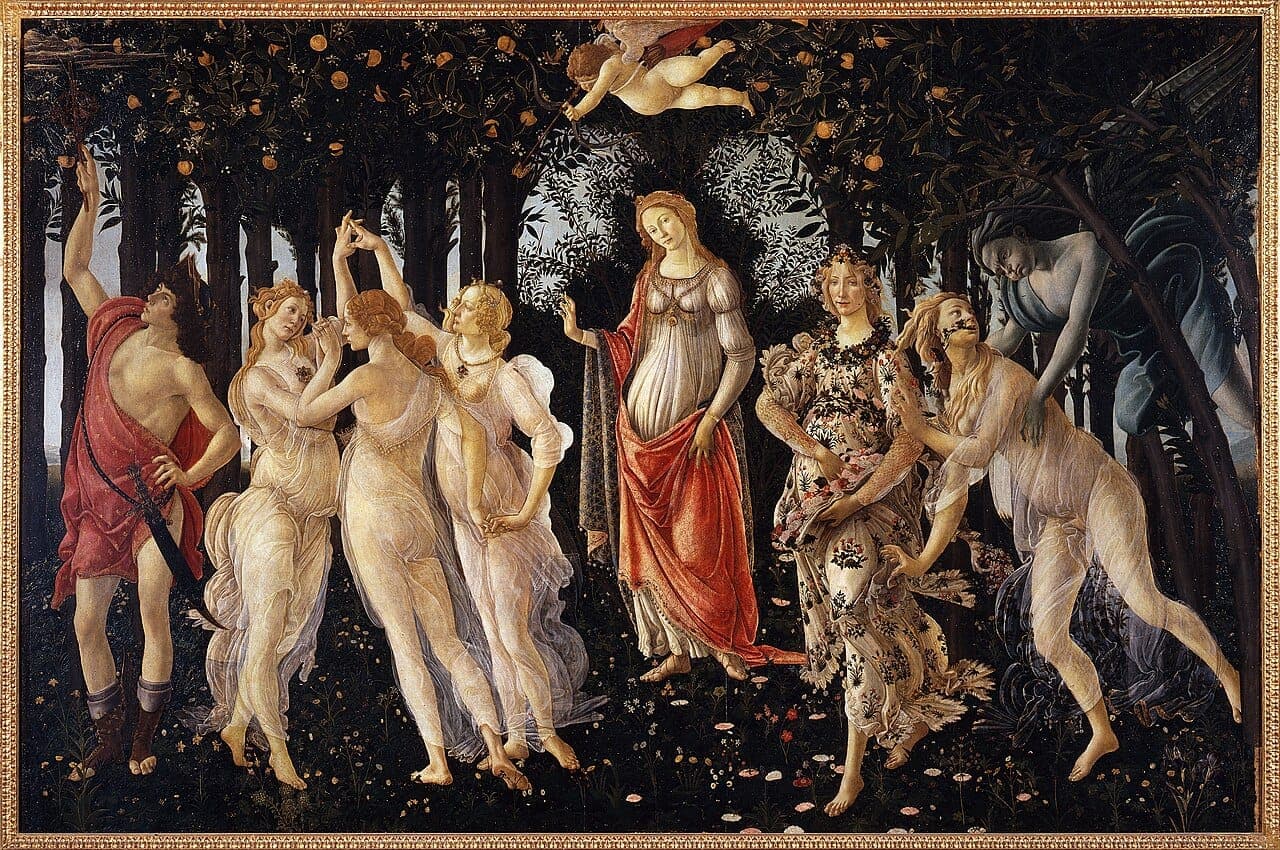
In an orange grove, Venus stands at the centre surrounded by the Three Graces, Mercury, Flora and the west wind Zephyr chasing a nymph. Painted around 1480, Botticelli's Primavera is one of the most beautiful and mysterious paintings of the Renaissance.
In this article
A garden for the Medici
Primavera, meaning "spring", was painted by Sandro Botticelli around 1480 in Florence. It was made for a member of the Medici family, probably Lorenzo di Pierfrancesco de' Medici, a cousin of Lorenzo the Magnificent, and in 1499 it was recorded in his palace in Florence, hanging above a daybed. It is painted in tempera on wooden panels and measures about 2 by 3.1 metres.
The painting shows nine mythological figures in a dark orange grove, on a meadow carpeted with flowers. Historians have identified about 500 plants of nearly 200 species, most of which grow around Florence in spring.
Venus at the centre
In the centre, slightly set back, stands Venus, the goddess of love, in a white dress and a red cloak. The trees behind her open into an arch, framing her like a Madonna in an altarpiece. Above her, her son Cupid flies blindfolded, aiming a flaming arrow at the Three Graces.
 Detail 1

Venus in the orange grove
Venus stands under an arch of dark leaves, her head slightly tilted. Her calm presence presides over the garden.
Detail 2Blindfolded Cupid
Above Venus, Cupid flies with his eyes covered, ready to shoot a fiery arrow. Love, the painting suggests, strikes blindly.
The story on the right
The action begins on the right. Zephyr, the blue-green west wind of spring, bursts through the trees and seizes the nymph Chloris. Flowers spill from her mouth as she turns into Flora, the goddess of flowers, who stands beside her in a dress covered with blossoms, scattering roses. This transformation comes from the Roman poet Ovid's Fasti.
Detail 3Zephyr and Chloris
The blue wind god Zephyr grasps the nymph Chloris. Flowers pour from her mouth as she is transformed into Flora.
Detail 4Flora's flowered dress
Flora, goddess of spring, wears a white dress embroidered with flowers and scatters roses from her lap. Every blossom is a recognisable species.
The Three Graces and Mercury
On the left, the Three Graces dance in a circle in transparent veils, their hands joined above their heads. They represent beauty, chastity and pleasure, or in other readings the qualities of generosity. Beside them, Mercury, the messenger of the gods, raises his staff to disperse the clouds and keep the garden in eternal spring.
Detail 5The Three Graces
The Graces dance in delicate, transparent veils, their fingers interlaced. Their flowing lines are among Botticelli's most beautiful.
What does it mean?
There is no single agreed explanation of Primavera. Some read it as an allegory of spring, from the winds of March on the right to Mercury, the god of May, on the left. Others see it as a Neoplatonic image of love transforming the soul, from passion to beauty to contemplation, as taught by the Florentine philosopher Marsilio Ficino. It may also celebrate a Medici marriage. Its richness is part of its appeal.
Seeing Primavera
Primavera hangs in the Botticelli rooms of the Uffizi Gallery in Florence, alongside The Birth of Venus. Restored in 1982, its colours and flowers can again be seen in detail.
Own a hand-painted copy
Primavera
Painted by hand in oil on canvas, any size. Free worldwide shipping.
From $349 — Make it yours.Frequently asked questions
What does Primavera mean?
Primavera means "spring" in Italian.
Who are the figures in Primavera?
From left to right: Mercury, the Three Graces, Venus with Cupid above, Flora, the nymph Chloris and the west wind Zephyr.
How many flowers are in Primavera?
Botanists have identified about 500 plants of nearly 200 species in the painting.
Where is Primavera?
It is in the Uffizi Gallery in Florence.
Sources and further reading
- Uffizi Galleries, collection notes on Primavera
- Ronald Lightbown, Sandro Botticelli: Life and Work (1989)
- Edgar Wind, Pagan Mysteries in the Renaissance (1958)
