

Listen to this article
0:00 / 3:41 · Read by ArtLogia
Gathered round a table, a band of Cossacks roars with laughter as their scribe writes a reply to the Ottoman Sultan, full of mockery and insults. Ilya Repin worked on the painting for more than a decade, and it became one of the most famous images of Ukrainian Cossack freedom.
In this article
A legendary letter
According to a story told in Ukraine since the seventeenth century, the Ottoman Sultan Mehmed IV demanded that the Zaporozhian Cossacks submit to him. The Cossacks, free warriors who lived beyond the rapids of the Dnieper river, replied with a letter full of rude jokes and insults, mocking the Sultan's grand titles. The authenticity of the letter is uncertain, but the story embodied the Cossack spirit of independence and humour.
Ilya Repin, born in Chuhuiv in Ukraine, heard the story in 1878 and was captivated. He began the painting in 1880 and finished it only in 1891, after travelling to the region of the old Cossack Sich, studying weapons, costumes and faces, and consulting the historian Dmytro Yavornytsky. Tsar Alexander III bought it for 35,000 roubles, then the highest price ever paid for a Russian painting.
The laughter
The painting is above all a study of laughter. Each Cossack laughs in his own way: some throw back their heads and roar, one doubles over holding his belly, another grins with a pipe between his teeth, others smile quietly. Repin wrote that he could hardly sleep while working on it, because the Cossacks' laughter kept ringing in his ears.
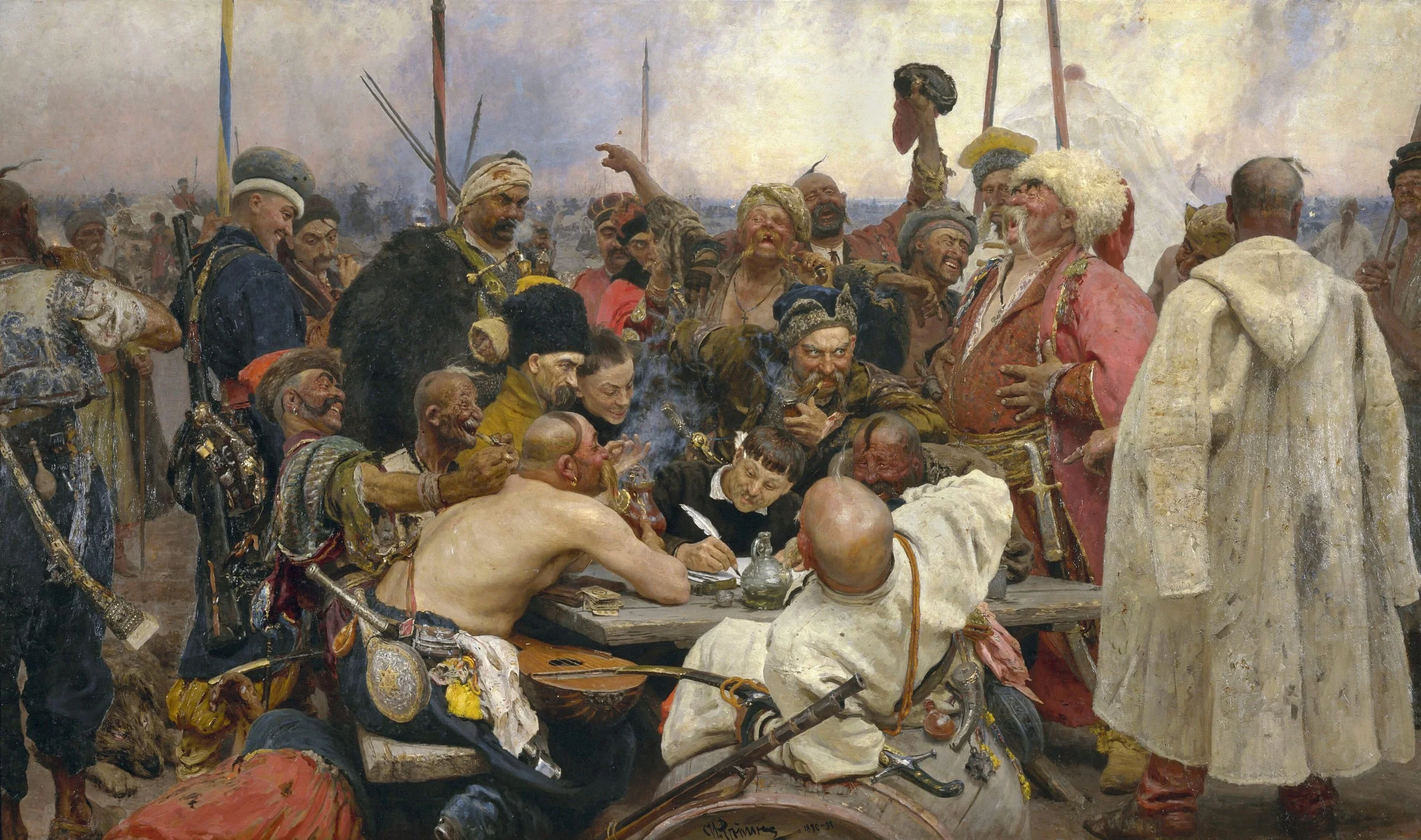 Detail 1
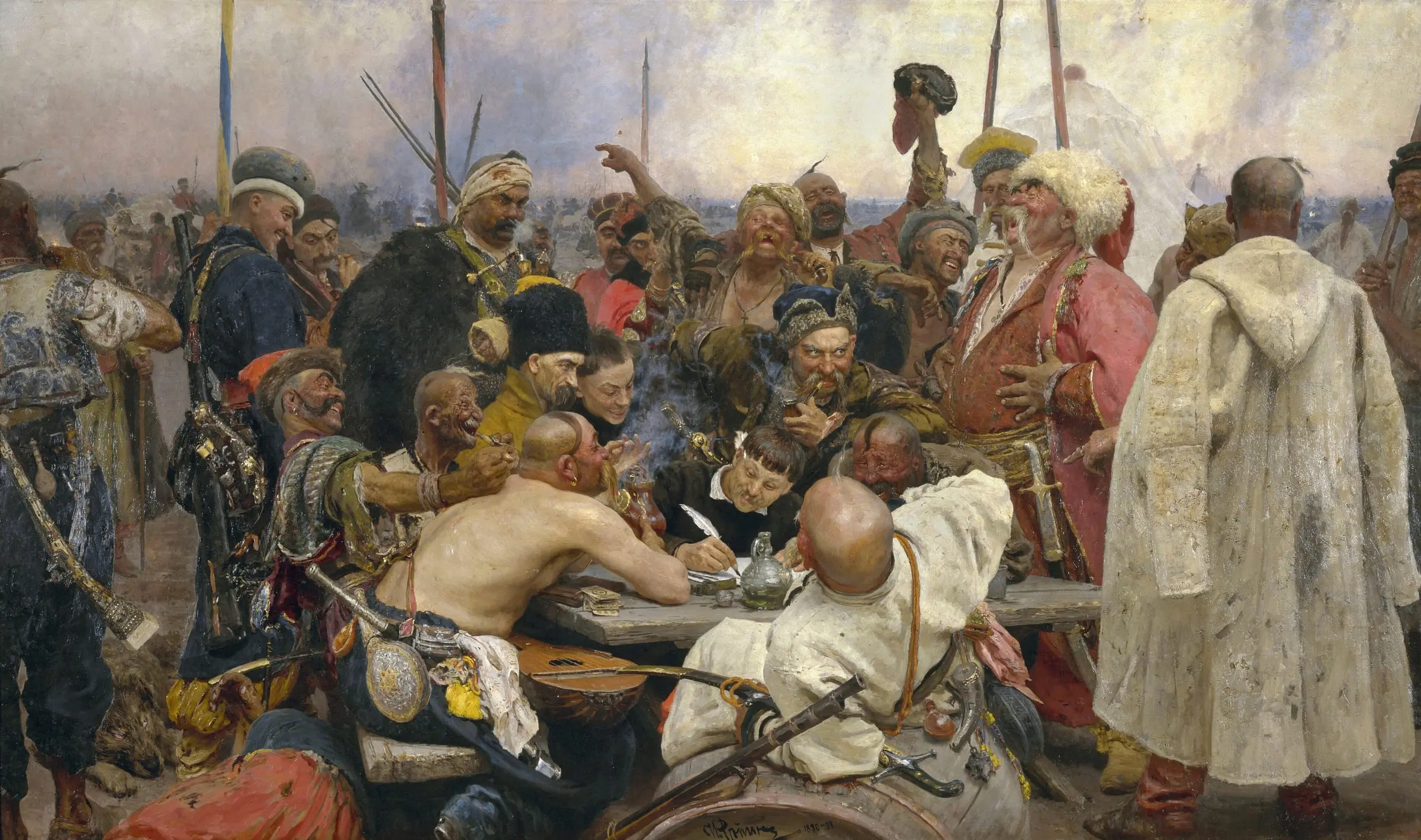
Roaring with laughter
A Cossack in a red coat throws his head back and laughs, holding his sides. Repin studied dozens of faces to capture every kind of laughter.
Ataman Sirko
Near the centre, an older man with a white moustache and a tall fur hat leans over the table with a pipe in his mouth, smiling as he dictates. He is Ivan Sirko, the legendary ataman, or chief, of the Cossacks. Repin used as his model the general Mikhail Dragomirov, a professor of military science. Several other figures were modelled on Repin's friends, including Yavornytsky himself.
Detail 2Ataman Ivan Sirko
The chief, with his white moustache and pipe, grins as he dictates the next insult. His calm smile contrasts with the roaring men around him.
The scribe
At the centre of the table, the scribe writes the letter, pen in hand, looking up with a sly smile as he waits for the next phrase. He is the only literate man in the group, and his neat clothes contrast with the rough costumes around him. On the table lie a bottle, cups and papers.
Detail 3The scribe at work
The scribe pauses with his pen raised, smiling at the latest joke. Everyone else's attention converges on his letter.
A crowd of characters
Around the table, Repin painted a crowd of distinct personalities: a bald Cossack with his back to us, his head shaved except for a single lock of hair, the traditional oseledets; a man with a bandaged head; a young man in a fine coat; and on the right a towering figure in a white cloak. Weapons, banners and lances rise above the heads, and smoke from the pipes drifts through the air.
Detail 4The shaven head
The bald Cossack seen from behind wears the traditional single lock of hair, the oseledets. His bare shoulders and muscular back are painted with great vigour.
Detail 5The man in the white cloak
On the right, a tall Cossack in a long white coat stands apart, a quieter presence beside the laughing crowd.
A national image
For Ukrainians the painting has become a symbol of freedom, courage and humour in the face of a powerful enemy. Repin painted a second, smaller version, now in the Kharkiv Art Museum in Ukraine. The large version, about 2 by 3.6 metres, is in the State Russian Museum in Saint Petersburg.
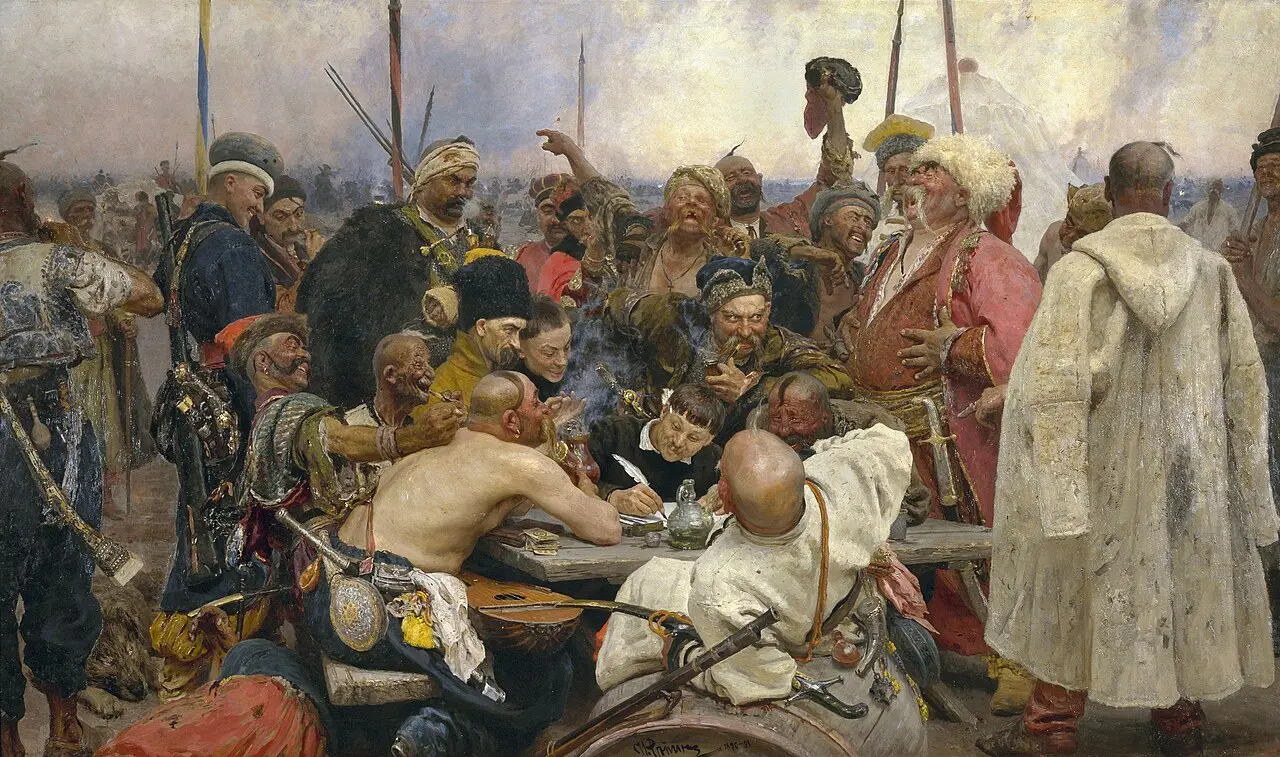
Own a hand-painted copy
Reply of the Zaporozhian Cossacks
Painted by hand in oil on canvas, any size. Free worldwide shipping.
From $299 — Make it yours.Frequently asked questions
What is the story of Reply of the Zaporozhian Cossacks?
It illustrates a legend in which the Zaporozhian Cossacks answered the Ottoman Sultan's demand for submission with a letter full of insults and jokes.
How long did Repin take to paint it?
Repin worked on the painting from 1880 to 1891, more than ten years.
Who is the man with the pipe?
He is the Cossack ataman Ivan Sirko; Repin used General Mikhail Dragomirov as a model.
Where is Reply of the Zaporozhian Cossacks?
The main version is in the State Russian Museum in Saint Petersburg; a second version is in the Kharkiv Art Museum in Ukraine.
Sources and further reading
- State Russian Museum, collection notes on Reply of the Zaporozhian Cossacks
- Elizabeth Kridl Valkenier, Ilya Repin and the World of Russian Art (1990)
- Dmytro Yavornytsky, History of the Zaporozhian Cossacks
