Listen to this article
0:00 / 4:11 · Read by ArtLogia
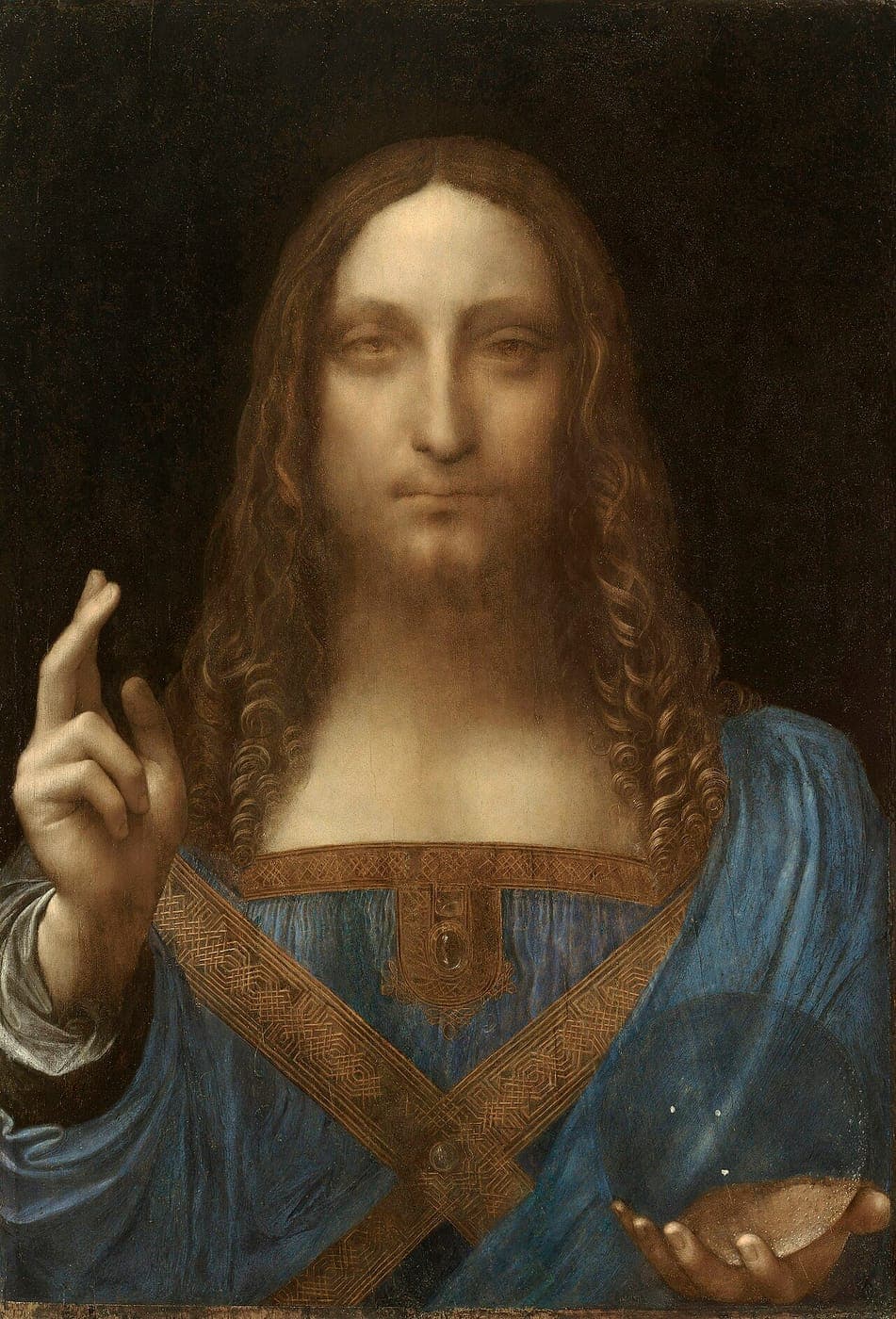
Christ raises his right hand in blessing and holds a crystal orb in his left. Attributed to Leonardo da Vinci, the Salvator Mundi sold in 2017 for 450 million dollars, the highest price ever paid for a painting, and it has not been seen in public since.
In this article
Christ, Saviour of the World
Salvator Mundi means "Saviour of the World". The subject was popular in Northern Europe and Italy around 1500: Christ is shown from the waist up, facing the viewer, blessing with his right hand and holding in his left a globe, symbol of the world he rules and redeems. Leonardo da Vinci is known to have worked on this subject; drawings of the drapery in the Royal Collection at Windsor are accepted as his studies for a Salvator Mundi.
The painting known today was probably made in the early 1500s in Milan or Florence. It is painted in oil on a walnut panel, about 65 by 45 centimetres.
A painting lost and found
The work is thought to have belonged to King Charles I of England in the seventeenth century, and later disappeared from view. By the twentieth century it was heavily overpainted and attributed to a follower of Leonardo; in 1958 it sold at auction in London for just 45 pounds. In 2005 it was bought by American dealers at a small auction in New Orleans. After a long restoration by Dianne Modestini in New York, it was shown in 2011 in the National Gallery's exhibition of Leonardo's Milanese works, presented as an original Leonardo.
The debate over attribution
Not all experts agree that the painting is by Leonardo himself. Some, including Martin Kemp, consider it a genuine work by the master. Others believe it was largely painted by members of his workshop, such as Giovanni Antonio Boltraffio, with Leonardo contributing to parts. The panel was badly damaged and heavily restored, which makes judgement difficult. The Louvre did not include it in its great Leonardo exhibition of 2019–2020.
The face
Christ's face is painted with very soft transitions of light and shadow in the manner of Leonardo's sfumato. His eyes look directly at us, slightly unfocused, and his curling hair falls to his shoulders. The face is among the most restored parts of the panel, which is one reason for the debate.
 Detail 1

The face of Christ
Soft, smoky modelling and a direct gaze give the face its mysterious presence. The curls of hair are among the best preserved and most admired passages.
The blessing hand
Christ's right hand is raised in blessing, two fingers extended. It stands forward from the body, and its convincing three-dimensional modelling is one of the arguments for Leonardo's involvement. Infrared images revealed that the position of the thumb was changed during painting, a sign that the artist was working out the composition rather than copying.
Detail 2The blessing hand
The raised hand seems to project out of the picture towards us. Changes in the thumb's position, visible in infrared, show the painter rethinking the pose.
The crystal orb
In his left hand Christ holds a transparent crystal sphere with small bright inclusions. Critics have pointed out that a solid glass globe would distort and invert what lies behind it, while here the drapery seen through it is not distorted. Defenders reply that Leonardo may have chosen not to show the distortion, so as not to deform Christ's body.
Detail 3The crystal orb
The clear orb has tiny sparkling inclusions. The absence of optical distortion behind it is one of the most discussed details of the painting.
The embroidered garment
Christ wears a blue robe with a richly embroidered band crossing his chest, decorated with knot patterns. Leonardo was fascinated by such interlaced knots, which appear in his designs and in the ceiling of the Sala delle Asse in Milan.
Detail 4Knotwork embroidery
The crossing bands of embroidery are decorated with interlaced patterns, a motif Leonardo loved and used in other works.
The record sale
In November 2017 the painting was sold at Christie's in New York for 450.3 million dollars including fees, the highest price ever paid for a work of art. The buyer was reported to be acting for Saudi Crown Prince Mohammed bin Salman. It was expected to be shown at the Louvre Abu Dhabi, but the unveiling was postponed, and the painting has not been exhibited publicly since the sale.
Own a hand-painted copy
Salvator Mundi
Painted by hand in oil on canvas, any size. Free worldwide shipping.
From $299 — Make it yours.Frequently asked questions
What does Salvator Mundi mean?
Salvator Mundi is Latin for "Saviour of the World", a traditional image of Christ blessing and holding a globe.
Is the Salvator Mundi really by Leonardo da Vinci?
Some experts accept it as Leonardo's work; others think it was painted largely by his workshop. The attribution remains debated.
How much did the Salvator Mundi sell for?
It sold at Christie's in New York in 2017 for 450.3 million dollars, a world record for a painting.
Where is the Salvator Mundi now?
It is in a private collection and has not been publicly exhibited since its sale in 2017.
Sources and further reading
- Christie's, Salvator Mundi sale catalogue (2017)
- Ben Lewis, The Last Leonardo (2019)
- Martin Kemp, Leonardo's Salvator Mundi and the Collecting of Leonardo in the Stuart Courts (2019)
