Listen to this article
0:00 / 3:26 · Read by ArtLogia
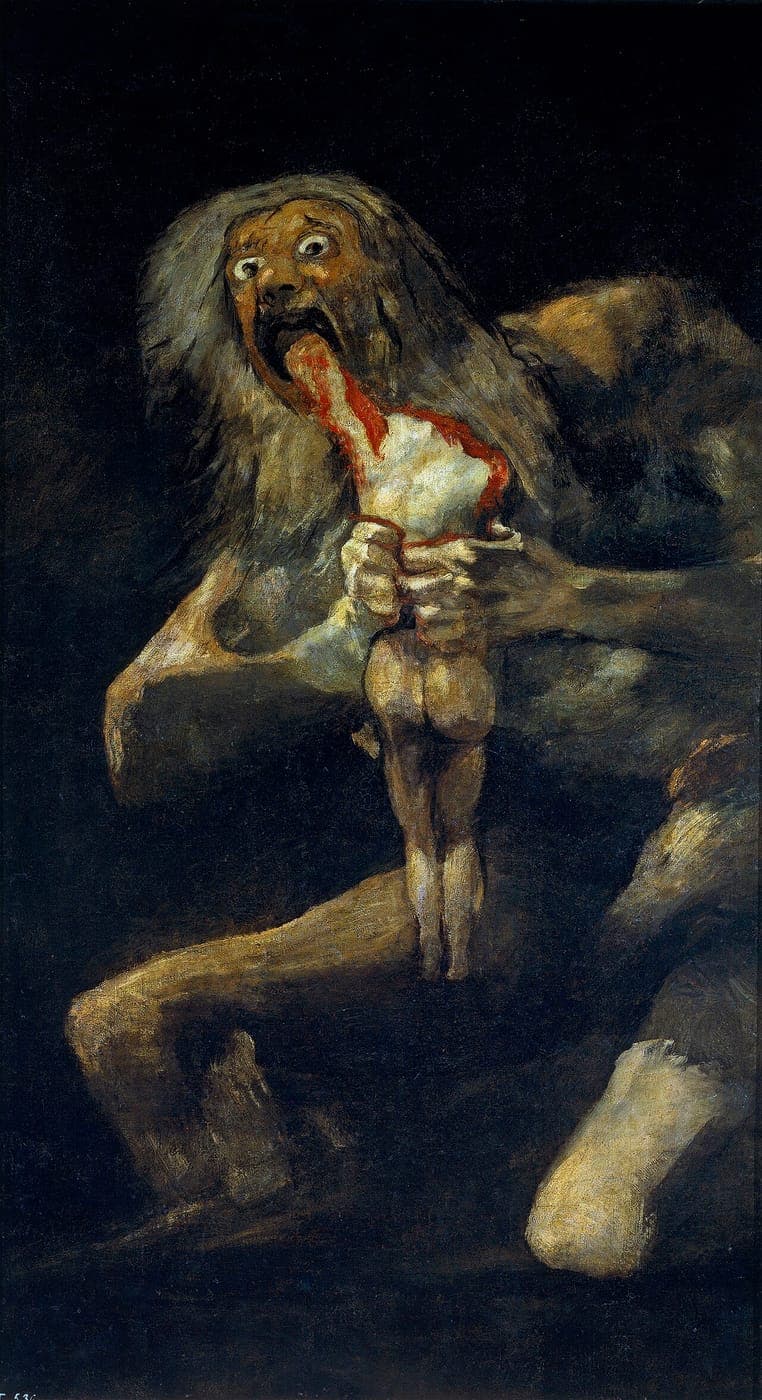
A wild-eyed giant tears at the body of one of his children in the darkness. Francisco Goya painted Saturn Devouring His Son directly on the wall of his house outside Madrid around 1820–1823, as part of the Black Paintings that he never intended to show.
In this article
The house of the deaf man
In 1819 Francisco Goya, now in his seventies and completely deaf after an illness in 1792, bought a country house on the banks of the Manzanares river outside Madrid. It became known as the Quinta del Sordo, the House of the Deaf Man, after a previous owner who was also deaf. Between about 1820 and 1823, Goya covered the walls of two rooms with fourteen dark, haunting images painted in oil directly on the plaster. They are known as the Black Paintings.
Goya never titled them, never spoke about them and never meant them for the public. Saturn Devouring His Son hung in the ground-floor dining room.
The myth of Saturn
In Greek mythology, Cronus, called Saturn by the Romans, was warned that one of his children would overthrow him, as he had overthrown his own father. To prevent this, he ate each child at birth. Only Zeus escaped, saved by his mother, and eventually fulfilled the prophecy. The myth had been painted before, notably by Rubens, whose version Goya knew from the royal collection.
The eyes
Goya's Saturn is not a classical god but a monstrous, half-mad giant emerging from the darkness. His eyes are wide open, bulging, staring in what seems to be terror or madness rather than triumph. It is as if he is horrified by what he is doing but cannot stop.
 Detail 1

Wild, staring eyes
Saturn's eyes bulge with horror and frenzy. He seems as frightened as he is frightening.
The hands
Saturn's huge hands grip the body of his child so hard that his fingers dig into the flesh. The body is that of an adult rather than a baby, and some have noted it may be female. The gripping hands are painted with rough, violent strokes that express the intensity of the act.
Detail 2The gripping hands
Saturn's fingers dig into the pale body he holds. The brushwork is rough and urgent, matching the violence of the scene.
Darkness all around
The figure seems to crouch or kneel in total blackness, his body lit from one side. There is no setting, no landscape, only darkness. The palette of the Black Paintings, blacks, browns, ochres and greys, is unlike anything else in art of the time.
Detail 3A body in the dark
Saturn's knee and leg emerge from the black background. Light falls on the figure from the side, leaving everything else in shadow.
What does it mean?
Many interpretations have been proposed. Saturn has long been a symbol of time, which devours everything it creates. The painting has been read as an image of Spain devouring its own children in war and revolution, of the destructive power of old age, of the fear of death, or of Goya's own despair after years of war, illness and political repression. Goya left no explanation, and the painting's power lies partly in its mystery.
From wall to museum
In 1874 the house's new owner, Baron Émile d'Erlanger, had the Black Paintings transferred from the walls to canvas, a difficult operation that damaged them in places. He exhibited them in Paris in 1878, then gave them to the Spanish state. Since 1889 they have been in the Museo del Prado in Madrid, where they are displayed together in a room evoking the house. Saturn measures about 1.43 by 0.81 metres.
Own a hand-painted copy
Saturn Devouring His Son
Painted by hand in oil on canvas, any size. Free worldwide shipping.
From $299 — Make it yours.Frequently asked questions
What are Goya's Black Paintings?
They are fourteen dark paintings Goya painted directly on the walls of his house, the Quinta del Sordo, around 1820–1823.
What is the story of Saturn Devouring His Son?
In mythology, Saturn (Cronus) ate his children to prevent the prophecy that one of them would overthrow him.
Did Goya intend the painting to be seen?
No. He painted it on the wall of his own dining room and never exhibited or titled it.
Where is Saturn Devouring His Son?
It is in the Museo del Prado in Madrid, with the other Black Paintings.
Sources and further reading
- Museo del Prado, collection notes on Saturn and the Black Paintings
- Nigel Glendinning, "The Strange Translation of Goya's Black Paintings", Burlington Magazine (1975)
- Robert Hughes, Goya (2003)
