Listen to this article
0:00 / 3:03 · Read by ArtLogia
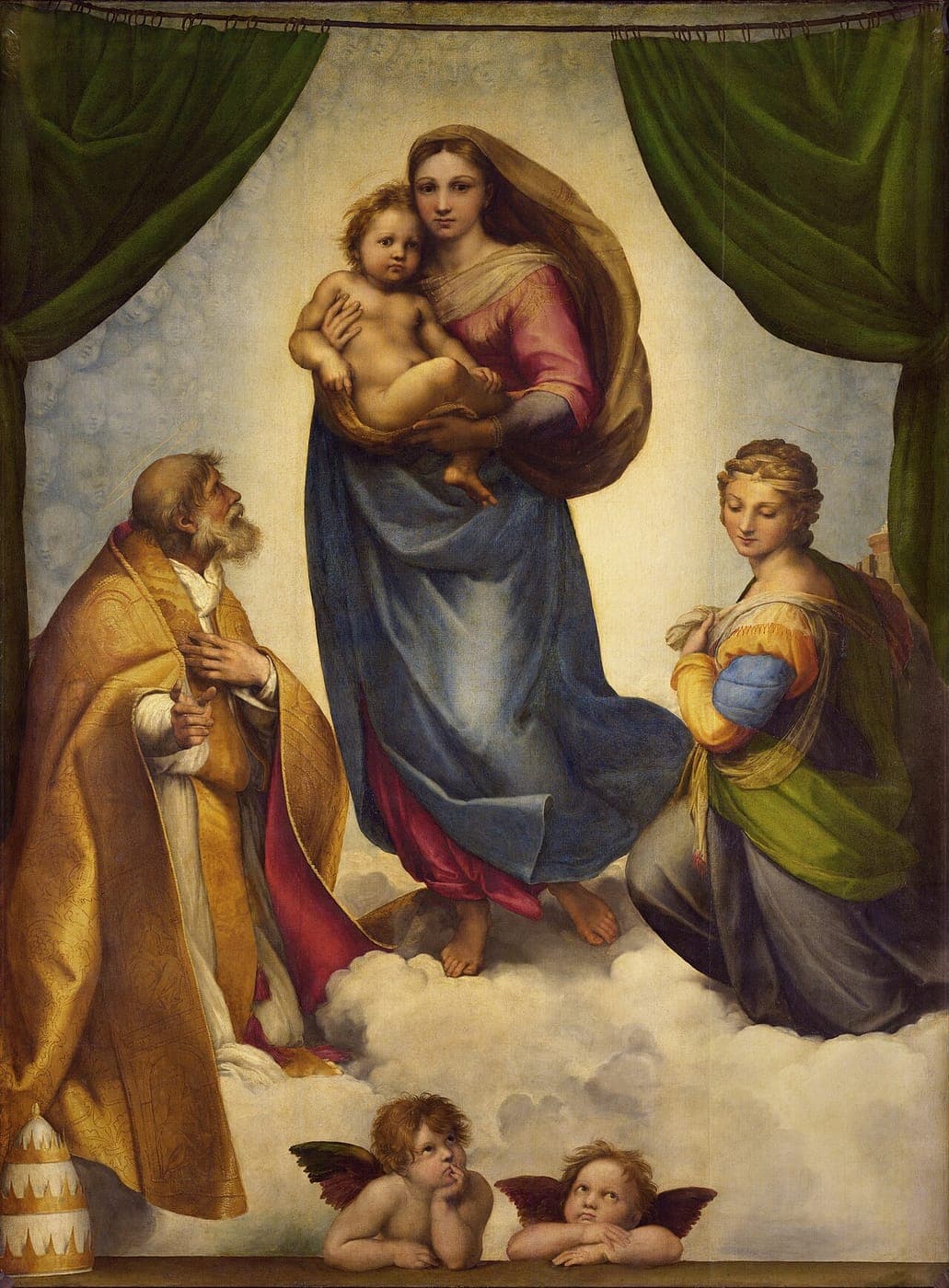
The Virgin Mary steps forward on the clouds holding the infant Christ, between a green curtain drawn open, with Pope Sixtus and Saint Barbara on either side and two dreamy cherubs leaning on a ledge below. Painted around 1512, Raphael's Sistine Madonna has moved visitors to Dresden for centuries.
In this article
An altarpiece for Piacenza
Around 1512 Pope Julius II commissioned Raphael to paint an altarpiece for the church of the Benedictine monastery of San Sisto in Piacenza, in northern Italy. The pope's family, the della Rovere, venerated Saint Sixtus, an early pope and martyr, and the city had recently come under papal rule. The painting is named after him: the Sistine Madonna, the Madonna of Saint Sixtus.
In 1754 the monks sold it to Augustus III, Elector of Saxony and King of Poland, for an enormous sum. Its arrival in Dresden was celebrated, and the king is said to have moved his throne to make room for it.
The Virgin on the clouds
At the centre, the Virgin Mary walks barefoot on the clouds towards the viewer, holding the infant Christ in her arms. A green curtain has just been drawn aside, as if revealing a vision. Her face is calm but serious, and both she and the child look out at us with grave, wide eyes, as if they already foresee the Passion.
 Detail 1

Mother and child
Mary and the infant Christ look out with solemn, wide-eyed expressions. Their gaze seems to see the future sacrifice of the child.
Pope Sixtus
On the left kneels Pope Sixtus II, wearing a golden cope, his papal tiara set on the ledge beside him. He looks up at the Virgin and points out towards the viewer, as if presenting the faithful to her. His features are often thought to resemble Julius II, Raphael's patron.
Detail 2Saint Sixtus pointing
The kneeling pope gestures towards us, interceding for the faithful. His golden cope is painted with rich, warm light.
Saint Barbara
On the right, Saint Barbara kneels and turns her eyes downward, towards the cherubs and the world below. She was a patron saint of Piacenza and the protector against sudden death. Her graceful pose balances that of Sixtus, completing a triangle around the Virgin.
Detail 3Saint Barbara
The saint gazes down with gentle modesty. Her pose and lowered eyes balance the upward look of Saint Sixtus.
The two cherubs
At the bottom of the painting, two little winged angels lean on the ledge, gazing upward with bored or dreamy expressions, chins on their hands. They are the most famous detail of the painting, reproduced endlessly on postcards, chocolates, umbrellas and stamps since the nineteenth century, often without the rest of the picture.
Detail 4The dreamy cherubs
Two small angels lean on the ledge, looking up with daydreaming expressions. They have become one of the most reproduced images in the world.
A painting that survived the war
During the Second World War the painting was hidden in a tunnel outside Dresden and escaped the bombing of the city in February 1945. Found by the Soviet army, it was taken to Moscow, then returned to Dresden in 1955. The painting, about 2.7 by 2 metres, hangs in the Gemäldegalerie Alte Meister in the Zwinger in Dresden.
Own a hand-painted copy
Sistine Madonna
Painted by hand in oil on canvas, any size. Free worldwide shipping.
From $299 — Make it yours.Frequently asked questions
Why is it called the Sistine Madonna?
It was painted for the church of San Sisto (Saint Sixtus) in Piacenza, and Saint Sixtus appears in the painting.
Who are the two angels at the bottom?
They are two cherubs leaning on the ledge, the most famous detail of the painting, reproduced countless times.
When was the Sistine Madonna painted?
Raphael painted it around 1512.
Where is the Sistine Madonna?
It is in the Gemäldegalerie Alte Meister in Dresden, Germany.
Sources and further reading
- Gemäldegalerie Alte Meister, Dresden, collection notes on the Sistine Madonna
- Andreas Henning (ed.), Raphael: The Sistine Madonna (Dresden, 2012)
- Johann Joachim Winckelmann, Thoughts on the Imitation of Greek Works (1755)
