Listen to this article
0:00 / 3:38 · Read by ArtLogia
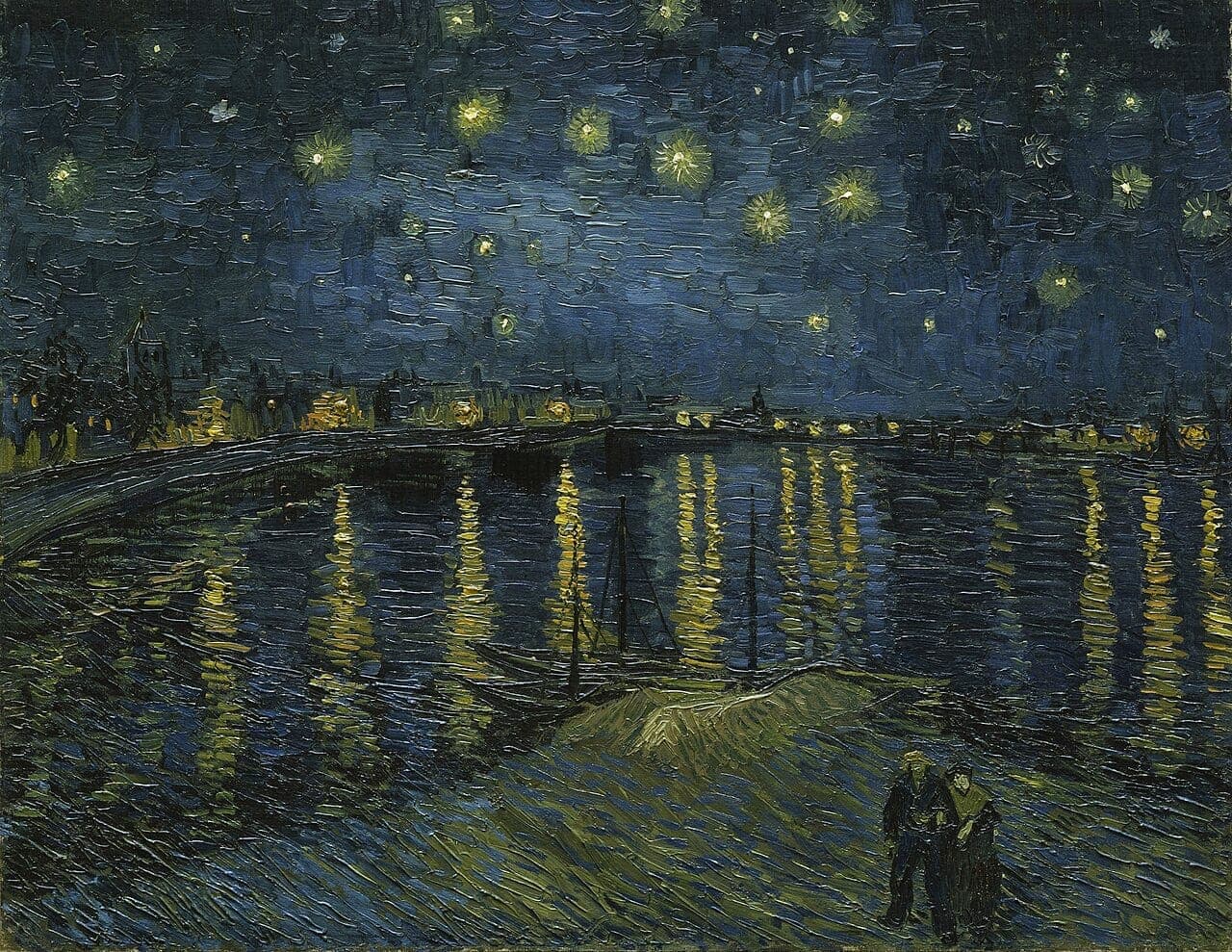
The stars of the Great Bear sparkle over the river Rhône, the gas lights of Arles shine in golden streaks on the water, and a couple walks along the bank. Painted in September 1888, this was Van Gogh's first starry night, painted on the spot, nine months before The Starry Night.
In this article
Painting at night by the river
In September 1888, a few days after painting Café Terrace at Night, Vincent van Gogh set up his easel on the bank of the Rhône in Arles, a few minutes' walk from the Yellow House where he lived. He wanted to paint the night sky directly, by the light of the gas lamps along the quay. He wrote to his brother Theo about the blue-green sky, the Great Bear sparkling in green and pink, and the orange gaslights reflected in the water.
The stars
Above the river, the seven stars of the Great Bear, or Plough, shine against a deep blue sky. Van Gogh painted each star as a small burst of white, yellow and green, with rays radiating outward. Unlike the swirling sky of The Starry Night, painted from memory nine months later, this sky is calm and spacious, close to what he actually saw.
 Detail 1

The Great Bear
The seven stars of the Great Bear sparkle in small bursts of yellow and white. Van Gogh painted them as he saw them from the riverbank.
Gaslight on the water
Across the river, the gas lamps of Arles glow orange and yellow, and their reflections stretch down into the dark water in long, rippling streaks. Gas lighting was still a modern wonder, and Van Gogh was fascinated by the way artificial light competed with the light of the stars.
Detail 2Reflections of the gaslights
The lights of Arles stretch into the river in long streaks of orange and yellow. Each reflection is painted with thick, broken strokes.
The boats
In the lower part of the painting, small boats are moored at the riverbank, painted in blue and green with a few strokes. They anchor the scene in the everyday life of the river port.
Detail 3Boats at the bank
Two small boats rest by the shore, their shapes outlined in blue against the dark water.
The couple
In the lower right corner, a man and a woman walk arm in arm along the riverbank. They are tiny compared with the vast sky and river, but they bring a human, tender note to the scene. Van Gogh often dreamed of love and companionship, which he never found.
Detail 4A couple on the riverbank
Two lovers stroll arm in arm along the quay, small figures beneath the immense night sky.
A painting for an exhibition
Van Gogh sent the painting to Paris, and in 1889 it was shown at the Salon des Indépendants, one of the few times his work was exhibited publicly during his lifetime. Today it measures about 72.5 by 92 centimetres and hangs in the Musée d'Orsay in Paris, in the galleries of Post-Impressionism.
How Van Gogh painted the night
Painting at night was a challenge in 1888. Van Gogh worked by the light of the gas lamps on the quay, and he had to judge his colours in near darkness. He laid the paint on thickly, with short, directional strokes, so that the stars and reflections stand out in relief from the canvas. The deep blue sky is not a flat field: it is built from many shades of ultramarine, cobalt and Prussian blue, with touches of green near the horizon. The contrast between the cool blues and the warm yellows of the gaslight is the engine of the painting. This experiment in Arles prepared the way for The Starry Night, painted from memory the following year, and for the night skies that have become inseparable from his name.
Own a hand-painted copy
Starry Night Over the Rhône
Painted by hand in oil on canvas, any size. Free worldwide shipping.
From $299 — Make it yours.Frequently asked questions
Where was Starry Night Over the Rhône painted?
It was painted on the bank of the Rhône in Arles, in the south of France, in September 1888.
What stars are in Starry Night Over the Rhône?
The seven stars of the Great Bear (the Plough or Big Dipper) shine over the river.
Is it the same as The Starry Night?
No. Starry Night Over the Rhône was painted on the spot in Arles in 1888; The Starry Night was painted from memory in Saint-Rémy in 1889.
Where is Starry Night Over the Rhône?
It is in the Musée d'Orsay in Paris.
Sources and further reading
- Musée d'Orsay, collection notes on Starry Night Over the Rhône
- Vincent van Gogh, letters to Theo van Gogh and Eugène Boch, September 1888
- Van Gogh Museum letters edition
