

Listen to this article
0:00 / 3:19 · Read by ArtLogia
A famous surgeon lifts the muscles of a dead man's forearm with forceps while seven men lean in to watch. Painted in 1632, when Rembrandt was just 26, The Anatomy Lesson turned a group portrait into a drama of knowledge.
In this article
A public anatomy lesson
In seventeenth-century Amsterdam, the Guild of Surgeons held one public anatomy lesson a year, in winter, when the cold slowed decomposition. The body was that of an executed criminal, and the lesson was a social event attended by guild members, students and paying spectators.
On 31 January 1632 the lesson was given by Dr Nicolaes Tulp, the official anatomist of the city. Several members of the guild commissioned the young Rembrandt van Rijn, who had just moved to Amsterdam from Leiden, to paint a group portrait to commemorate it. The result made him the most sought-after portrait painter in the city.
Dr Tulp
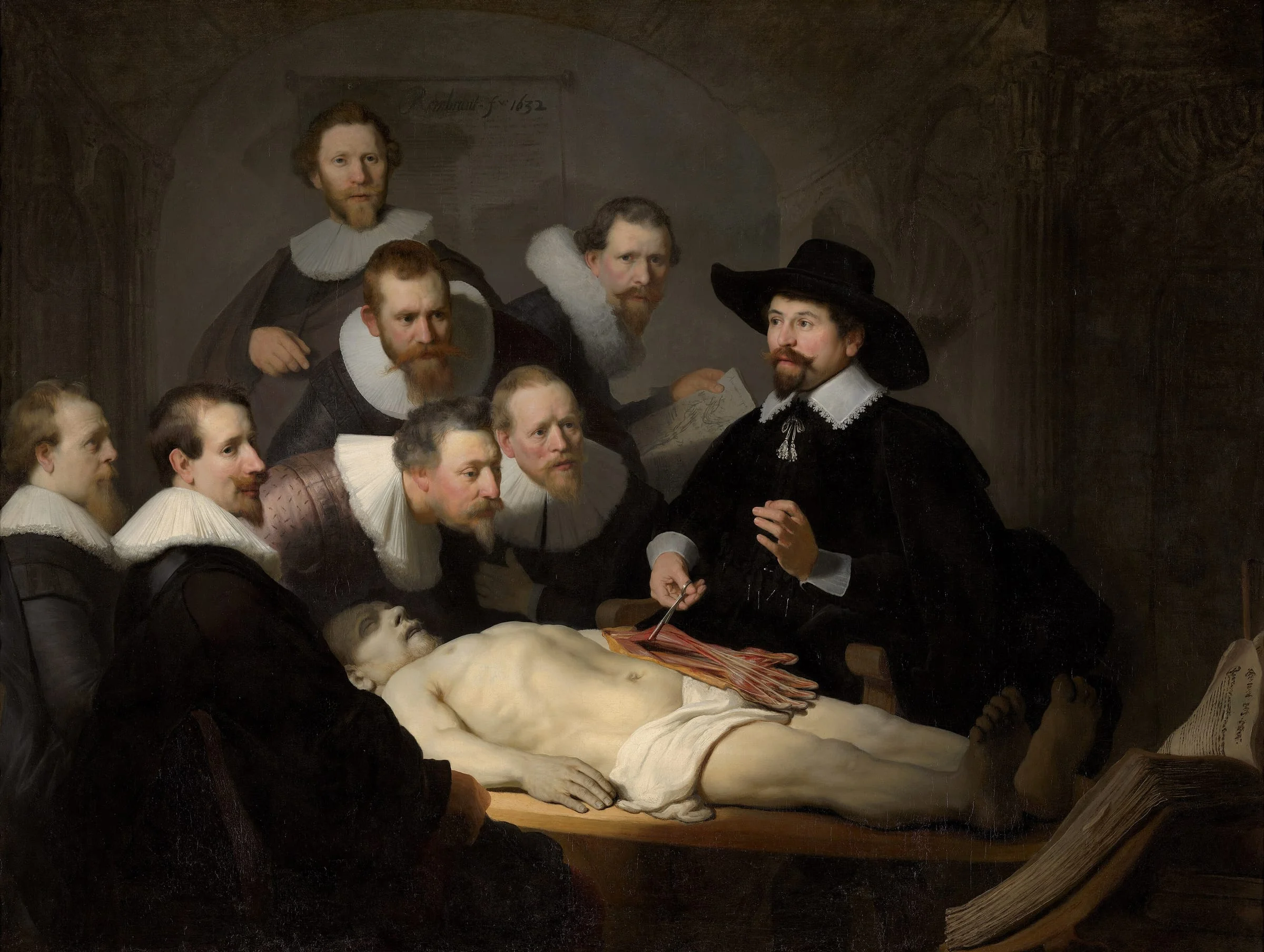
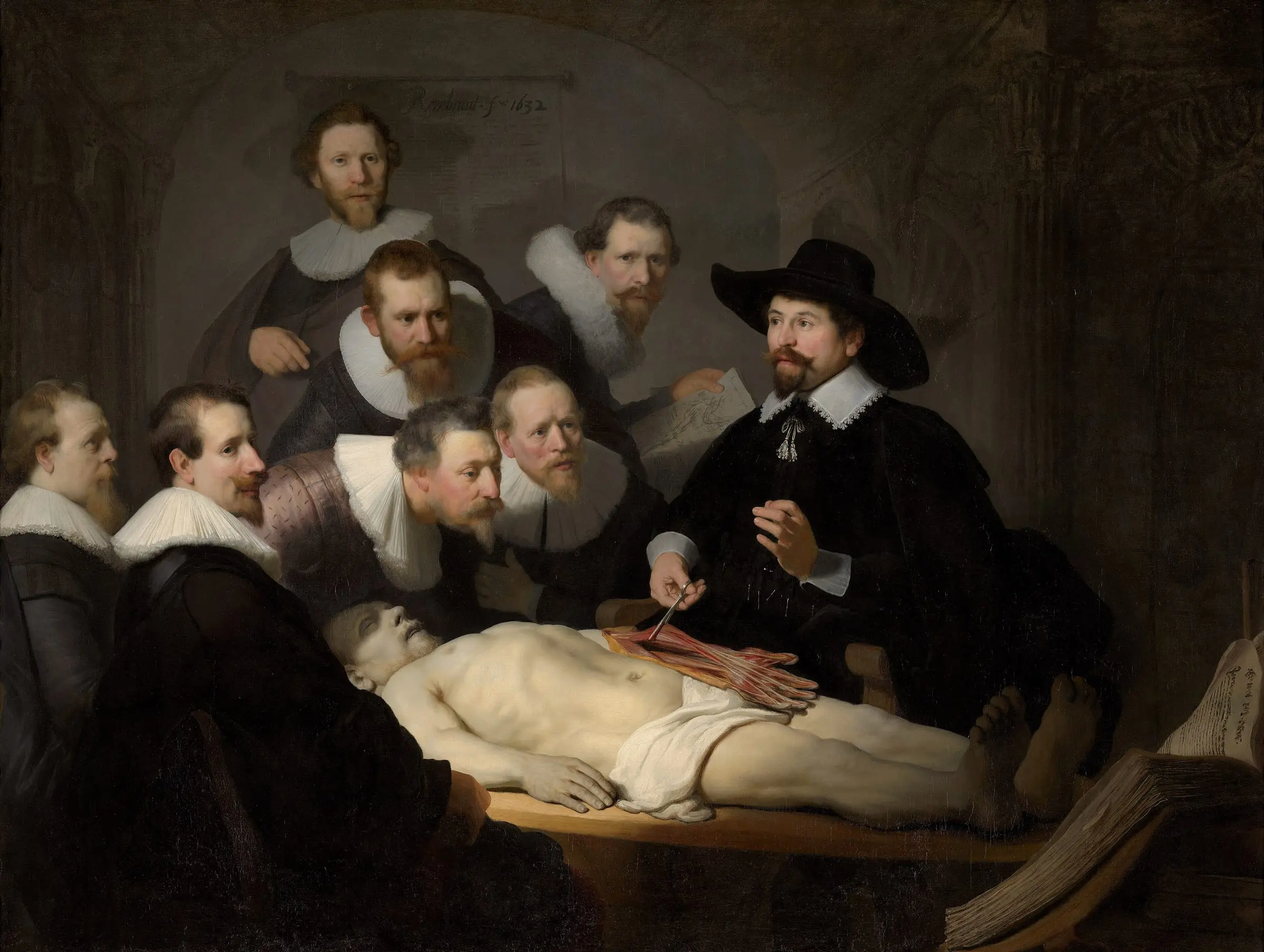
Tulp sits on the right in a black gown and a broad-brimmed hat, the only figure wearing a hat, which marks his authority. With forceps in his right hand he lifts the flexor muscles of the dead man's forearm, while with his left hand he demonstrates the movement they produce: the bending of the fingers. He is explaining how the hand works, the hand that was considered the instrument of the intellect.
 Detail 1
Dr Tulp
The anatomist wears a hat as a sign of his rank. He turns to his audience as he lectures, calm and authoritative.
Detail 2The demonstrating hand
Tulp's left hand mimics the action of the muscles he is showing, curling the fingers as the tendons would. Knowledge and gesture meet in one movement.
The dissected arm
The painting shows the dissection beginning with the arm, though real lessons usually began with the abdomen, whose organs decayed first. Rembrandt probably chose the arm for its symbolic value, and because it allowed a dramatic central focus. The anatomy is painted with great precision, though a few details, such as the origin of the muscles, are not quite correct; Rembrandt may have based it partly on anatomical books.
Detail 3The open forearm
Tulp's forceps lift the red muscles and tendons of the forearm. The dissection is the bright focus of the composition, lit against the pale body.
The audience
Seven surgeons lean in around the body, each turning in a different direction. Some look at the arm, some at the open book at the foot of the corpse, some out at the viewer. Rembrandt broke the stiff rows of earlier group portraits and arranged the men in a pyramid of attention, unified by the light that falls on their faces and white collars. The names of the men are written on a sheet of paper held by the man at the top.
Detail 4Faces of attention
The surgeons lean forward with intense curiosity, their faces lit from above. Each one reacts differently, giving the group the life of a real scene.
The dead man
The corpse is that of Aris Kindt, a petty criminal from Leiden whose real name was Adriaan Adriaanszoon, hanged for armed robbery the same day as the lesson. His body lies diagonally across the foreground, pale and heavy, his face half in shadow. Rembrandt painted death with a sober realism that contrasts with the lively faces above.
Seeing the Anatomy Lesson
The painting measures about 1.7 by 2.2 metres and hangs in the Mauritshuis in The Hague, which acquired it in 1828.
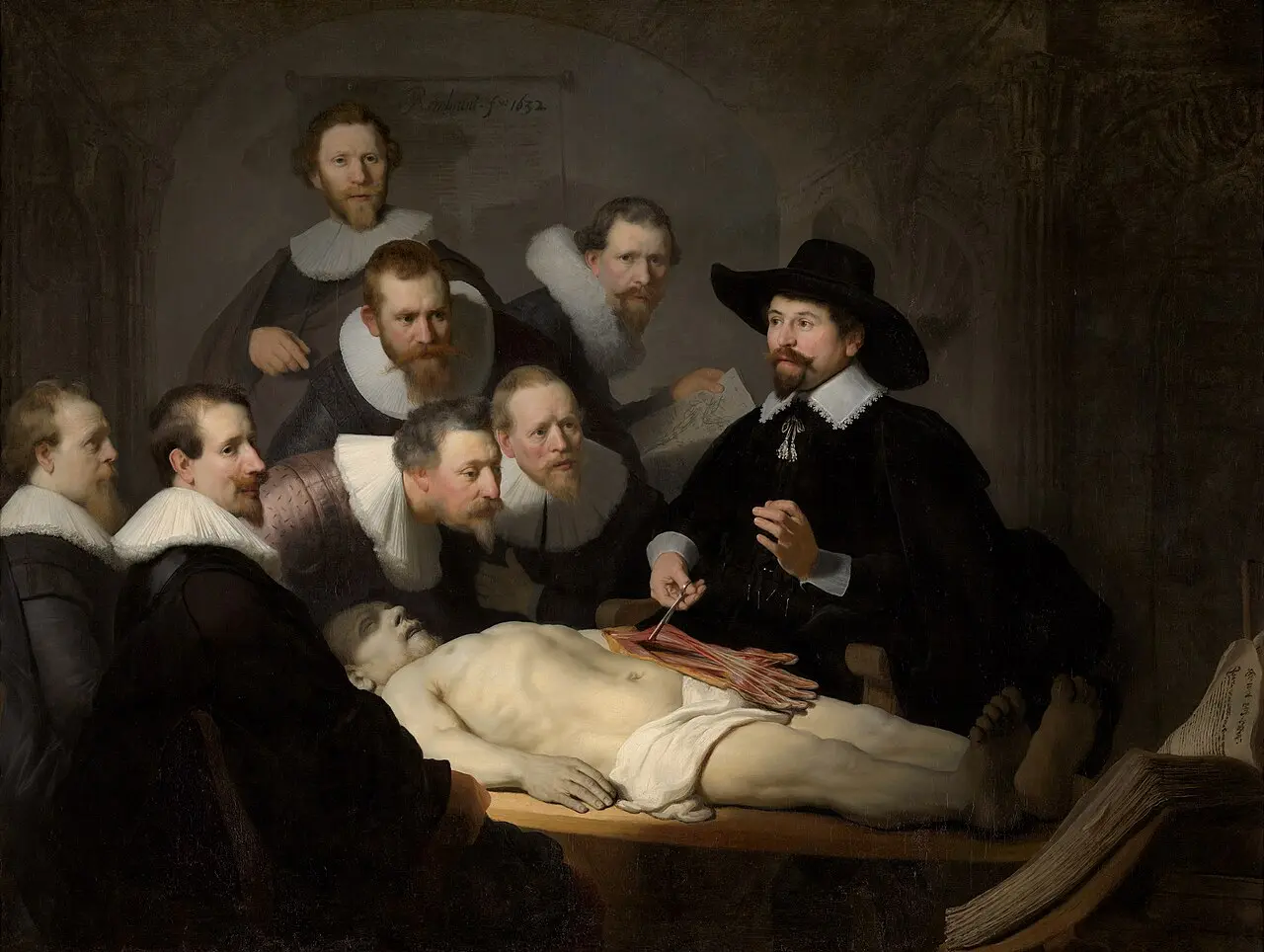
Own a hand-painted copy
The Anatomy Lesson of Dr. Nicolaes Tulp
Painted by hand in oil on canvas, any size. Free worldwide shipping.
From $299 — Make it yours.Frequently asked questions
Who is Dr Tulp?
Nicolaes Tulp (1593–1674) was the official anatomist of the Amsterdam Guild of Surgeons, and later mayor of Amsterdam.
Whose body is being dissected?
The corpse is that of Aris Kindt (Adriaan Adriaanszoon), a criminal executed in Amsterdam on 31 January 1632.
How old was Rembrandt when he painted it?
Rembrandt was 26 years old in 1632.
Where is The Anatomy Lesson of Dr. Nicolaes Tulp?
It is in the Mauritshuis in The Hague, the Netherlands.
Sources and further reading
- Mauritshuis, collection notes on The Anatomy Lesson of Dr. Nicolaes Tulp
- William S. Heckscher, Rembrandt's Anatomy of Dr. Nicolaas Tulp (1958)
- Mauritshuis, technical research on the painting
