

Listen to this article
0:00 / 3:29 · Read by ArtLogia
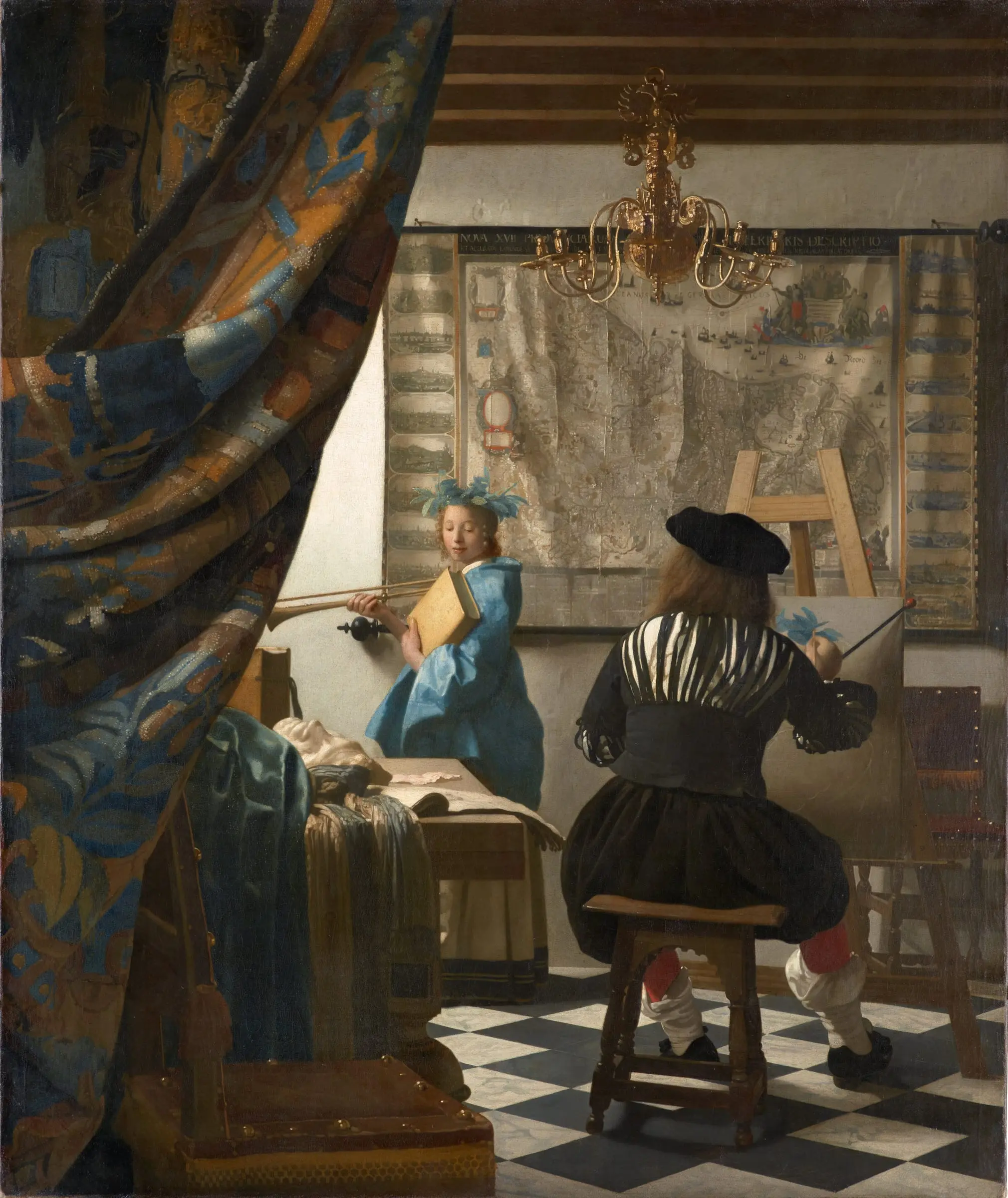
A curtain is pulled aside to reveal a painter at his easel, seen from behind, painting a young woman dressed as Clio, the muse of history, in front of a great map of the Netherlands. Vermeer kept The Art of Painting until his death, and his widow fought to keep it.
In this article
A painting about painting
The Art of Painting, also known as The Allegory of Painting, was painted by Johannes Vermeer around 1666–1668. It was not made for a client: Vermeer kept it in his house for the rest of his life. After his death in 1675, his widow Catharina Bolnes, deeply in debt, tried to keep it from creditors by transferring it to her mother, but it was eventually sold.
The painting is both a scene in a studio and an allegory: a statement about the art of painting itself, its history and its glory.
The curtain
On the left, a heavy tapestry curtain is drawn back, as if revealing a scene in a theatre. The device invites us into the studio and also reminds us that what we see is a staged image, an illusion created by the painter.
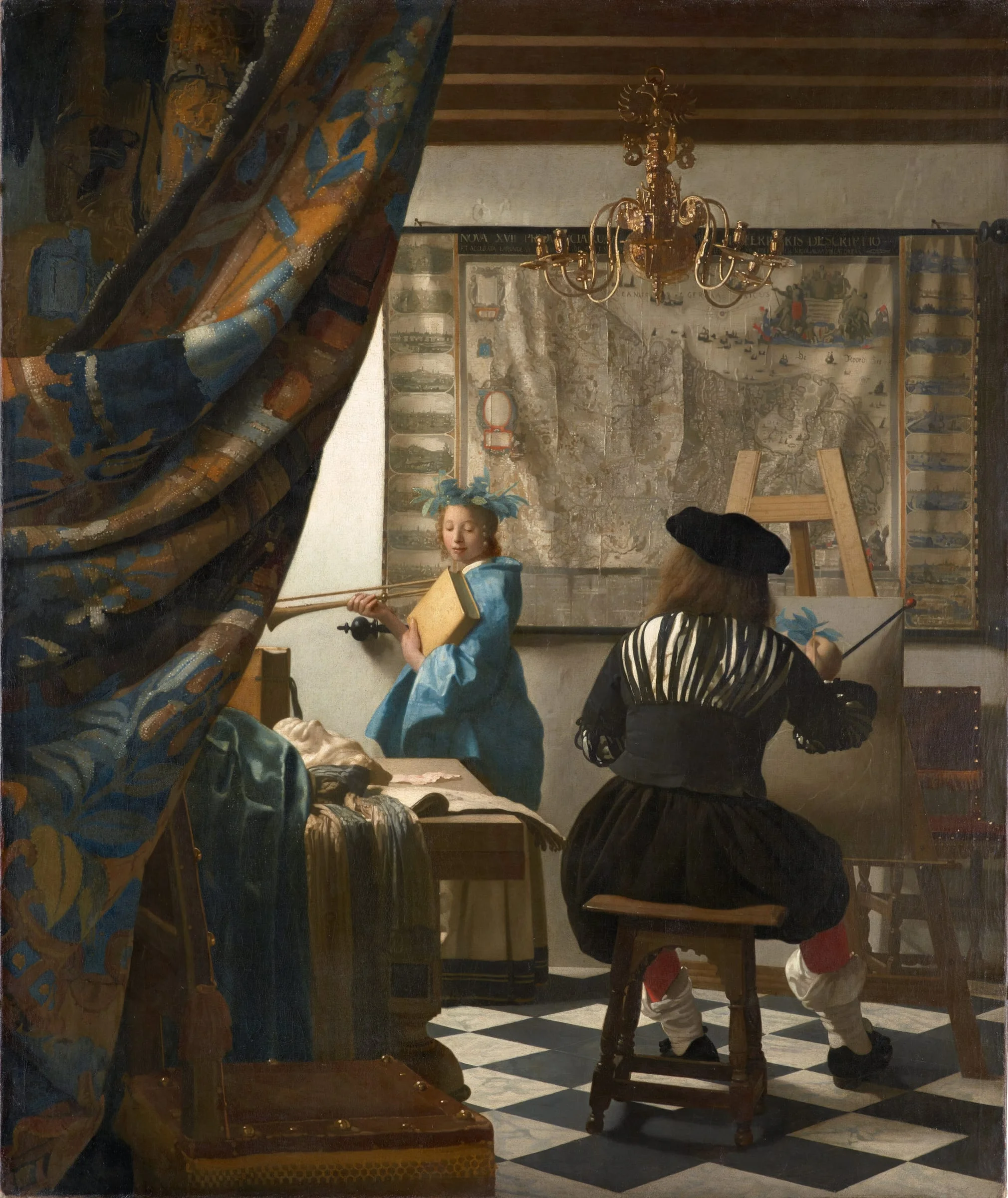 Detail 1
The drawn curtain
A heavy tapestry curtain is pulled aside to reveal the studio. It turns the scene into a kind of theatrical revelation.
Clio, the muse of history
The young woman posing for the painter wears a crown of laurel and holds a trumpet and a yellow book. She represents Clio, the muse of history, according to the iconography handbook of Cesare Ripa: the trumpet stands for fame, the book for history. By painting her, the artist preserves history and wins fame.
Detail 2Clio with her trumpet
The model wears a laurel crown and holds a trumpet and a book, the attributes of Clio, muse of history.
The painter seen from behind
The painter sits at his easel, seen from behind, wearing a black beret and an elegant black and white slashed doublet. We cannot see his face. He has just begun the painting, with the laurel crown of the model sketched on the canvas. Many believe he is a self-portrait of Vermeer, though he deliberately hid his face.
Detail 3The painter at work
The painter, seen from behind in a fashionable doublet, paints the muse's laurel crown on his canvas.
The map of the Netherlands
On the back wall hangs a large map of the Seventeen Provinces of the Netherlands, with views of cities along its borders. A crease runs down the middle, roughly along the line that separated the independent Dutch Republic from the Spanish-ruled southern Netherlands. Some read it as a symbol of the divided country, or of the past unity of the Netherlands.
Detail 4The great map
The map shows the Seventeen Provinces of the Netherlands, with city views along its edges. Its crease echoes the division between north and south.
The chandelier
Above the scene hangs a brass chandelier crowned with a double-headed eagle, symbol of the Habsburg dynasty that once ruled the Netherlands. It has no candles, which some interpret as a sign of the end of the old Catholic Habsburg order.
Detail 5The Habsburg chandelier
The brass chandelier bears the double-headed eagle of the Habsburgs. It has no candles, perhaps a sign of a vanished past.
A painting bought by Hitler
In 1940 Adolf Hitler bought the painting from the Czernin family of Vienna for his planned museum in Linz. After the war it was found in the salt mine of Altaussee and given to the Austrian state, which placed it in the Kunsthistorisches Museum in Vienna. The Czernin heirs have since tried to recover it, arguing that the sale was forced. The painting measures about 120 by 100 centimetres.
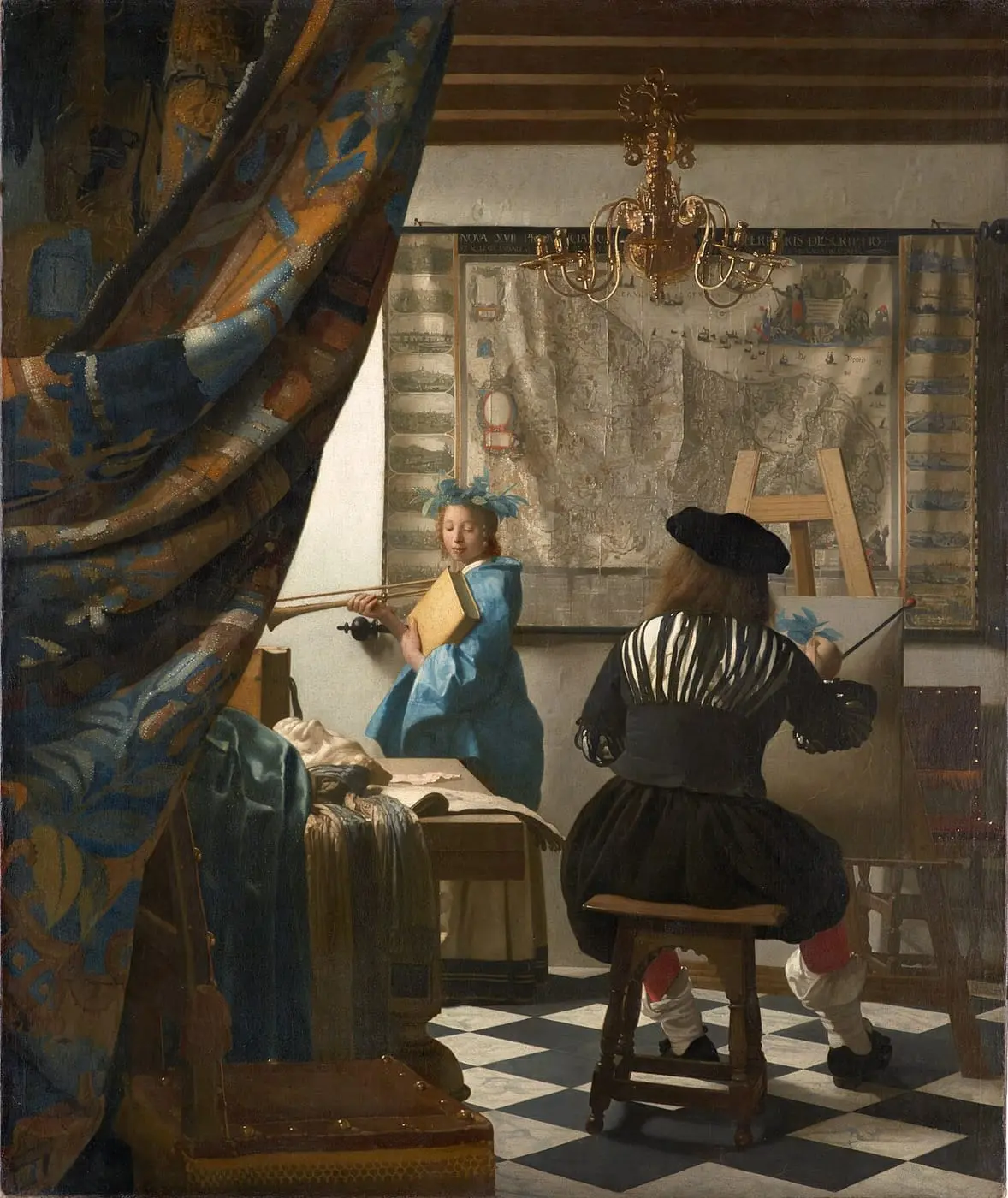
Own a hand-painted copy
The Art of Painting
Painted by hand in oil on canvas, any size. Free worldwide shipping.
From $299 — Make it yours.Frequently asked questions
What does The Art of Painting represent?
It is an allegory of painting, showing an artist painting Clio, the muse of history, to suggest that painting preserves history and brings fame.
Who is the painter in The Art of Painting?
He is seen only from behind; many think he is a self-portrait of Vermeer.
What is the map on the wall?
It is a map of the Seventeen Provinces of the Netherlands, with a crease along the line dividing north and south.
Where is The Art of Painting?
It is in the Kunsthistorisches Museum in Vienna.
Sources and further reading
- Kunsthistorisches Museum Vienna, collection notes on The Art of Painting
- Sabine Haag (ed.), Vermeer: The Art of Painting (Vienna, 2010)
- Walter Liedtke, Vermeer: The Complete Paintings (2008)
