Listen to this article
0:00 / 2:57 · Read by ArtLogia
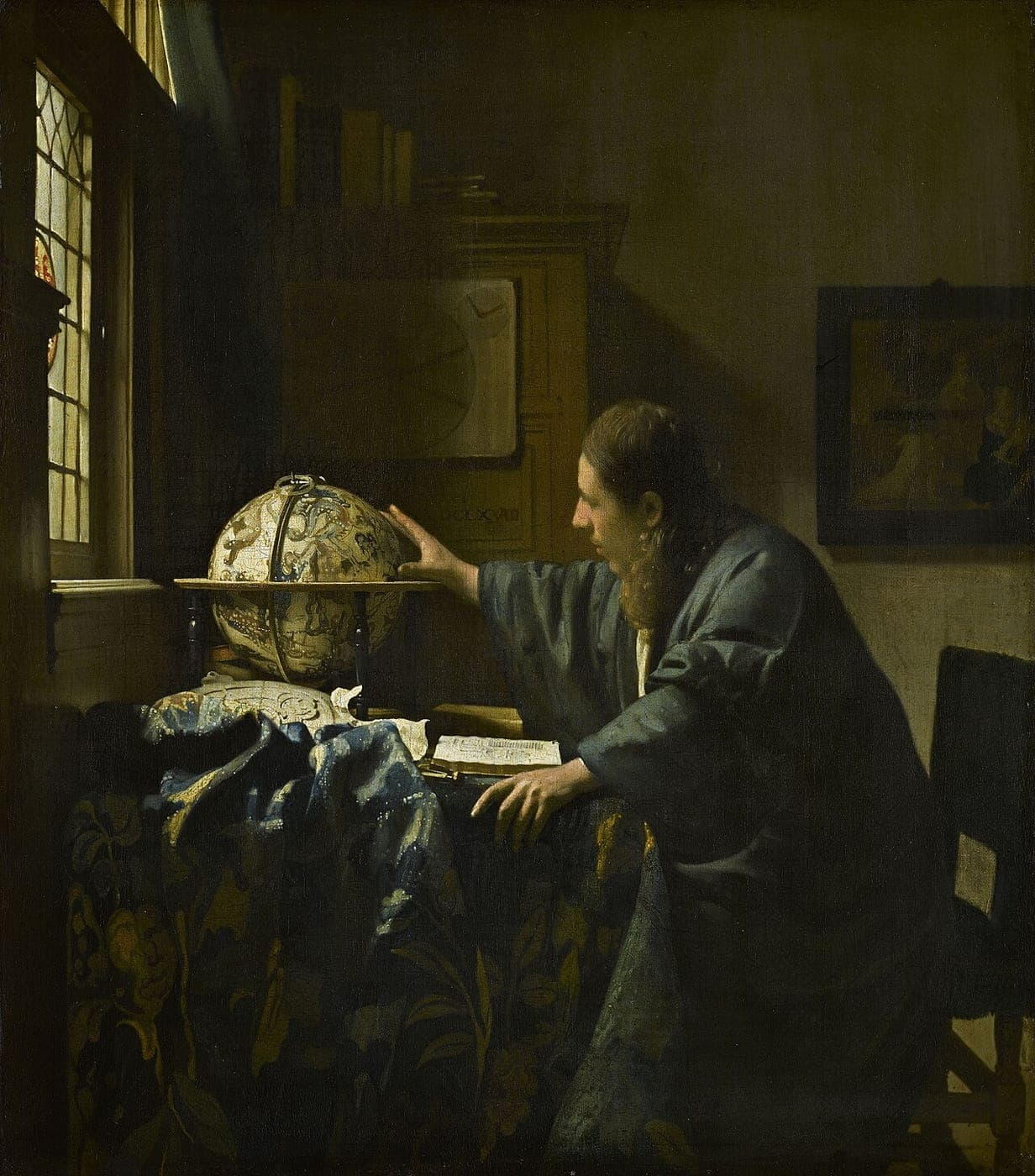
A scholar in a long robe leans towards a celestial globe in the light of a window, his fingers resting on the constellations. Painted in 1668, The Astronomer is one of Vermeer's rare paintings of a man, and one of only three he signed and dated.
In this article
A scholar at his desk
Johannes Vermeer painted The Astronomer in 1668, and it is one of only three paintings that he signed and dated. It shows a man in a long, loose robe seated at a table covered with a heavy carpet, leaning towards a celestial globe, his hand stretched out to touch it. In front of him an open book lies on the table, and light falls from a leaded window on the left.
The painting is closely related to The Geographer, now in the Städel Museum in Frankfurt, which shows a similar man with maps and a terrestrial globe. The two were probably painted as a pair, representing the study of the heavens and of the earth.
The celestial globe
The globe is a real one, made by the Amsterdam cartographer Jodocus Hondius in 1600. Historians have identified the constellations visible on it: the Great Bear, Draco, Hercules and Lyra. The astronomer's hand rests on the globe as if to turn it, connecting the human mind with the cosmos.
 Detail 1

The celestial globe
The globe, by Jodocus Hondius, shows the constellations of the northern sky. Vermeer painted it with soft light from the window.
Detail 2A hand on the stars
The astronomer's fingers rest lightly on the globe, as if he were about to set the heavens turning.
The book
The open book on the table has been identified as the treatise On the Investigation or Observation of the Stars by Adriaan Metius, published in 1621. It is open at the section that advises the astronomer to seek inspiration from God, which suggests a meaning that combines science and faith.
Detail 3The open book
The open treatise on astronomy lies on the table beside an astrolabe. Its text links the study of the stars with divine inspiration.
The window and the light
As in so many of Vermeer's paintings, the light comes from a window on the left, falling softly on the man's face and robe and on the globe. The rest of the room is in half-shadow, creating a calm, contemplative atmosphere.
Detail 4Light from the window
Light streams through the leaded window, illuminating the scholar's face and the globe. It is the quiet light of concentration.
The painting on the wall
On the back wall hangs a painting of The Finding of Moses, the baby Moses rescued from the Nile. Moses was seen as a wise man learned in all the knowledge of the Egyptians, including astronomy, which links the picture to the scholar's work.
A painting with a turbulent history
In the Second World War, the painting was taken by the Nazis from the Rothschild family in Paris and destined for Hitler's planned museum in Linz. It was recovered after the war and returned to the Rothschilds, who gave it to the French state. It entered the Louvre in 1983. It measures about 51 by 45 centimetres.
Own a hand-painted copy
The Astronomer
Painted by hand in oil on canvas, any size. Free worldwide shipping.
From $299 — Make it yours.Frequently asked questions
Who is the man in The Astronomer?
His identity is unknown; some think the model was the scientist Antonie van Leeuwenhoek, but there is no proof.
Is The Astronomer related to The Geographer?
Yes. The two paintings show similar scholars and were probably made as a pair, representing heaven and earth.
What is the globe in The Astronomer?
It is a real celestial globe made by Jodocus Hondius in 1600, showing the northern constellations.
Where is The Astronomer?
It is in the Musée du Louvre in Paris.
Sources and further reading
- Musée du Louvre, collection notes on The Astronomer
- Walter Liedtke, Vermeer: The Complete Paintings (2008)
- Arthur K. Wheelock Jr., Vermeer and the Art of Painting (1995)
