


Listen to this article
0:00 / 3:35 · Read by ArtLogia
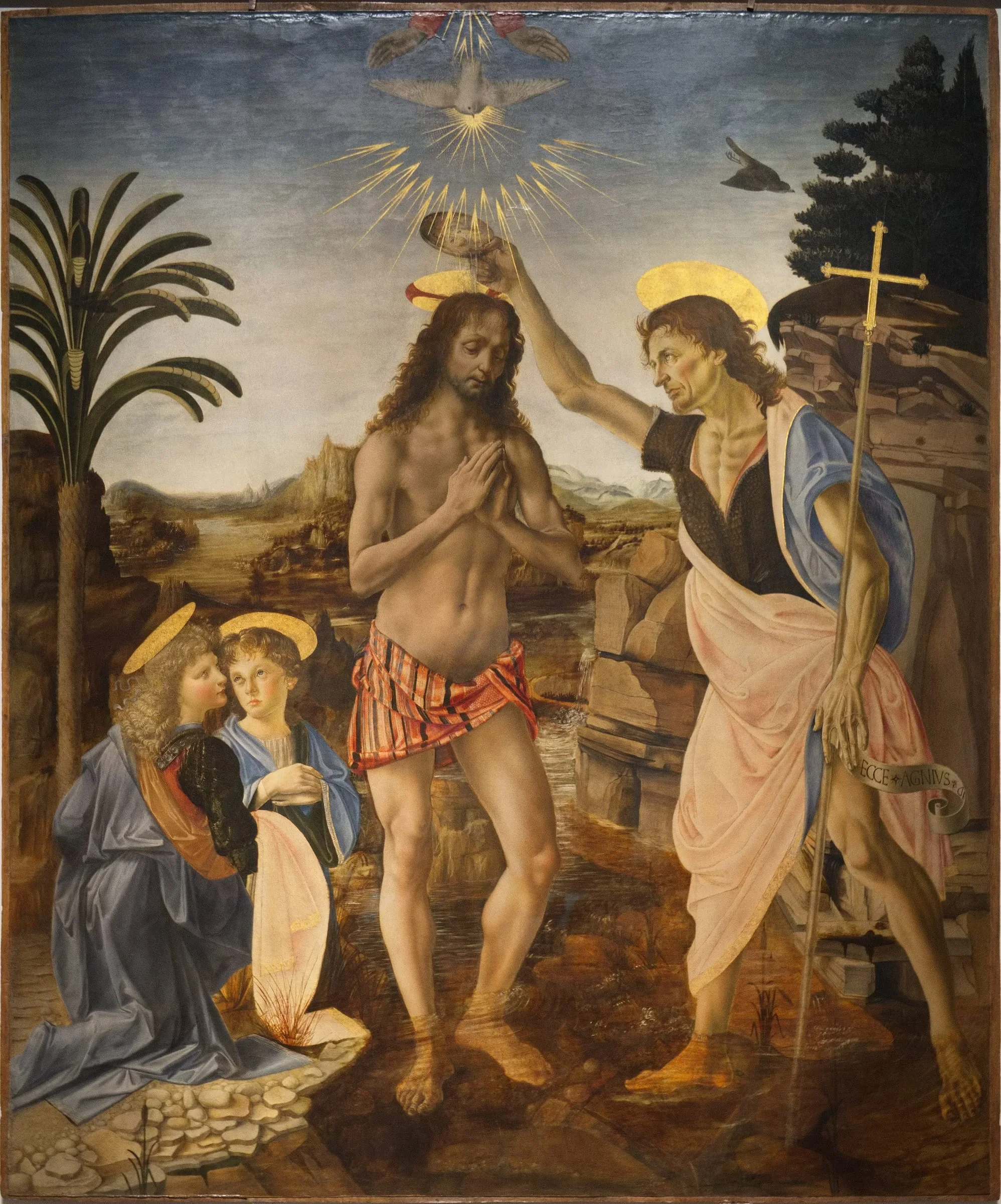
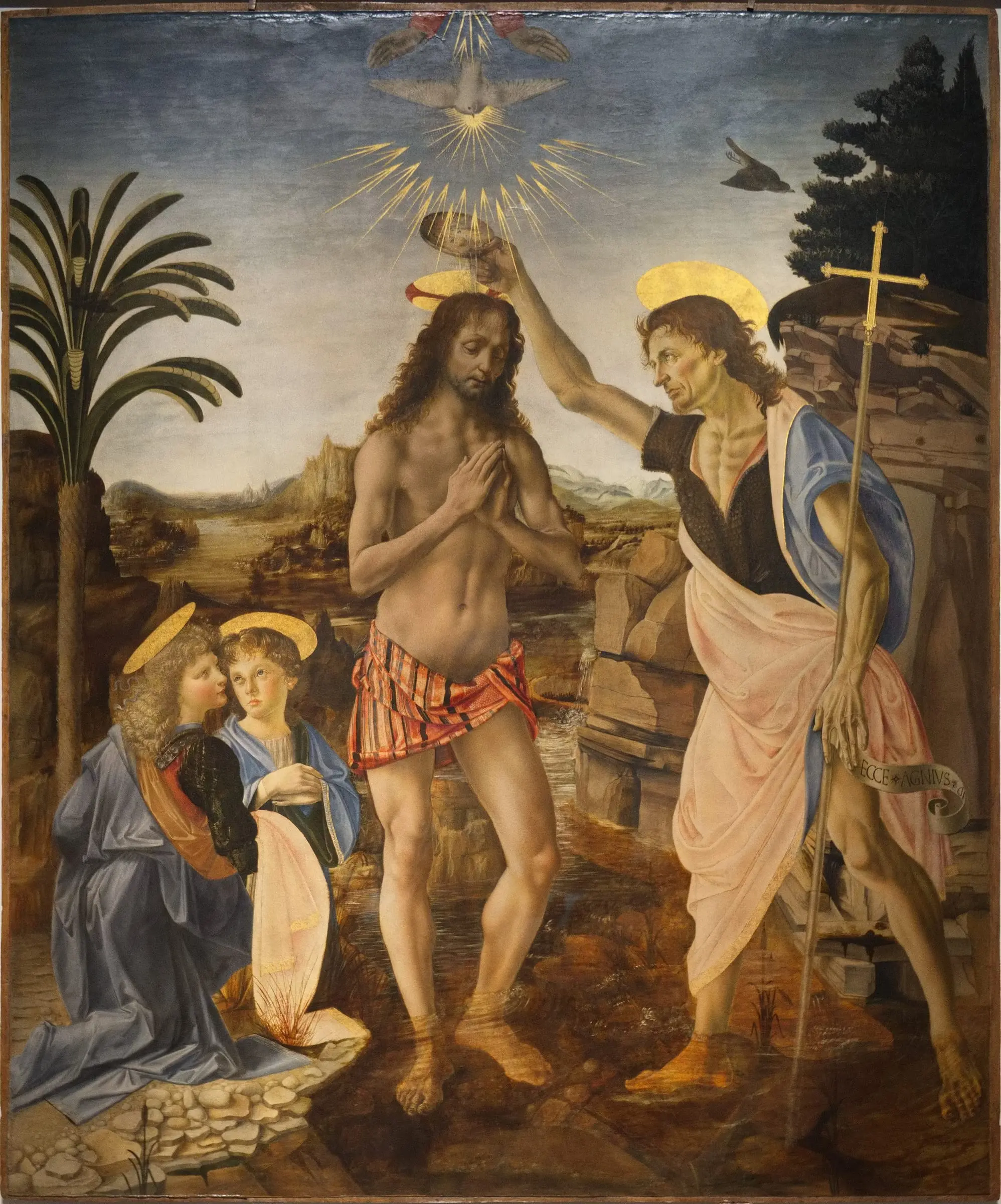
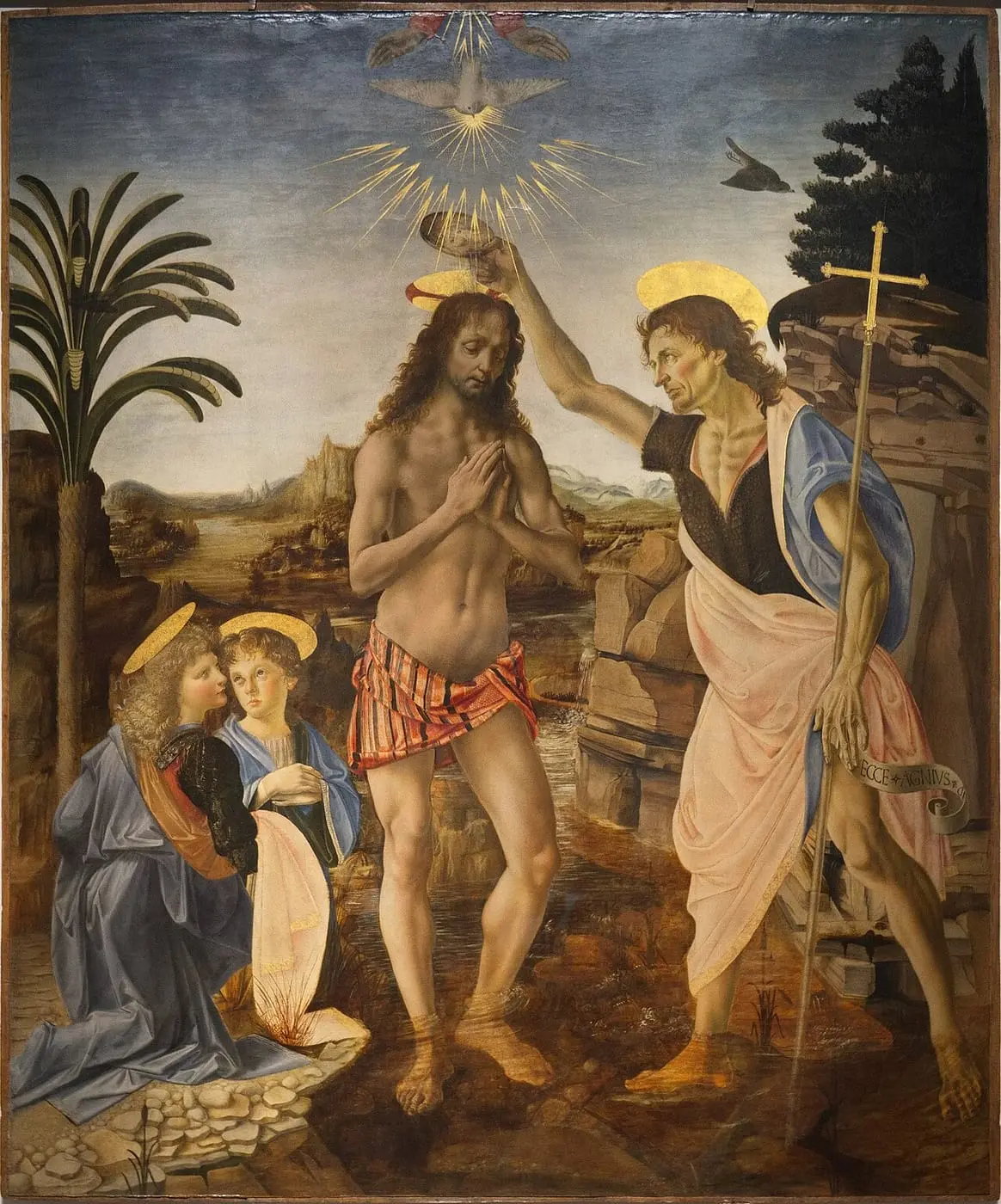
John the Baptist pours water over Christ in the river Jordan while two angels kneel on the bank. Painted in Verrocchio's workshop around 1470–1475, The Baptism of Christ is famous for the angel on the left, painted by the young Leonardo da Vinci.
In this article
A workshop painting
The Baptism of Christ was painted in Florence around 1470–1475 in the workshop of Andrea del Verrocchio, the sculptor, goldsmith and painter who trained the young Leonardo da Vinci. It was made for the church of San Salvi, a monastery just outside Florence. Like many workshop paintings, it was the work of several hands: Verrocchio designed it and painted most of the figures, and assistants worked on other parts.
Leonardo's angel
Giorgio Vasari tells a famous story: Verrocchio let the young Leonardo paint one of the angels, and when he saw how much better the boy's angel was than his own figures, he resolved never to touch a brush again. The story is certainly exaggerated, since Verrocchio continued to work, but technical studies confirm that the angel on the far left, seen in profile, is by Leonardo, painted in the new oil technique over the older tempera.
 Detail 1
Leonardo's angel
The angel on the left, turning to look up at Christ, is attributed to the young Leonardo. Its soft modelling and luminous hair stand out from the rest of the painting.
Christ and John
In the centre, Christ stands in the shallow waters of the Jordan, his hands joined in prayer, his body lean and muscular. John the Baptist, on the right, pours water over his head from a small bowl, holding a tall cross. Their sculptural, angular forms reflect Verrocchio's work as a sculptor.
Detail 2Christ in the Jordan
Christ stands in the river with joined hands, his body modelled with the sculptural firmness of Verrocchio's style.
Detail 3John pouring the water
John the Baptist raises a bowl and pours water over Christ's head, holding a cross in his other hand.
The dove and the hands of God
At the top of the painting, the hands of God the Father appear from the heavens, sending down the dove of the Holy Spirit, which descends towards Christ's head in a shower of gold rays. The scene follows the Gospel account of the baptism, when the heavens opened.
Detail 4The dove of the Holy Spirit
The hands of God release the dove of the Holy Spirit, which descends on golden rays towards Christ.
The landscape
Behind the figures, a landscape of rocks, water and misty distances stretches into the background. Parts of it, especially the river winding into the haze on the left, are thought to be by Leonardo, and they announce the atmospheric landscapes of his later works.
Detail 5A misty river landscape
The river winds into a hazy landscape of rocks and hills, parts of which are attributed to Leonardo.
Verrocchio's workshop
Andrea del Verrocchio ran one of the most important workshops in Florence, producing sculptures, paintings, goldsmith's work and decorations for the Medici and other patrons. Young artists trained there by grinding pigments, preparing panels and copying drawings before being allowed to paint parts of commissioned works. Leonardo, Perugino, Lorenzo di Credi and perhaps Botticelli all worked with Verrocchio. The Baptism of Christ is a rare document of this collaborative system, showing different hands and techniques side by side. Technical analysis has revealed that Leonardo reworked parts of the painting in oil, giving them a softness and luminosity that the older tempera parts lack. It is, in a sense, the first appearance of Leonardo's genius on the stage of art history.
Seeing the painting
The painting measures about 1.8 by 1.5 metres and is in the Uffizi Gallery in Florence, near Leonardo's Annunciation and Adoration of the Magi.
Own a hand-painted copy
The Baptism of Christ
Painted by hand in oil on canvas, any size. Free worldwide shipping.
From $299 — Make it yours.Frequently asked questions
Who painted The Baptism of Christ?
It was painted in Andrea del Verrocchio's workshop around 1470–1475, with the young Leonardo da Vinci painting the angel on the left and parts of the landscape.
Did Verrocchio stop painting because of Leonardo?
Vasari says so, but the story is exaggerated; it reflects how remarkable Leonardo's angel was.
What does the dove represent?
The dove represents the Holy Spirit descending on Christ at his baptism.
Where is The Baptism of Christ?
It is in the Uffizi Gallery in Florence.
Sources and further reading
- Uffizi Galleries, collection notes on the Baptism of Christ
- Giorgio Vasari, Lives of the Artists (1550)
- David Alan Brown, Leonardo da Vinci: Origins of a Genius (1998)
