


Listen to this article
0:00 / 3:29 · Read by ArtLogia
In a prison courtyard, an executioner pins John the Baptist to the ground and reaches for his knife, while a young woman holds out a platter for the head and two prisoners watch from a barred window. Painted in Malta in 1608, it is Caravaggio's largest work and the only one he signed.
In this article
Caravaggio in Malta
In 1606 Caravaggio killed a man in a fight in Rome and fled, condemned to death. After a period in Naples, he arrived in Malta in 1607, hoping to become a Knight of the Order of Saint John, which could earn him a papal pardon. In 1608 he was admitted to the order, and he painted The Beheading of Saint John the Baptist, the patron saint of the order, for the oratory of the Co-Cathedral of Saint John in Valletta.
A few months later, after another violent quarrel, he was imprisoned, escaped and was expelled from the order, possibly in the very oratory where his painting hung.
The executioner
In the centre, the executioner bends over the saint, who lies on the ground with his hands tied behind his back. The sword has already struck, but the executioner reaches for a knife at his back to finish the act. The moment is brutal and silent.
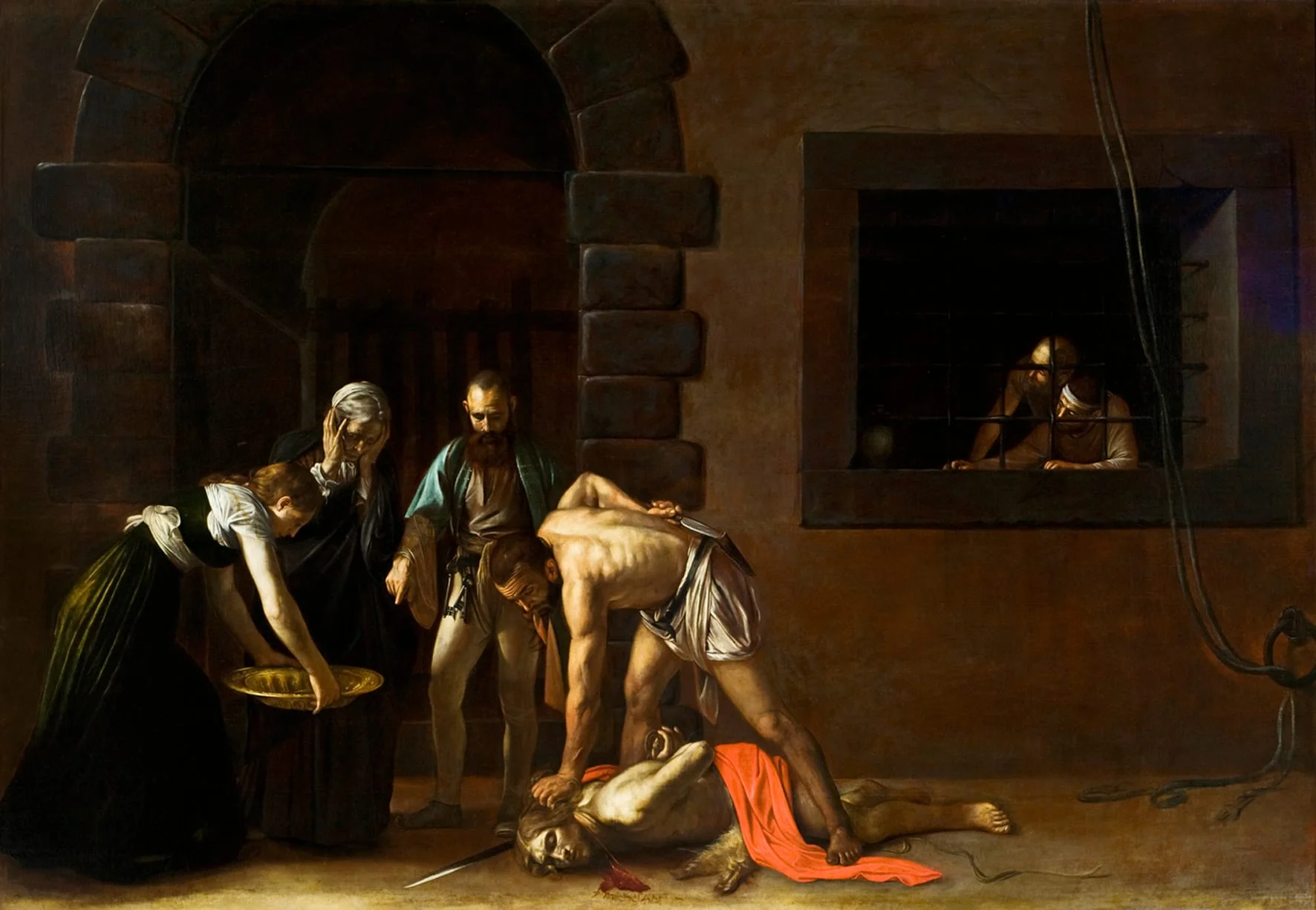 Detail 1
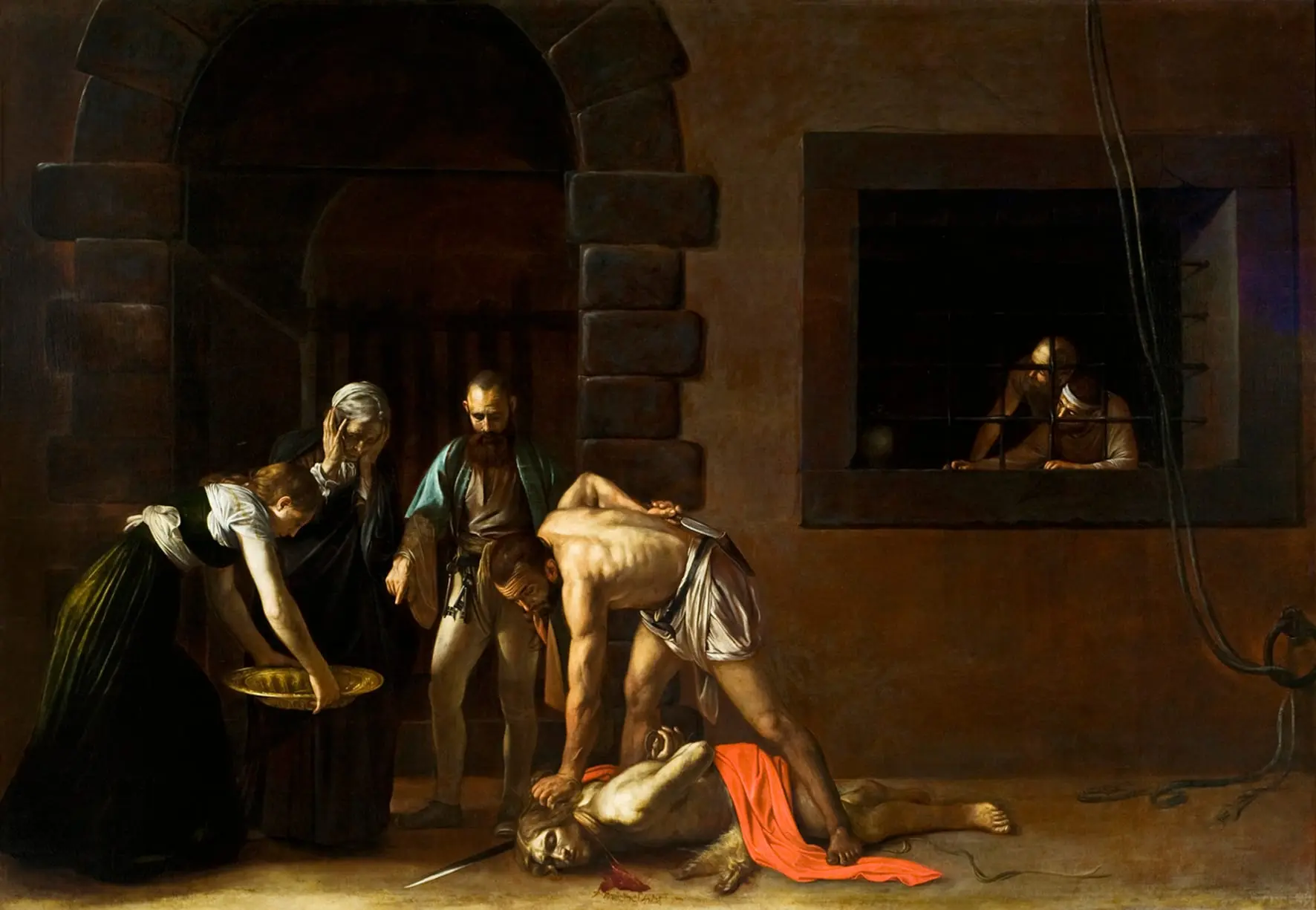
The executioner
The executioner bends over John, his knife hidden behind his back, about to complete the beheading.
Salome and the old woman
On the left, a young woman, Salome or a servant, bends forward with a golden platter to receive the head. Beside her, an old woman raises her hands to her head in horror, the only figure who shows emotion.
Detail 2The golden platter
The young woman holds out the platter for John's head, while an old woman beside her clutches her head in horror.
The prisoners at the window
On the right, two prisoners watch through the bars of a window, silent witnesses of the execution. Their presence underlines the injustice of John's death and perhaps Caravaggio's own fear of imprisonment.
Detail 3Prisoners at the window
Two prisoners watch the execution through a barred window, silent and powerless.
The signature in blood
Caravaggio signed only one of his paintings, and this is it. In the blood that flows from John's neck, he wrote "f. MichelAn", the "f" probably standing for fra, "brother", his new title as a Knight of Malta. Some read it as a confession, linking his own violent past with the saint's death.
Detail 4Signed in blood
In the blood flowing from the saint's neck, Caravaggio wrote his only signature, "f. MichelAn".
Darkness and space
The painting is enormous, about 3.6 by 5.2 metres, and much of it is empty: a dark prison wall and an archway. Caravaggio placed the figures in the lower half and left the vast darkness above, making the silent violence even more oppressive.
Caravaggio's last years
The Beheading of Saint John the Baptist was painted at the height of Caravaggio's powers, in the last turbulent years of his life. After escaping from Malta, he moved between Sicily and Naples, painting powerful works for churches and patrons, while fearing for his life. In 1609 he was attacked and disfigured in Naples. In 1610, on his way to Rome to receive a papal pardon, he died at Porto Ercole, aged thirty-eight. His late paintings, including this one, are darker and more austere than his Roman works, with large areas of shadow and a stark, silent drama. The Beheading is considered by many his masterpiece and one of the most important paintings of the seventeenth century.
Seeing the painting
The painting is still in the oratory of St John's Co-Cathedral in Valletta, Malta, for which it was painted.
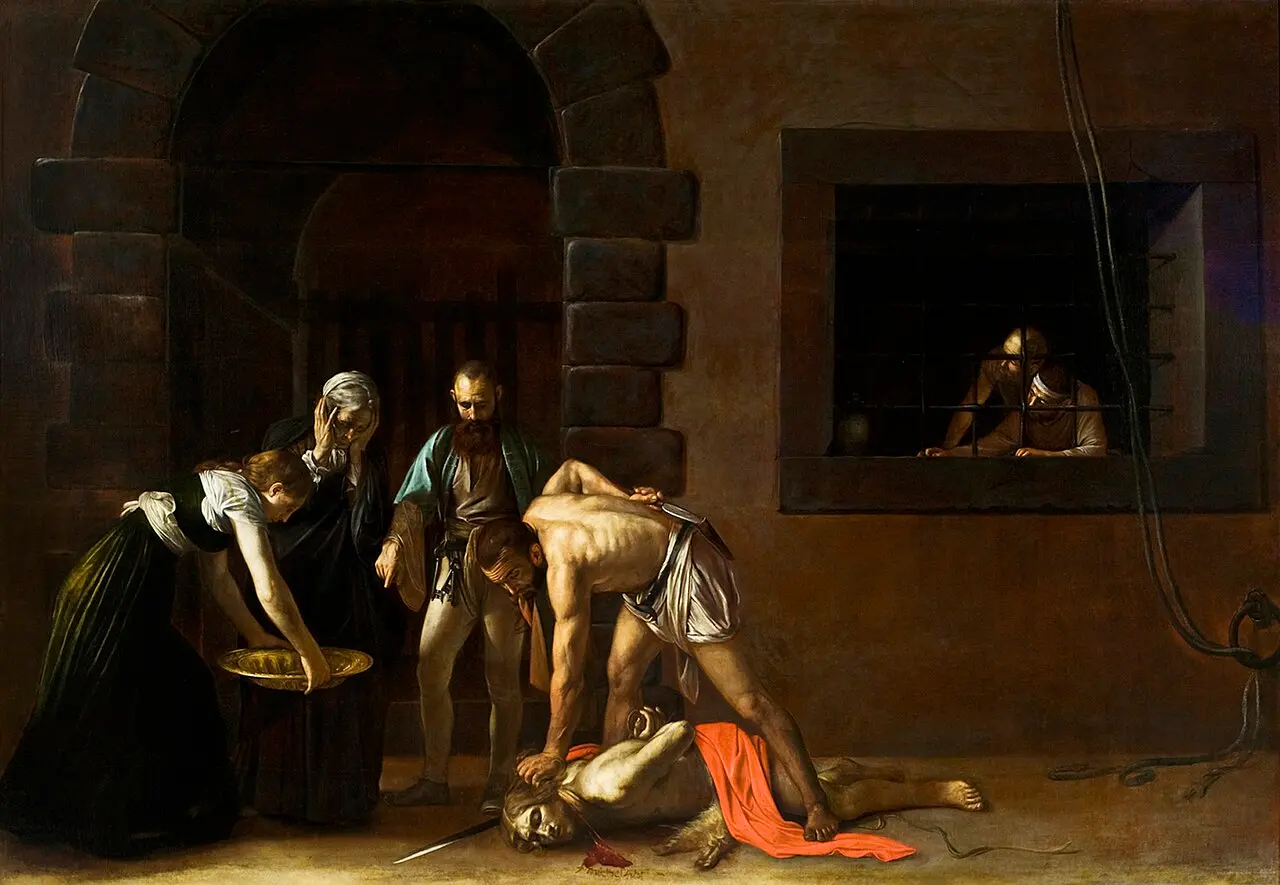
Own a hand-painted copy
The Beheading of Saint John the Baptist
Painted by hand in oil on canvas, any size. Free worldwide shipping.
From $299 — Make it yours.Frequently asked questions
Where is The Beheading of Saint John the Baptist?
It is in the oratory of St John's Co-Cathedral in Valletta, Malta.
Did Caravaggio sign the painting?
Yes. It is the only work he signed, writing "f. MichelAn" in the blood flowing from the saint's neck.
Why did Caravaggio go to Malta?
He fled Rome after killing a man and hoped to become a Knight of Malta to obtain a papal pardon.
How big is The Beheading of Saint John the Baptist?
It measures about 3.6 by 5.2 metres, Caravaggio's largest painting.
Sources and further reading
- St John's Co-Cathedral, Valletta, collection notes on the Beheading of Saint John the Baptist
- Helen Langdon, Caravaggio: A Life (1998)
- Keith Sciberras and David M. Stone, Caravaggio: Art, Knighthood and Malta (2006)
