


Listen to this article
0:00 / 3:38 · Read by ArtLogia
Venus stands on a scallop shell, arms raised to her hair, surrounded by nymphs, tritons blowing conch shells and a cloud of cupids. William-Adolphe Bouguereau painted this triumphant Birth of Venus in 1879, the height of French academic painting.
In this article
The master of the Salon
William-Adolphe Bouguereau was the most celebrated academic painter of nineteenth-century France, a professor at the École des Beaux-Arts and a pillar of the official Salon. His smooth, flawless technique, his idealised figures and his mythological subjects represented everything the Impressionists rebelled against, and for much of the twentieth century he was dismissed as old-fashioned. Since the 1980s his reputation has risen again, and his technical mastery is widely admired.
He painted The Birth of Venus in 1879 for the Salon, where it was a great success. The French state bought it the same year.
Venus
At the centre, Venus stands on a scallop shell drawn by a dolphin, raising her arms to wring out her long hair. Her pose, a graceful S-curve, comes from classical sculpture and from the Venus Anadyomene, Venus rising from the sea. Her skin is painted with such smooth, invisible brushwork that it seems almost real.
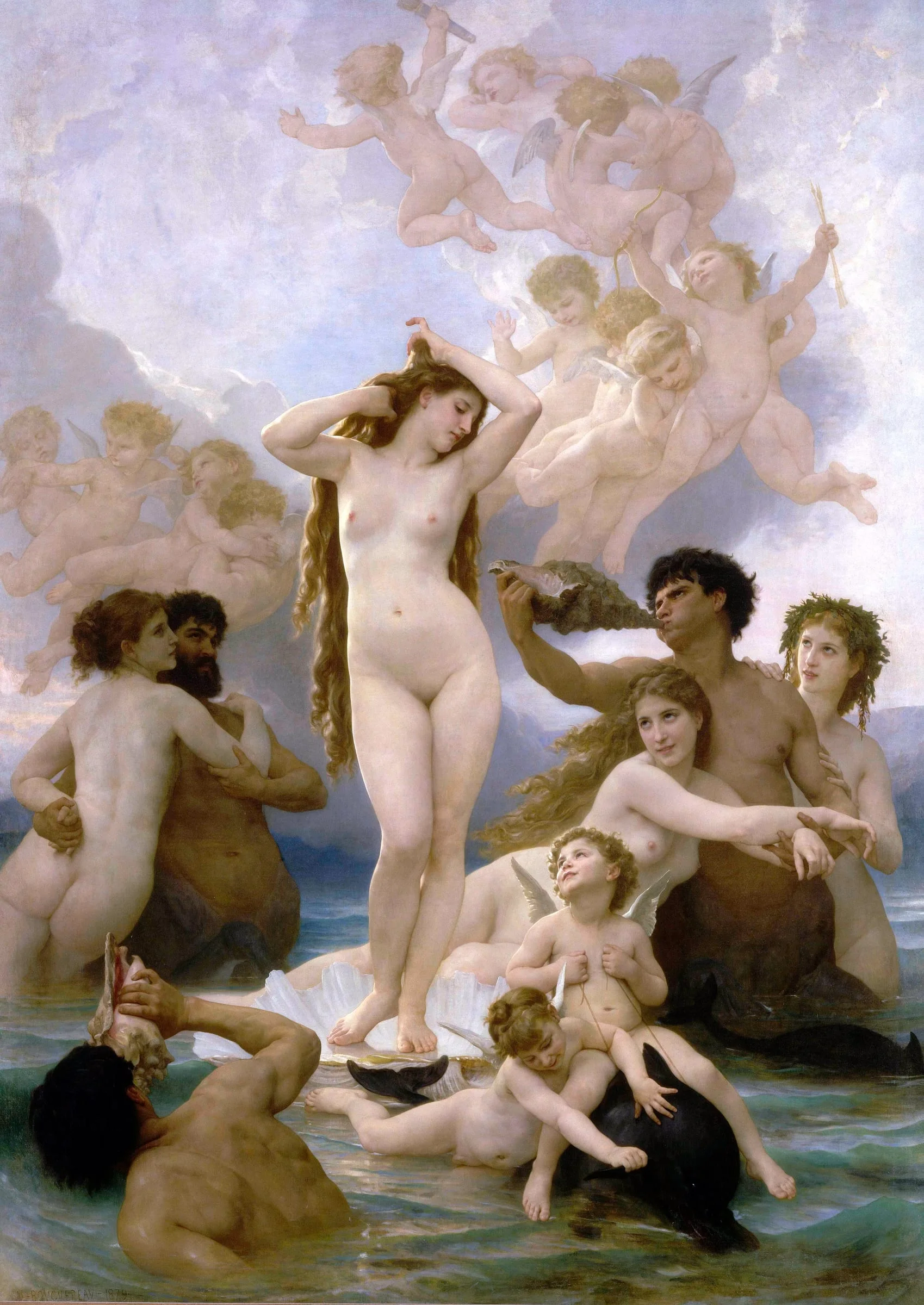 Detail 1
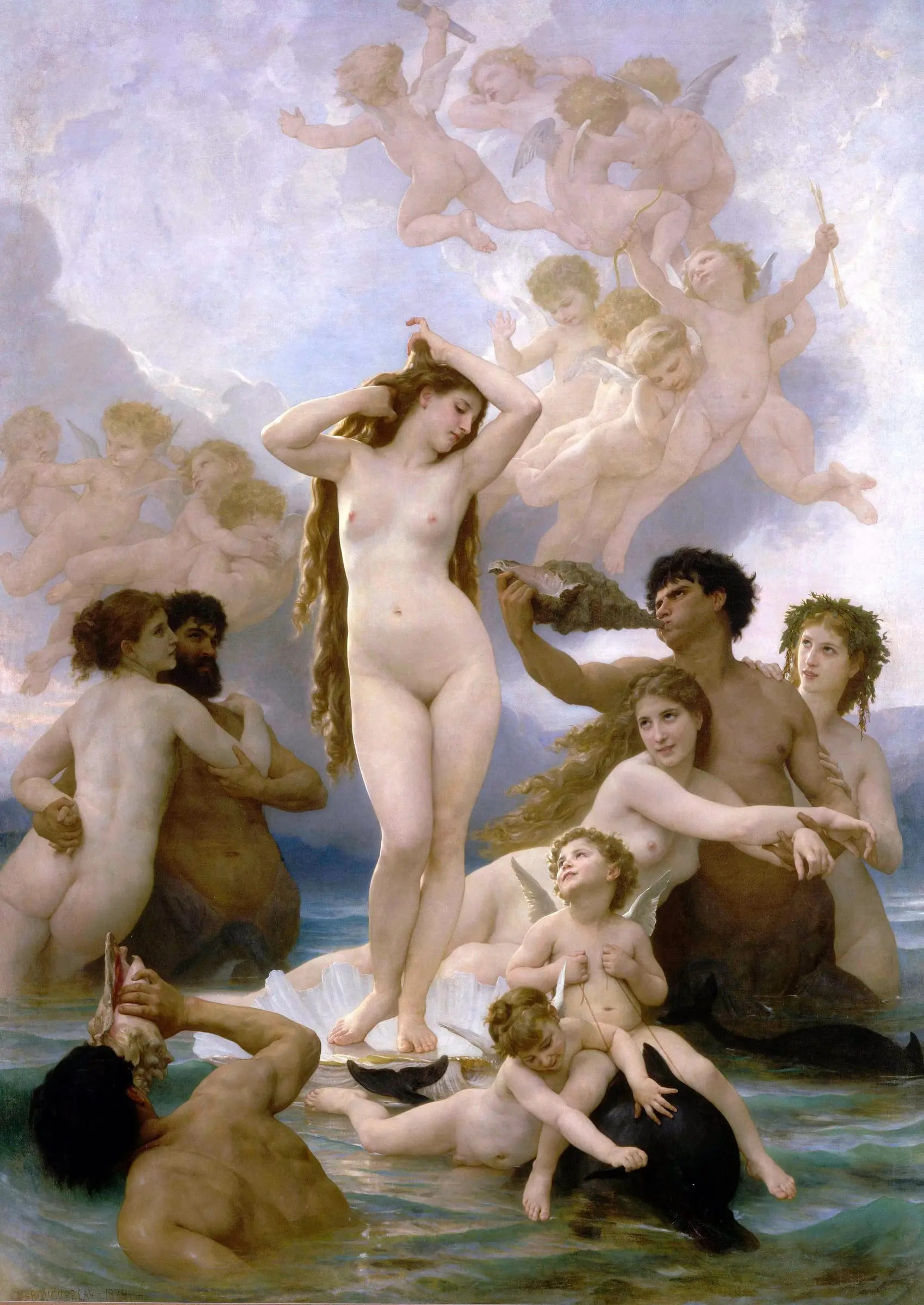
Venus lifting her hair
The goddess raises her arms to wring out her long hair, her face turned upward. The pose comes from the classical Venus Anadyomene.
The procession of the sea
Around her, a joyful procession of sea gods and nymphs celebrates her birth: tritons blow conch shells, nymphs ride on their backs, and figures swim in the waves. Their twisting, muscular bodies form a circle of movement around the calm, vertical goddess.
Detail 2A triton blowing a conch
On the right, a triton blows a conch shell to announce the birth of the goddess, a nymph at his side.
The cupids
Above the scene, a cloud of winged cupids, the putti, flies in the sky, some aiming their arrows, some playing. They fill the upper part of the painting with lightness and movement, and lead the eye upward to Venus.
Detail 3Cupids in the sky
A swarm of winged cupids fills the sky, aiming arrows and tumbling through the air.
The shell and the waves
At the bottom of the painting, the scallop shell floats on the green sea, and a dolphin pulls it forward. A young cupid rides the dolphin. The water is painted with a cool, glassy transparency that contrasts with the warm flesh tones.
Detail 4The scallop shell
Venus stands on a great shell borne by the sea, a symbol of her birth from the foam since antiquity.
Botticelli and Bouguereau
It is fascinating to compare this painting with Botticelli's Birth of Venus of the 1480s. Botticelli's Venus is modest, melancholy and stylised, floating in a decorative world. Bouguereau's Venus is triumphant, sensual and anatomically perfect, surrounded by a crowd of joyful figures. Both painters looked back to classical models, but in very different ways.
The art of the academic painter
Bouguereau's technique was the result of years of academic training: drawing from casts and live models, careful preparatory studies, and the slow building up of thin layers of oil paint to achieve perfectly smooth transitions. He worked out the composition in detailed drawings and oil sketches, then painted the final canvas with brushstrokes so fine they are almost invisible. This polished finish was what the Salon public admired and what the Impressionists rejected as artificial. Today, collectors and painters admire Bouguereau again for his craftsmanship, his command of anatomy and his luminous flesh tones. The Birth of Venus, with its swirling crowd of figures around a calm centre, is one of the clearest demonstrations of that skill.
Seeing the painting
Bouguereau's Birth of Venus measures about 3 by 2.2 metres and hangs in the Musée d'Orsay in Paris.
Own a hand-painted copy
The Birth of Venus
Painted by hand in oil on canvas, any size. Free worldwide shipping.
From $299 — Make it yours.Frequently asked questions
Who painted this Birth of Venus?
William-Adolphe Bouguereau, the leading French academic painter, painted it in 1879.
How is it different from Botticelli's Birth of Venus?
Bouguereau's Venus is surrounded by a joyful crowd of sea gods and cupids and painted with academic realism, while Botticelli's is quieter and more stylised.
What is Venus doing in Bouguereau's painting?
She is wringing out her long hair after rising from the sea, a pose known as Venus Anadyomene.
Where is Bouguereau's Birth of Venus?
It is in the Musée d'Orsay in Paris.
Sources and further reading
- Musée d'Orsay, collection notes on The Birth of Venus by Bouguereau
- Mark Steven Walker, William-Adolphe Bouguereau: L'Art Pompier (1984)
- Fronia E. Wissman, Bouguereau (1996)
