


Listen to this article
0:00 / 4:09 · Read by ArtLogia
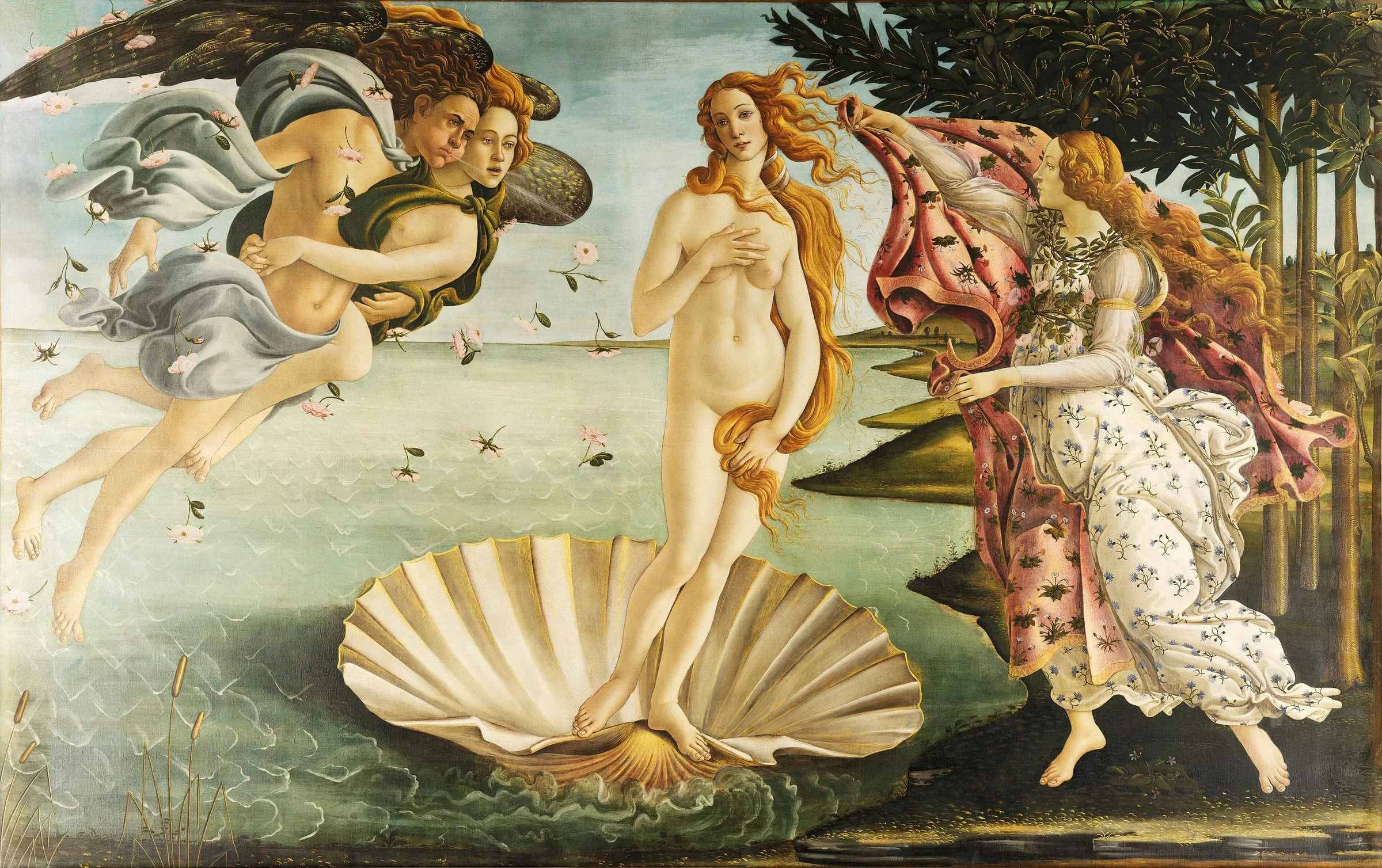
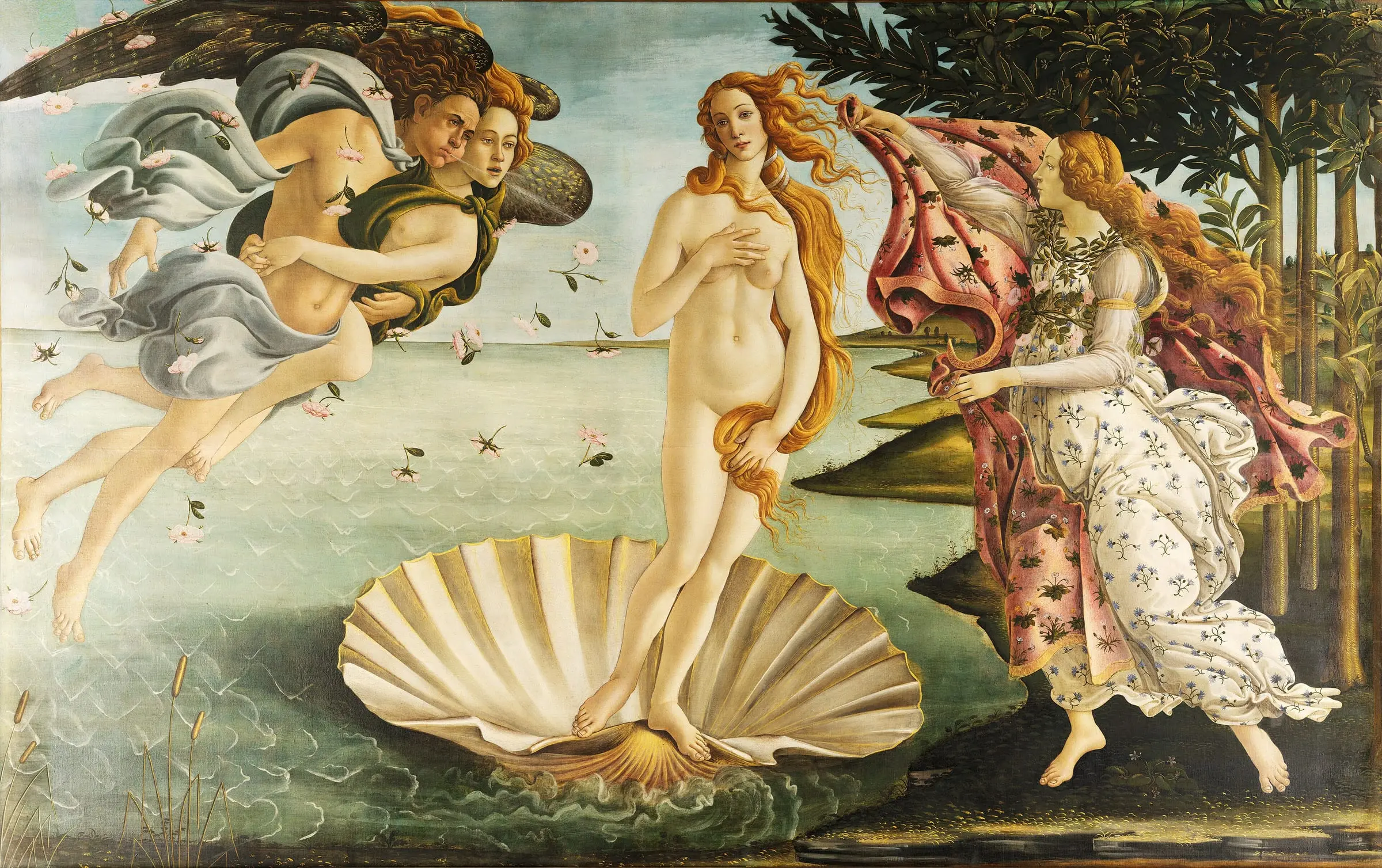
Pushed to shore by the winds, Venus stands on a scallop shell as a nymph rushes to cover her with a flowered cloak. Painted in Florence in the 1480s, The Birth of Venus brought pagan beauty back into Western art on a monumental scale.
In this article
A goddess born from the sea
According to the ancient Greek poet Hesiod, Venus (Aphrodite) was born from the foam of the sea and carried to shore on the island of Cyprus. In Sandro Botticelli's painting, made in Florence around 1484–1486, she has already risen. She stands on a giant scallop shell, blown towards the shore by the winds, while a goddess of the seasons waits to clothe her.
The painting was revolutionary simply for existing. It is one of the first large-scale images of a nude pagan goddess painted since antiquity, and it was painted on canvas, not on a wooden panel, which was unusual in Florence at the time. It was probably made for a member of the Medici family; by the sixteenth century it hung in the Medici villa at Castello, outside the city.
Venus herself
Venus stands in a gentle curve, her weight on one leg. Her pose comes from a classical statue type, the Venus Pudica, the modest Venus who covers herself with her hands, which Botticelli could have seen in the Medici collections. Her long neck, sloping shoulders and elongated body are not anatomically correct, but they create a flowing, graceful line that matters more to Botticelli than realism.
 Detail 1
The face of Venus
Her face is calm and slightly melancholy. A legend says it is a portrait of Simonetta Vespucci, the celebrated beauty of Florence, who died in 1476, but there is no evidence for it.
Her hair is one of the wonders of the painting. It flows around her in long golden strands, some touched with real gold, and she uses a lock of it to cover herself. The gold catches the light differently from the paint around it, which is why the painting seems to glow in the gallery.
The winds
On the left, Zephyr, the west wind, flies in with cheeks puffed, blowing Venus to shore. He holds a nymph in his arms, usually identified as Aura, the breeze, or Chloris. Their legs are intertwined, and pink roses fall around them, flowers that according to legend were born at the same time as Venus.
Detail 2Zephyr and Aura
The two wind gods fly locked together, their breath visible as faint lines. The roses tumbling around them were the flowers of Venus.
The Hora with the cloak
On the right, a Hora, one of the goddesses of the seasons, runs forward with a richly embroidered cloak to cover Venus. Her white dress is decorated with blue cornflowers, and a garland of myrtle, the plant of Venus, hangs around her neck. Her gesture brings the goddess from the realm of the gods into the world of humans.
Detail 3The Hora of spring
The goddess of spring wears a dress embroidered with cornflowers and a belt of roses. The cloak she offers is covered in daisies.
The shell and the sea
The sea is painted in a stylised way, with little V-shaped waves that look almost like a decorative pattern. The great shell, in gold and pink, floats on the water like a boat. Botticelli was less interested in depth and space than in rhythm and line, a style that would later seem old-fashioned to the High Renaissance and was rediscovered by the Pre-Raphaelites in the nineteenth century.
Detail 4The scallop shell
The shell was an ancient symbol of Venus and of birth. Botticelli painted it with ridges of gold and pink that catch the light.
Beauty with a meaning
Florentine thinkers of the time, such as Marsilio Ficino, linked the classical goddess with spiritual love: the contemplation of physical beauty could lead the soul to divine beauty. Many historians read the painting in this light, as an image of the birth of beauty and love in the human soul, rather than as a purely sensual picture.
Seeing The Birth of Venus
The Birth of Venus measures about 1.7 by 2.8 metres. It hangs in the Botticelli rooms of the Uffizi Gallery in Florence, near his Primavera, and is one of the most visited paintings in Italy.
Own a hand-painted copy
The Birth of Venus
Painted by hand in oil on canvas, any size. Free worldwide shipping.
From $299 — Make it yours.Frequently asked questions
Who painted The Birth of Venus?
Sandro Botticelli painted it in Florence around 1484–1486.
Who was the model for Botticelli's Venus?
Tradition links her face to Simonetta Vespucci, a famous beauty of Florence, but this is a legend without firm evidence.
What is the meaning of The Birth of Venus?
It shows the classical goddess of love arriving on shore after her birth from the sea; Renaissance thinkers saw her as a symbol of divine beauty and love.
Where is The Birth of Venus?
It is in the Uffizi Gallery in Florence.
Sources and further reading
- Uffizi Galleries, collection notes on The Birth of Venus
- Ronald Lightbown, Sandro Botticelli: Life and Work (1989)
- Ovid and Hesiod, classical sources of the Venus myth
