


Listen to this article
0:00 / 3:06 · Read by ArtLogia
Six blind men walk in a line, each holding on to the one in front, and the leader has already fallen into a ditch, pulling the others after him. Painted in 1568, Pieter Bruegel the Elder's The Blind Leading the Blind illustrates a saying of Christ with unforgettable realism.
In this article
A parable of Christ
In the Gospel of Matthew, Christ says of the Pharisees: "They are blind guides. If the blind lead the blind, both will fall into a ditch." The saying was well known in the sixteenth century and was often illustrated as a warning against following false teachers.
Pieter Bruegel the Elder painted The Parable of the Blind, also known as The Blind Leading the Blind, in 1568, a year before his death. It is painted in tempera on canvas, a technique he used for several of his late works.
A fall in slow motion
Six blind men walk from left to right in a diagonal line, each holding the stick or shoulder of the man in front. The leader has fallen backwards into a ditch, and the second man is already losing his balance. The others, unaware, continue behind. The composition reads like a sequence of film frames, showing successive stages of a fall.
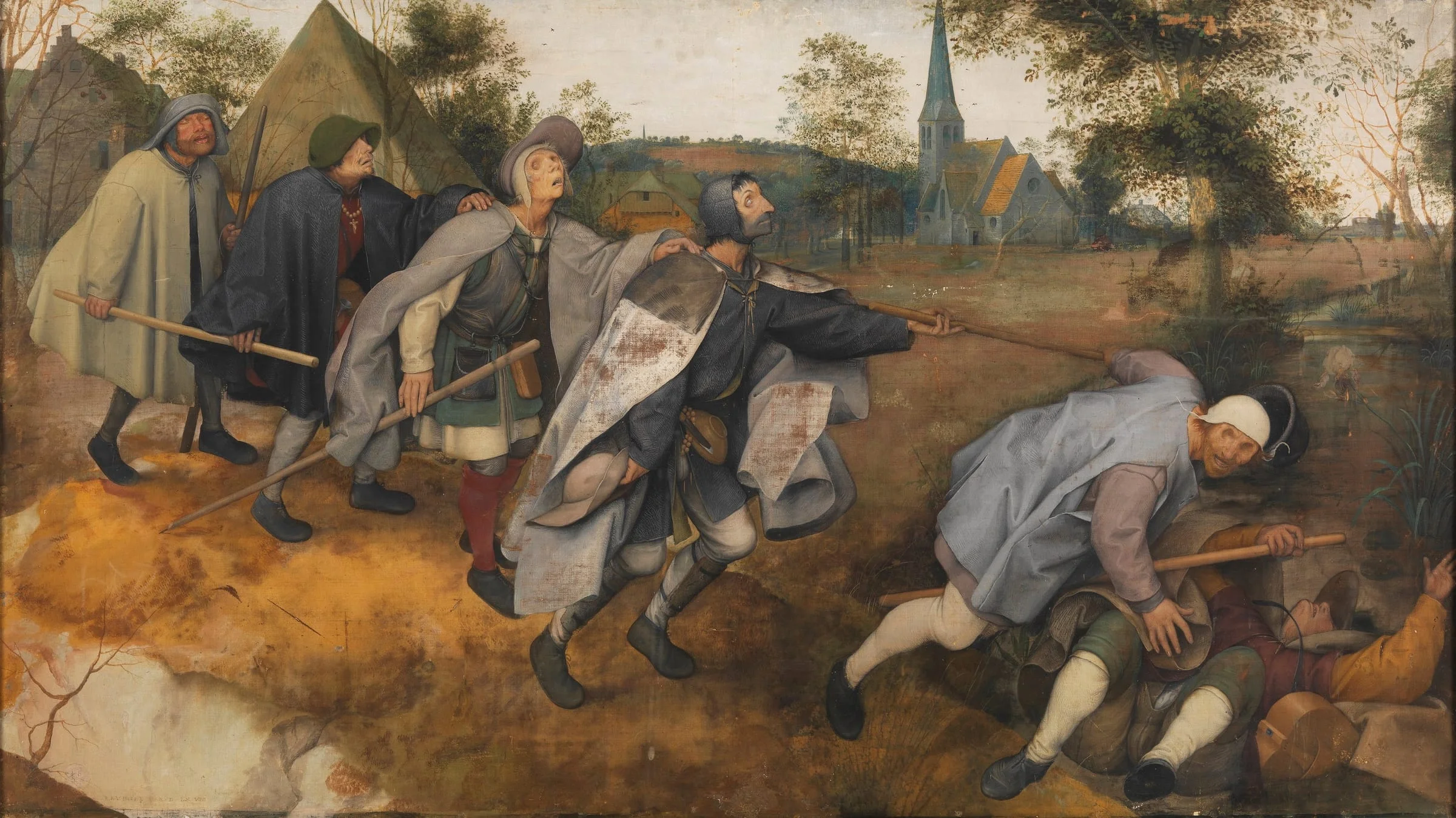 Detail 1
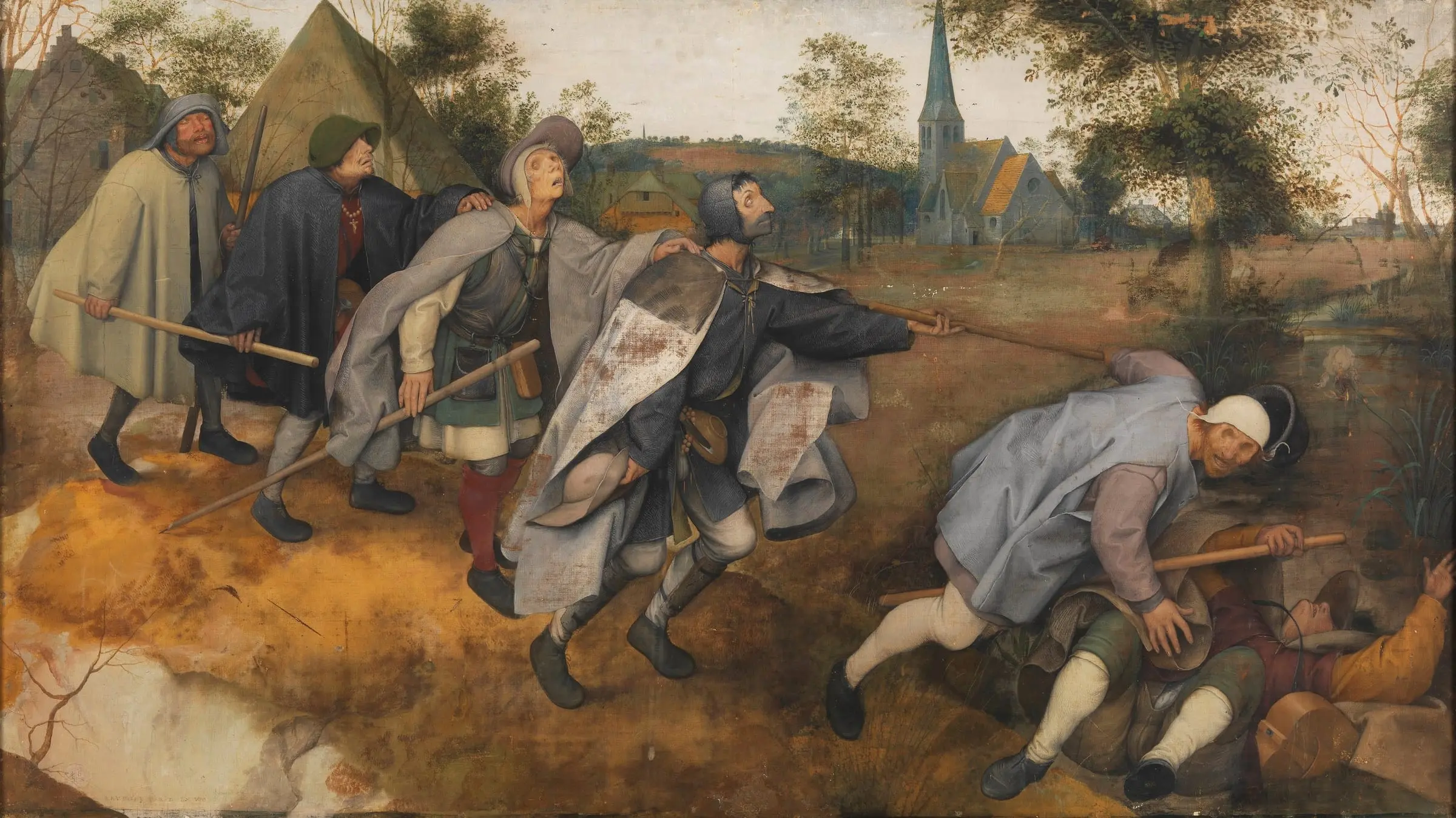
The leader falls
The first blind man has fallen into the ditch, and the second is about to follow. The disaster spreads down the line.
Detail 2Linked by their sticks
The blind men hold on to each other with sticks and hands, walking confidently towards the ditch they cannot see.
Faces of blindness
Bruegel painted the faces of the blind men with great realism. Doctors have identified several different eye conditions in them, such as corneal leucoma, the absence of eyes and atrophy of the eyeball. The men turn their faces upward, as blind people often do, listening rather than looking.
Detail 3Blind eyes
The faces of the blind men are turned upward, their eyes clouded or empty, painted with medical precision.
The village church
Behind the men lies a peaceful village with a church, whose tall spire rises above the trees. The church has been identified as that of Sint-Anna-Pede, near Brussels, which still stands today. Some see its presence as a contrast: the right path of faith stands just behind the men who are going astray.
Detail 4The village church
The church of Sint-Anna-Pede rises behind the blind men, a calm presence beside their stumbling procession.
Bruegel's moral vision
Bruegel often used everyday life to convey moral lessons, inspired by proverbs, parables and the teachings of humanists like Erasmus. In The Blind Leading the Blind, the physical blindness of the men stands for spiritual blindness: those who follow false leaders, or who are guided by ignorance and pride, are heading for a fall. In a period of bitter religious conflict between Catholics and Protestants, the image would have had a strong resonance. But Bruegel does not mock the blind men; he paints them with realism and compassion. The diagonal composition, with its sense of inevitable movement towards disaster, is one of the most powerful he ever created, and it has inspired writers, poets and filmmakers.
Seeing the painting
The painting measures about 86 by 154 centimetres. It belonged to the Farnese family and is now in the Museo di Capodimonte in Naples.
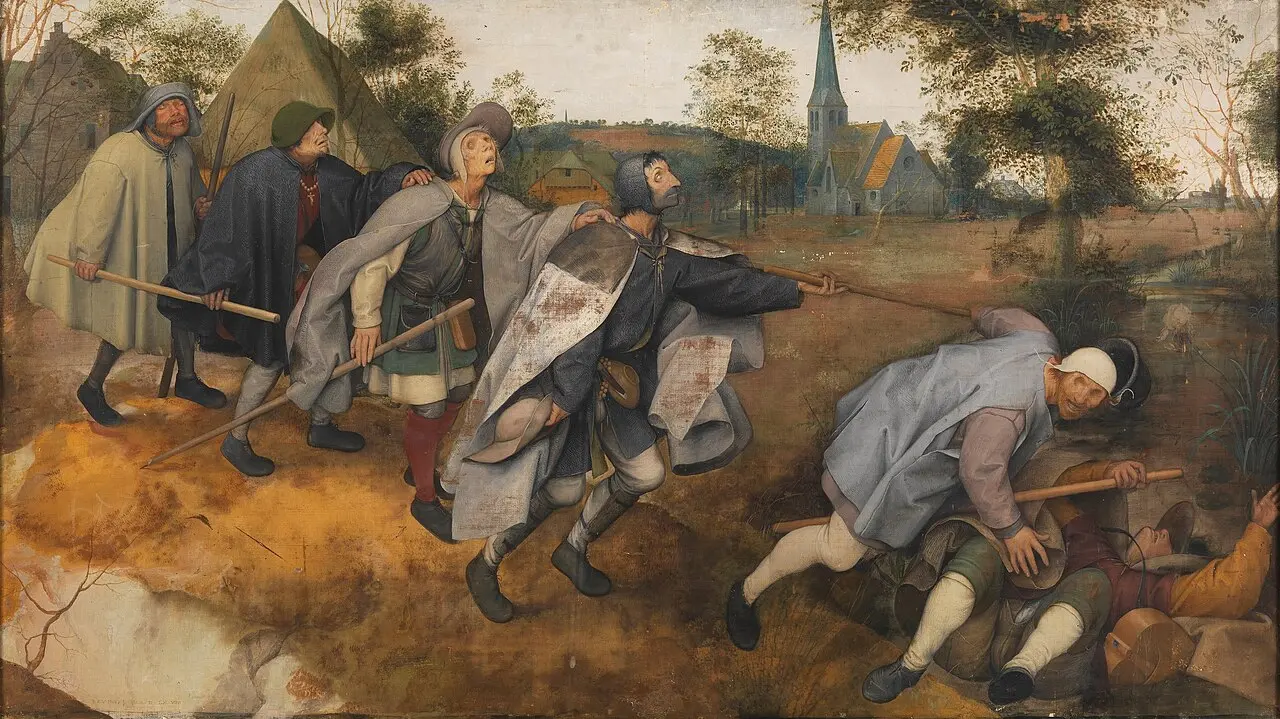
Own a hand-painted copy
The Blind Leading the Blind
Painted by hand in oil on canvas, any size. Free worldwide shipping.
From $299 — Make it yours.Frequently asked questions
What does The Blind Leading the Blind mean?
It illustrates Christ's saying that if the blind lead the blind, both fall into a ditch, a warning against following false guides.
When was it painted?
Pieter Bruegel the Elder painted it in 1568.
Is the church in the painting real?
Yes. It is usually identified as the church of Sint-Anna-Pede near Brussels, which still exists.
Where is The Blind Leading the Blind?
It is in the Museo di Capodimonte in Naples.
Sources and further reading
- Museo di Capodimonte, collection notes on The Parable of the Blind
- Gospel of Matthew 15:14
- Manfred Sellink, Bruegel: The Complete Paintings, Drawings and Prints (2007)
