

Listen to this article
0:00 / 3:14 · Read by ArtLogia
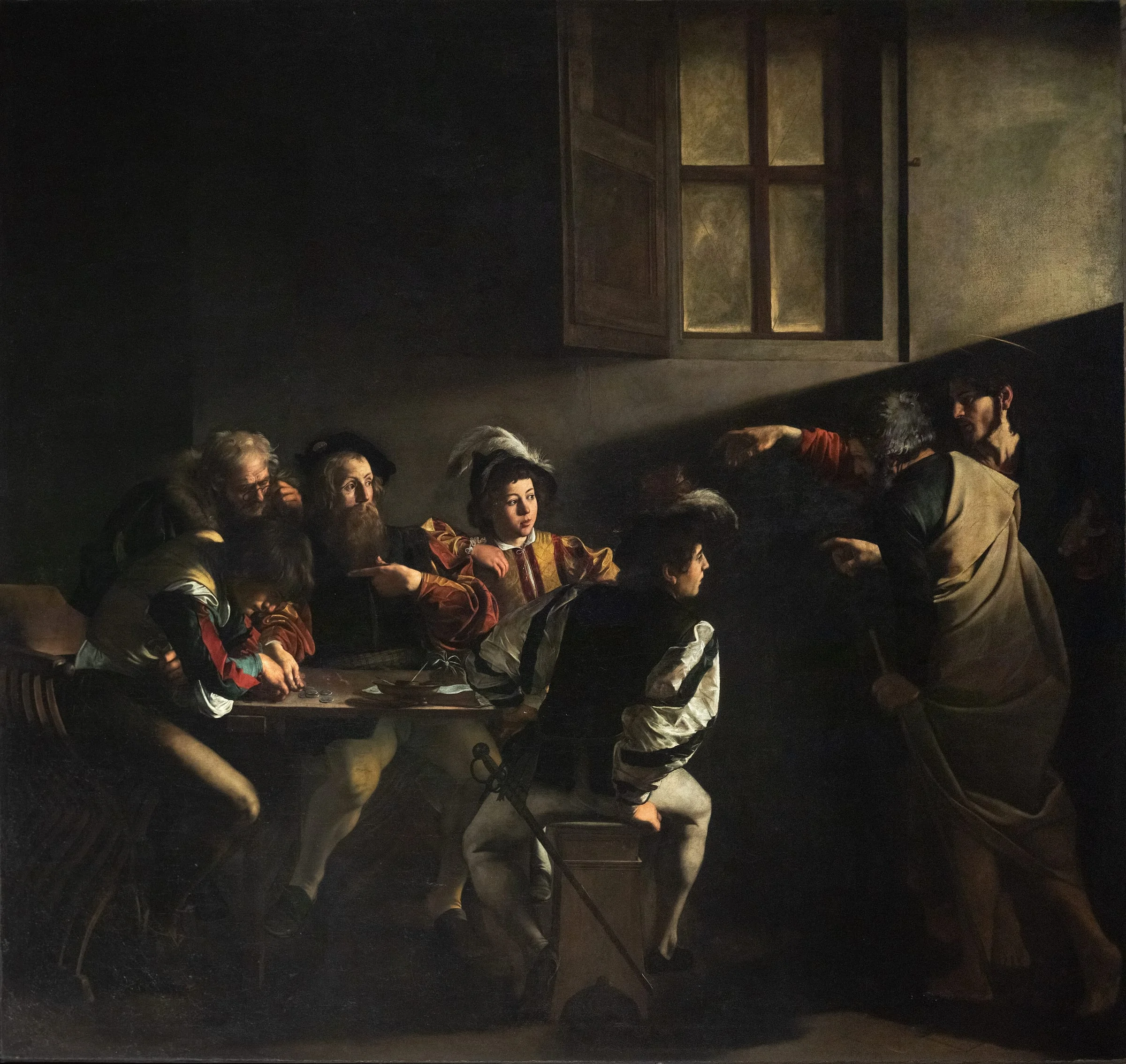
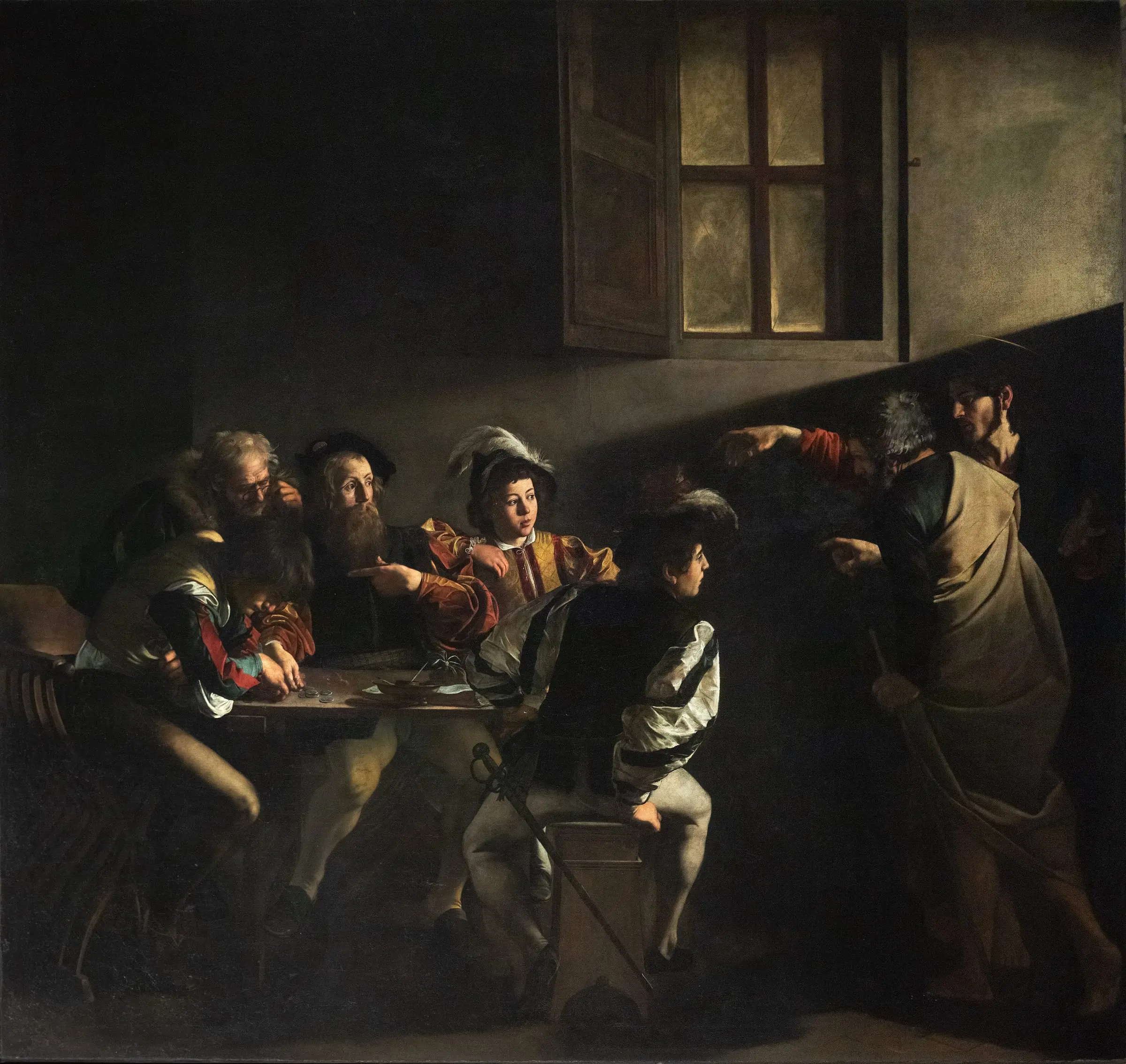
In a dark room, a group of men count coins around a table when Christ appears in the doorway and points at one of them. A beam of light cuts across the wall. Painted in 1599–1600 for a chapel in Rome, The Calling of Saint Matthew made Caravaggio famous overnight.
In this article
A chapel in Rome
In 1599 the young painter Michelangelo Merisi, known as Caravaggio, received his first public commission: two large paintings for the Contarelli Chapel in the French church of San Luigi dei Francesi in Rome, showing scenes from the life of Saint Matthew. The Calling of Saint Matthew and The Martyrdom of Saint Matthew were installed in 1600, and a third painting, Saint Matthew and the Angel, followed in 1602.
The paintings caused a sensation in Rome. Their dramatic realism and their contrasts of light and darkness were unlike anything painters had done before.
The story
According to the Gospel, Jesus passed by the tax office and saw a tax collector named Matthew. He said to him "Follow me", and Matthew got up and followed him. Tax collectors were despised as collaborators with the Roman occupiers and as cheats, so the calling of Matthew was an example of grace given to a sinner.
Christ's hand
On the right, Christ enters the room with Saint Peter and points towards the table. His hand, with its relaxed, extended finger, recalls the hand of God creating Adam in Michelangelo's Sistine Chapel ceiling, which Caravaggio knew well. The gesture creates a new life, a spiritual rebirth.
 Detail 1
Christ's pointing hand
Christ points towards the table with a relaxed gesture that echoes Michelangelo's hand of God creating Adam.
The beam of light
A beam of light falls diagonally from the upper right across the wall, above Christ's hand and towards the men at the table. It seems to come from a window outside the painting, but it is also the light of grace. Caravaggio made light itself the protagonist of the story.
Detail 2The beam of light
A diagonal shaft of light crosses the dark wall, running parallel to Christ's arm. It is both real light and the light of grace.
Who is Matthew?
At the table sit five men dressed in the fashionable clothes of Caravaggio's Rome, with feathered hats and swords. A bearded man points, apparently at himself, as if to ask "Me?". Traditionally he has been identified as Matthew. But some historians believe Matthew is the young man at the end of the table, bent over the coins, who does not look up. The ambiguity has been debated for decades.
Detail 3The bearded man
The bearded man at the centre of the table points, perhaps at himself, perhaps at the young man beside him. Is he Matthew, asking "Me?"
The coins
On the table lie coins and a ledger, the tools of the tax collector's trade. At the end of the table, a young man hunches over the money, counting it, absorbed in his greed. His head is down, unaware of the call.
Detail 4Counting the coins
The young man at the end of the table bends over the money, his hand on the coins. Some believe he is the real Matthew.
Seeing the painting
The painting measures about 3.2 by 3.4 metres and is still in its original place, the Contarelli Chapel of San Luigi dei Francesi in Rome, near the Piazza Navona. Visitors can see the three Matthew paintings together, as Caravaggio intended.
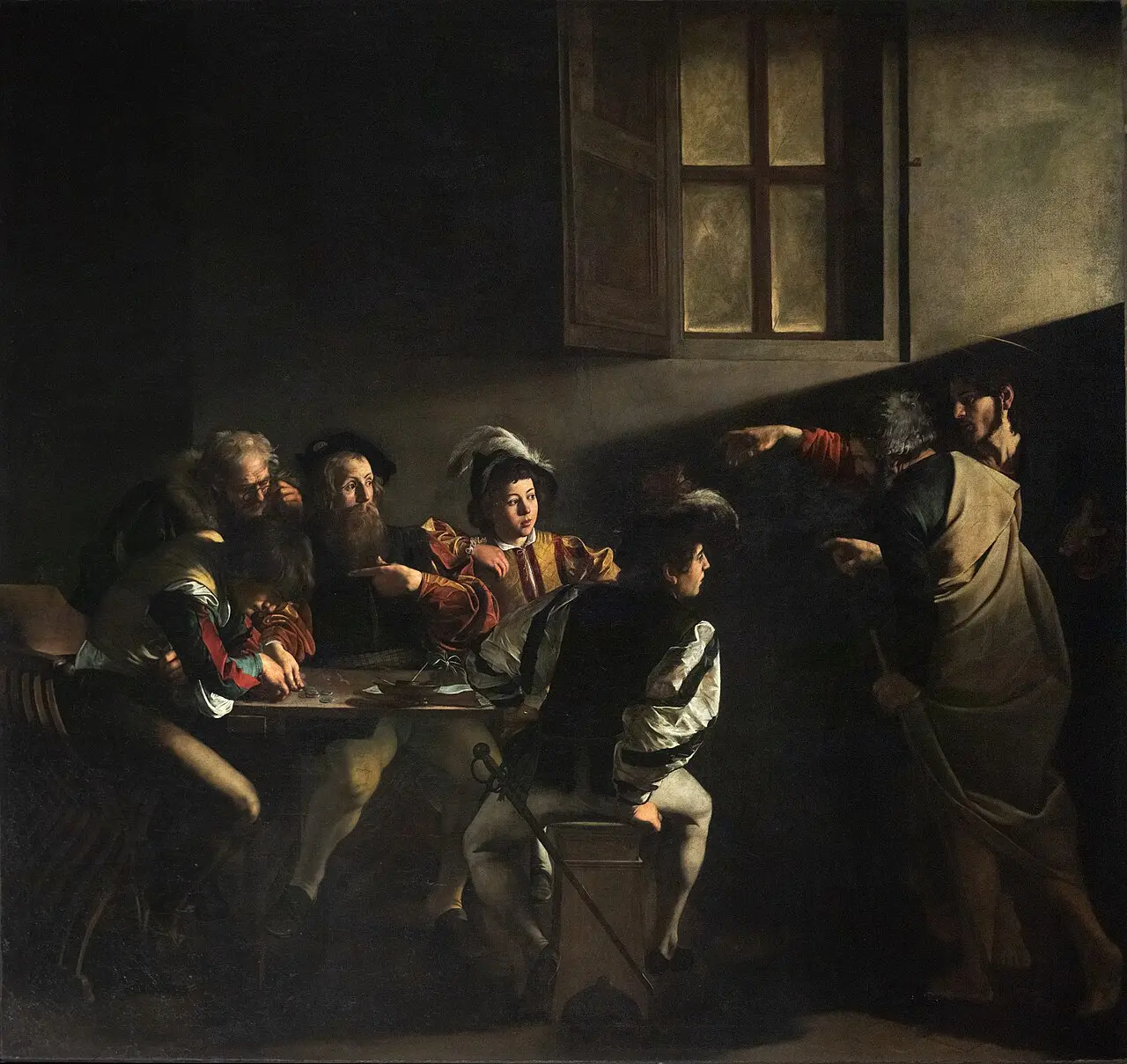
Own a hand-painted copy
The Calling of Saint Matthew
Painted by hand in oil on canvas, any size. Free worldwide shipping.
From $299 — Make it yours.Frequently asked questions
Where is The Calling of Saint Matthew?
It is in the Contarelli Chapel of the church of San Luigi dei Francesi in Rome, where it was placed in 1600.
Who is Matthew in the painting?
Traditionally he is the bearded man pointing at himself, but some historians think he is the young man counting coins.
What does the beam of light mean?
It is both natural light and a symbol of divine grace, falling on Matthew at the moment of his calling.
When was The Calling of Saint Matthew painted?
Caravaggio painted it in 1599–1600.
Sources and further reading
- Church of San Luigi dei Francesi, Contarelli Chapel
- Helen Langdon, Caravaggio: A Life (1998)
- Giovanni Pietro Bellori, Lives of the Modern Painters (1672)
