


Listen to this article
0:00 / 3:33 · Read by ArtLogia
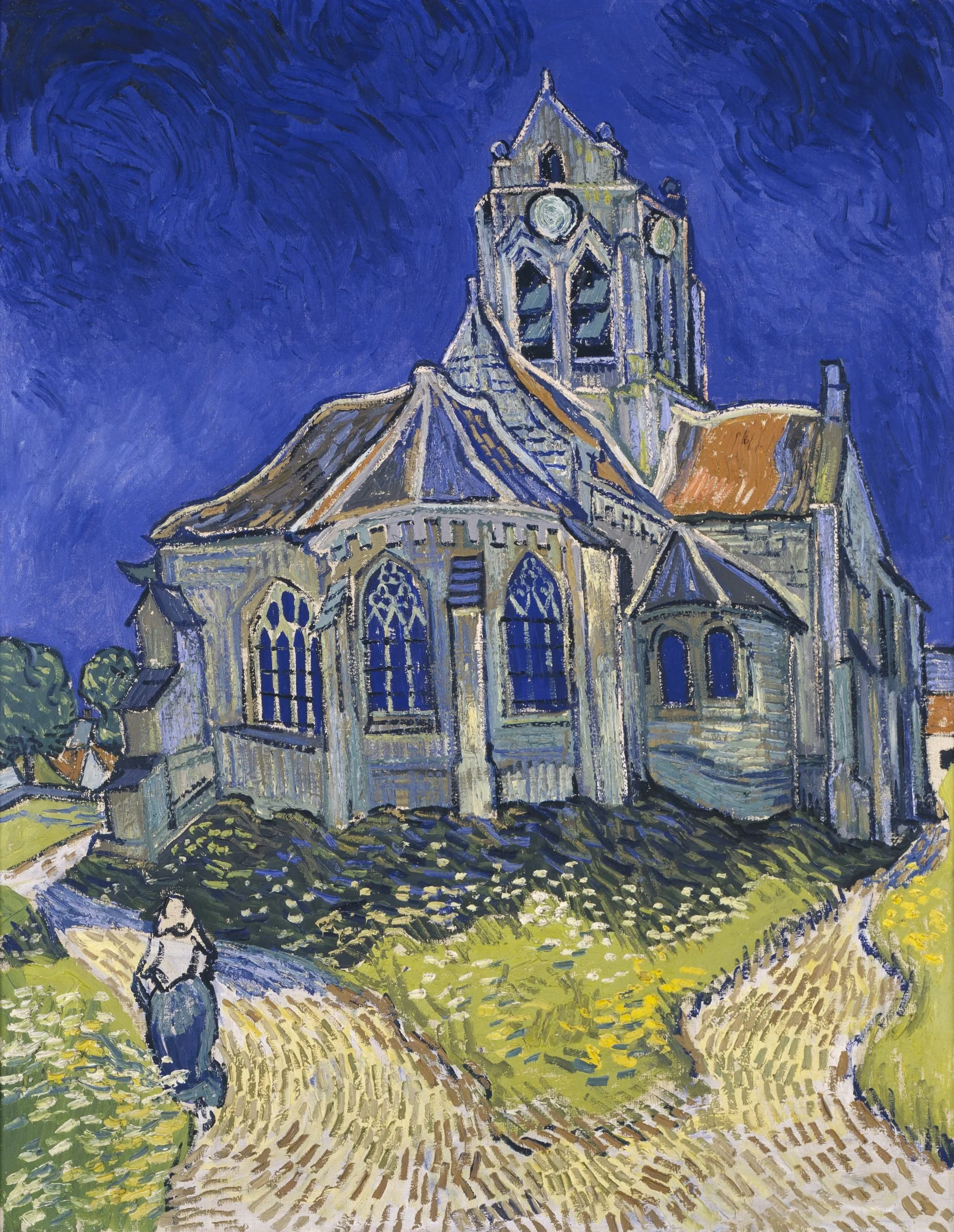
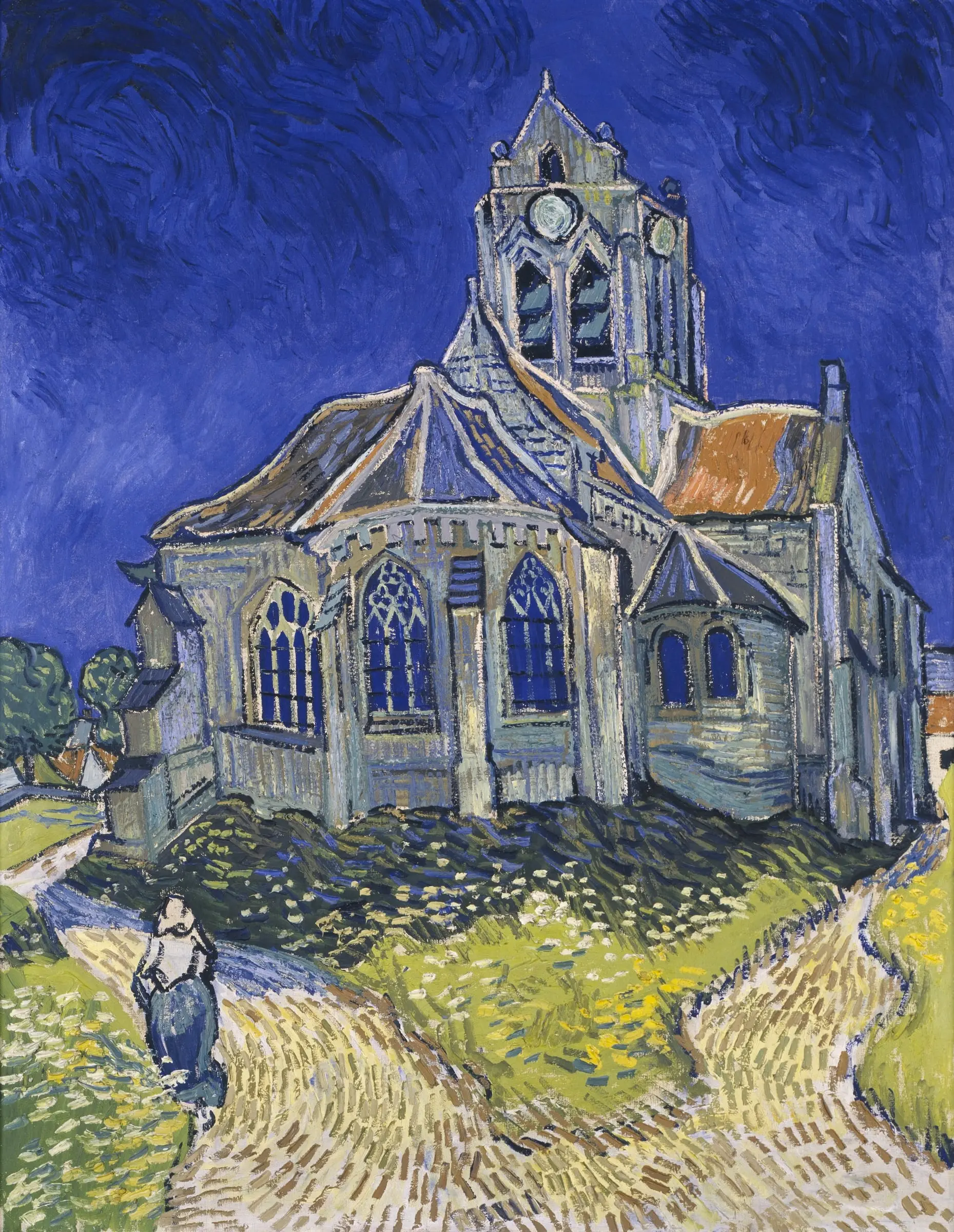
The village church of Auvers-sur-Oise stands against a deep cobalt sky, its walls and windows bending as if alive, while a path divides around it and a peasant woman walks away. Van Gogh painted it in June 1890, a few weeks before his death.
In this article
A church in a village north of Paris
In May 1890 Vincent van Gogh arrived in Auvers-sur-Oise, a village on the river Oise north of Paris, after a year in the asylum of Saint-Rémy. He stayed at the Auberge Ravoux and painted almost a picture a day. In early June he painted the village church, Notre-Dame-de-l'Assomption, a Gothic building of the twelfth and thirteenth centuries that still stands today.
He described the painting in a letter to his sister Wilhelmina: the building appears violet against a sky of deep, simple blue, pure cobalt, the stained-glass windows look like ultramarine blue patches, the roof is violet and partly orange, and in the foreground there is some green and sunny pink sand.
The church that moves
Van Gogh did not paint the church as a solid, stable building. Its walls bulge and bend, the roof seems to sag, and the lines of the windows curve as if the stone were alive. The church seems to sway in the heat. Some see in this a reflection of his inner turmoil; others an expression of the vitality he saw in all things.
 Detail 1
The bell tower
The tower rises against the cobalt sky, its lines curving and unsteady. Van Gogh made the old stone seem to breathe.
Blue windows
The stained-glass windows are painted as patches of deep ultramarine, almost the same colour as the sky, so that the sky seems to show through the church. This makes the building look hollow, as if light and air could pass through it.
Detail 2Windows of ultramarine
The church windows are painted in the same deep blue as the sky, as if the building were transparent.
The cobalt sky
The sky is a dark, intense cobalt blue, darker at the top, painted with swirling strokes. It is the kind of sky Van Gogh had painted at night in Arles and Saint-Rémy, but here it is daylight. The contrast between the dark sky and the sunlit sand in the foreground creates a strange, dreamlike light.
Detail 3A daytime sky of night
The deep cobalt sky, almost like night, contrasts with the sunlit path below, giving the scene a dreamlike quality.
The path and the woman
In the foreground, a sandy path divides into two around the church, one branch going left, the other right. A peasant woman in a white cap walks away along the left path. The forking path, like those in Wheatfield with Crows painted a few weeks later, has been read as a symbol of choice or uncertainty.
Detail 4The peasant woman
A woman in a white cap walks away along the path. She is the only figure in the scene, small and anonymous beside the great church.
Detail 5The dividing path
The path splits around the church into two branches, both leading out of the picture.
A memory of the north
Van Gogh wrote that the painting reminded him of the studies he had made in Nuenen of the old church tower and cemetery, but that the colour was now more expressive. The son of a pastor, he had a complex relationship with the church, and the painting has often been read as an image of faith seen from outside.
Seeing The Church at Auvers
The painting measures about 94 by 74 centimetres. It belonged to Dr Paul Gachet's family and was acquired by the French state in 1951; it is now in the Musée d'Orsay in Paris.
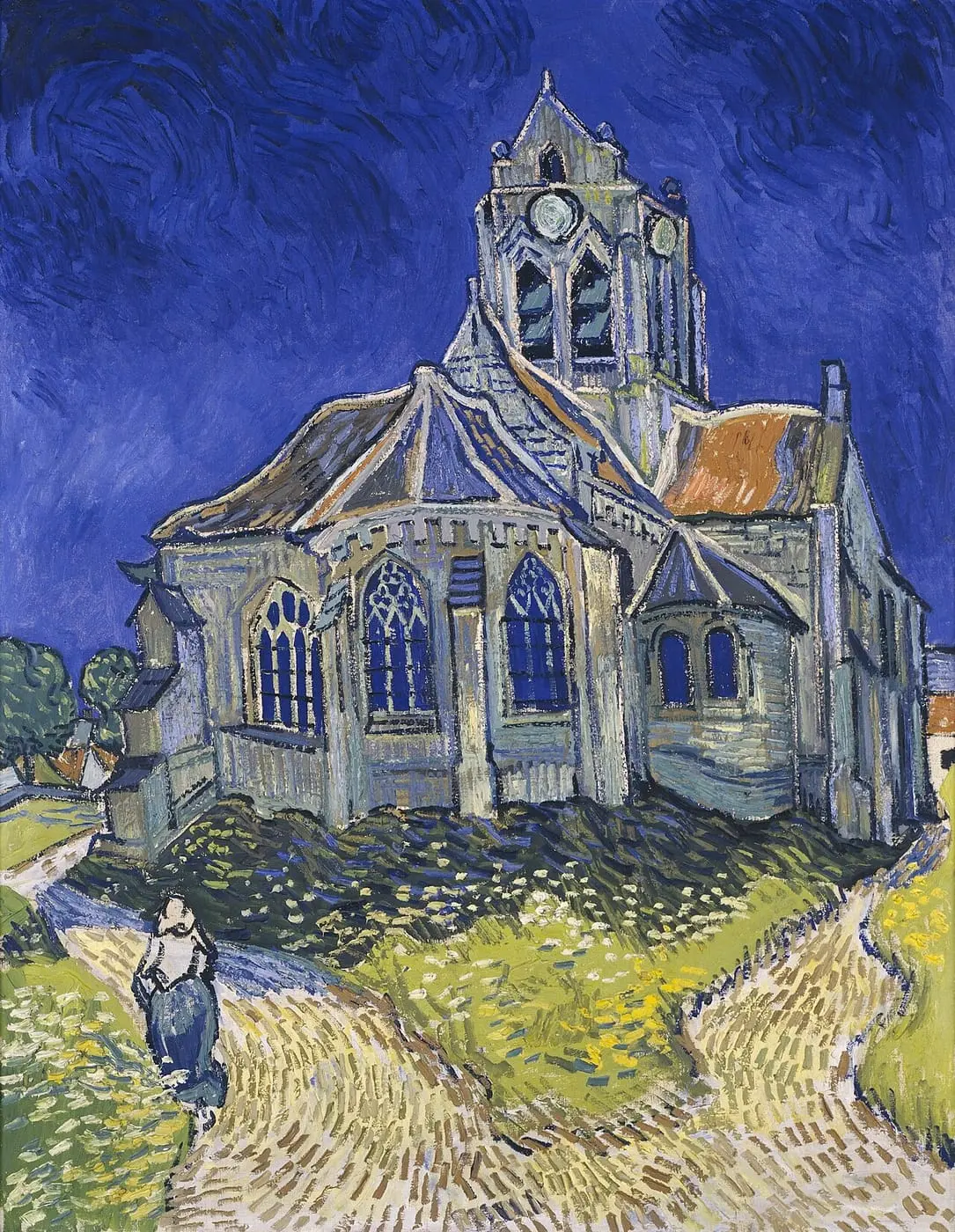
Own a hand-painted copy
The Church at Auvers
Painted by hand in oil on canvas, any size. Free worldwide shipping.
From $299 — Make it yours.Frequently asked questions
Where is the church in The Church at Auvers?
It is the church of Notre-Dame-de-l'Assomption in Auvers-sur-Oise, north of Paris, which still stands today.
When did Van Gogh paint The Church at Auvers?
He painted it in early June 1890, about seven weeks before his death.
Why does the church look distorted?
Van Gogh painted its lines curving and moving to express his feelings and the vitality he saw in nature.
Where is The Church at Auvers?
It is in the Musée d'Orsay in Paris.
Sources and further reading
- Musée d'Orsay, collection notes on The Church at Auvers
- Vincent van Gogh, letter to Wilhelmina van Gogh, June 1890
- Van Gogh Museum letters edition
