

Listen to this article
0:00 / 3:22 · Read by ArtLogia
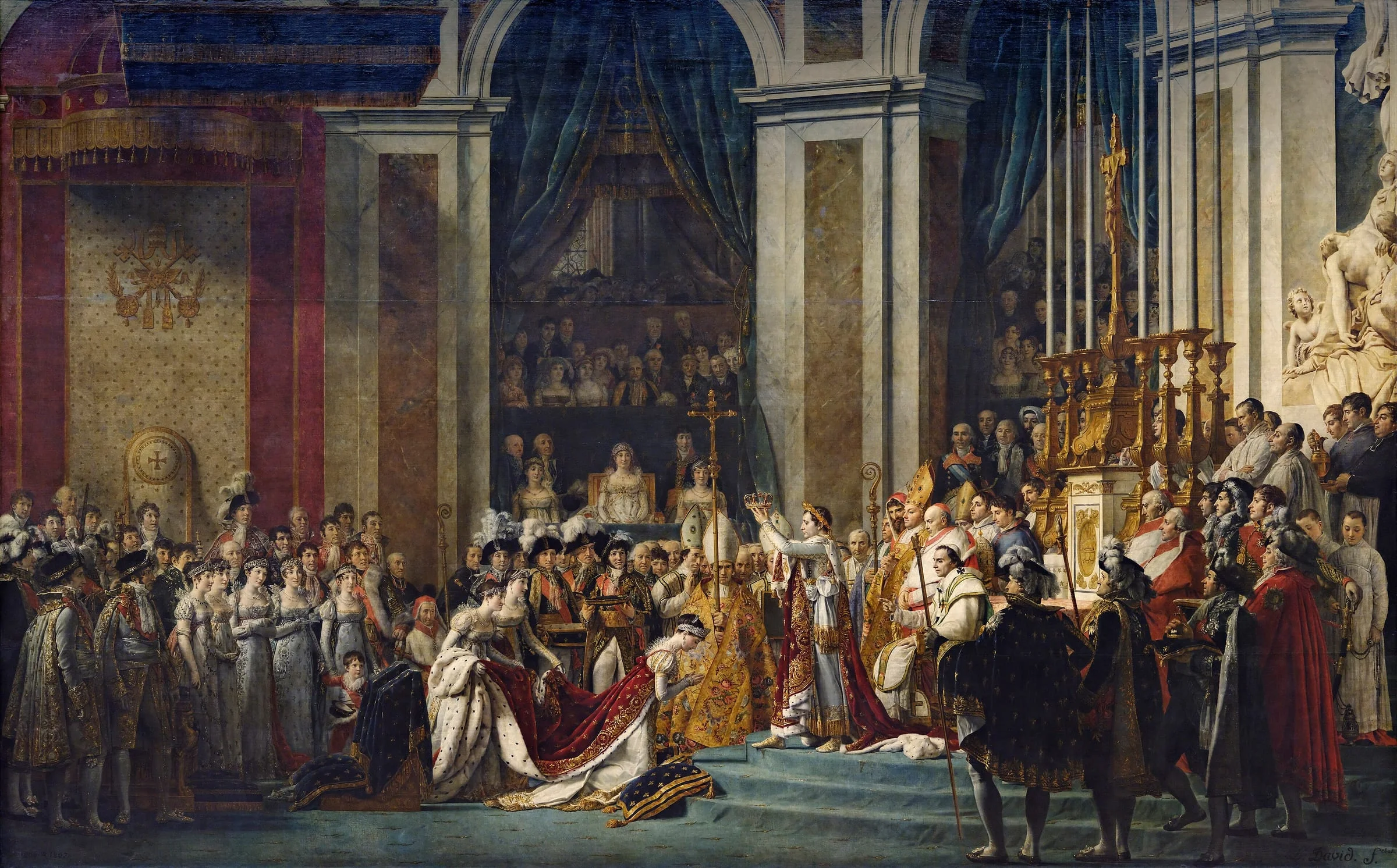
In Notre-Dame de Paris, Napoleon raises a crown above the head of his kneeling wife Joséphine, as the Pope blesses the ceremony and the court looks on. Jacques-Louis David's painting, finished in 1807, is one of the largest in the Louvre and a masterpiece of political image-making.
In this article
A ceremony in Notre-Dame
On 2 December 1804 Napoleon Bonaparte was crowned Emperor of the French in the cathedral of Notre-Dame de Paris, in the presence of Pope Pius VII. Breaking with tradition, he took the crown from the altar and placed it on his own head, then crowned his wife, Joséphine, as Empress.
Napoleon commissioned Jacques-Louis David, now his First Painter, to record the event. David attended the ceremony and made sketches, then worked for nearly three years on a canvas almost ten metres wide, finished in 1807. Its official title is The Consecration of the Emperor Napoleon and the Coronation of the Empress Joséphine.
Napoleon and the crown
At the centre, Napoleon, in a crimson velvet mantle embroidered with gold bees, raises the empress's crown with both hands. David first drew him crowning himself, but this seemed too arrogant, so he painted the more gracious moment when Napoleon crowns Joséphine. The laurel wreath of a Roman emperor already rests on his head.
 Detail 1
The raised crown
Napoleon lifts the crown above Joséphine's head. He already wears a golden laurel wreath, like a Roman emperor.
Joséphine
Joséphine kneels on a cushion before him, her hands joined, in a white silk dress and a red mantle held by her ladies-in-waiting. She was forty-one, but David made her look younger, which Napoleon appreciated. Her gentle expression gives the scene a note of grace amid the pomp.
Detail 2Joséphine kneeling
The empress kneels to receive her crown, her face calm and youthful. Her ladies-in-waiting hold the weight of her long velvet train.
The Pope
Seated behind Napoleon, Pope Pius VII raises his hand in blessing. In reality he did nothing of the kind; he sat with his hands on his knees. Napoleon is said to have insisted that David show the Pope blessing the ceremony, since he had not come all the way from Rome to do nothing.
Detail 3Pope Pius VII
The Pope raises his hand in blessing, a gesture Napoleon asked David to add. In fact the Pope remained passive during the ceremony.
A mother who was not there
In the central gallery, above the ceremony, sits Napoleon's mother, Letizia Bonaparte, known as Madame Mère, watching proudly. She did not attend the coronation, having quarrelled with her son over his treatment of his brothers, but Napoleon wanted her in the picture, and David obliged. David himself appears in a gallery above, sketching the scene.
Detail 4Madame Mère in the gallery
Napoleon's mother is shown in the place of honour, though she was absent from the ceremony. The painting records what Napoleon wanted remembered.
A crowd of portraits
Around the altar, David painted about 150 figures, most of them recognisable portraits: Napoleon's brothers and sisters, his marshals, cardinals, diplomats and court officials. Each was painted from life or from portraits, making the painting a vast group portrait of the new imperial regime.
Two versions
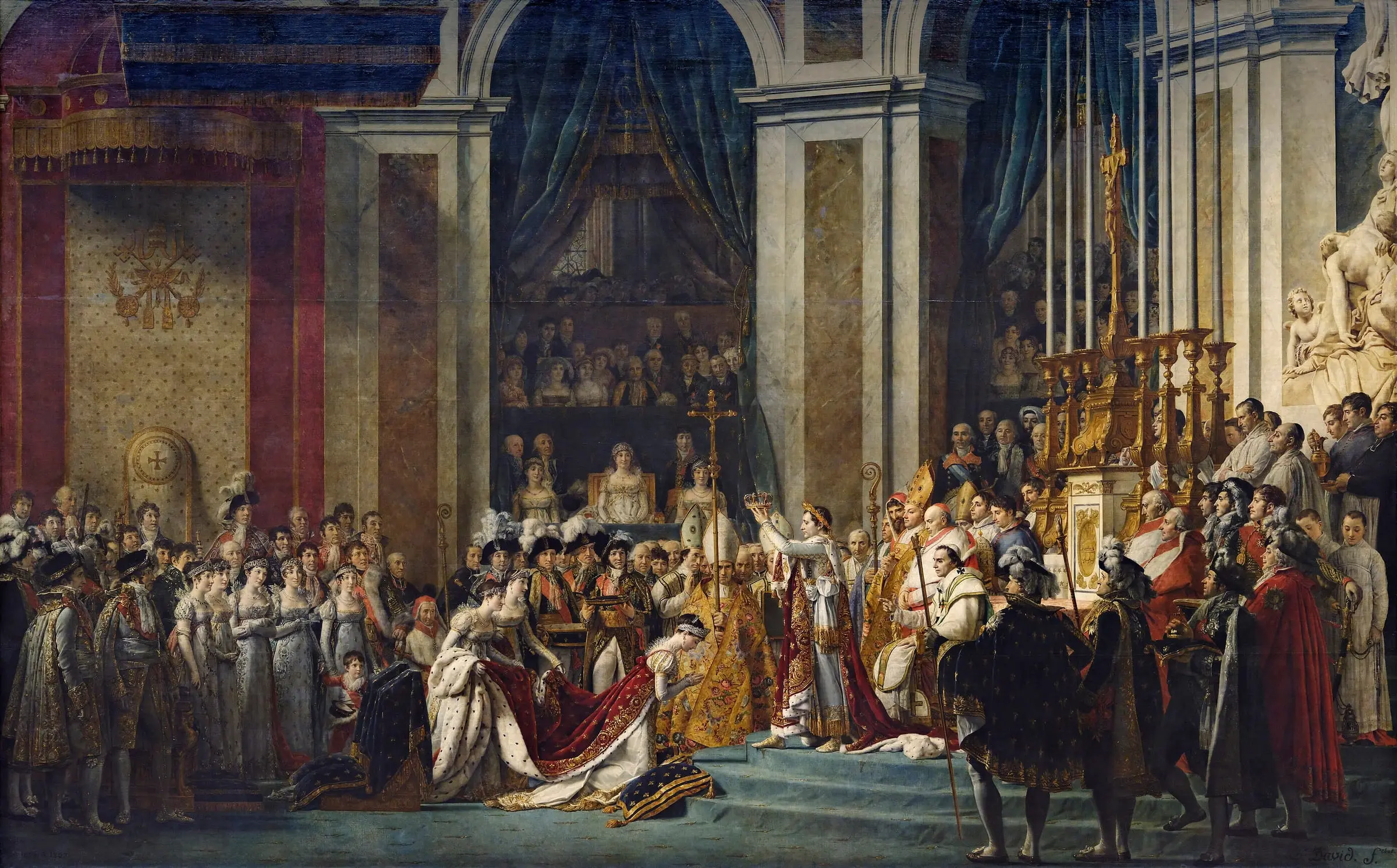
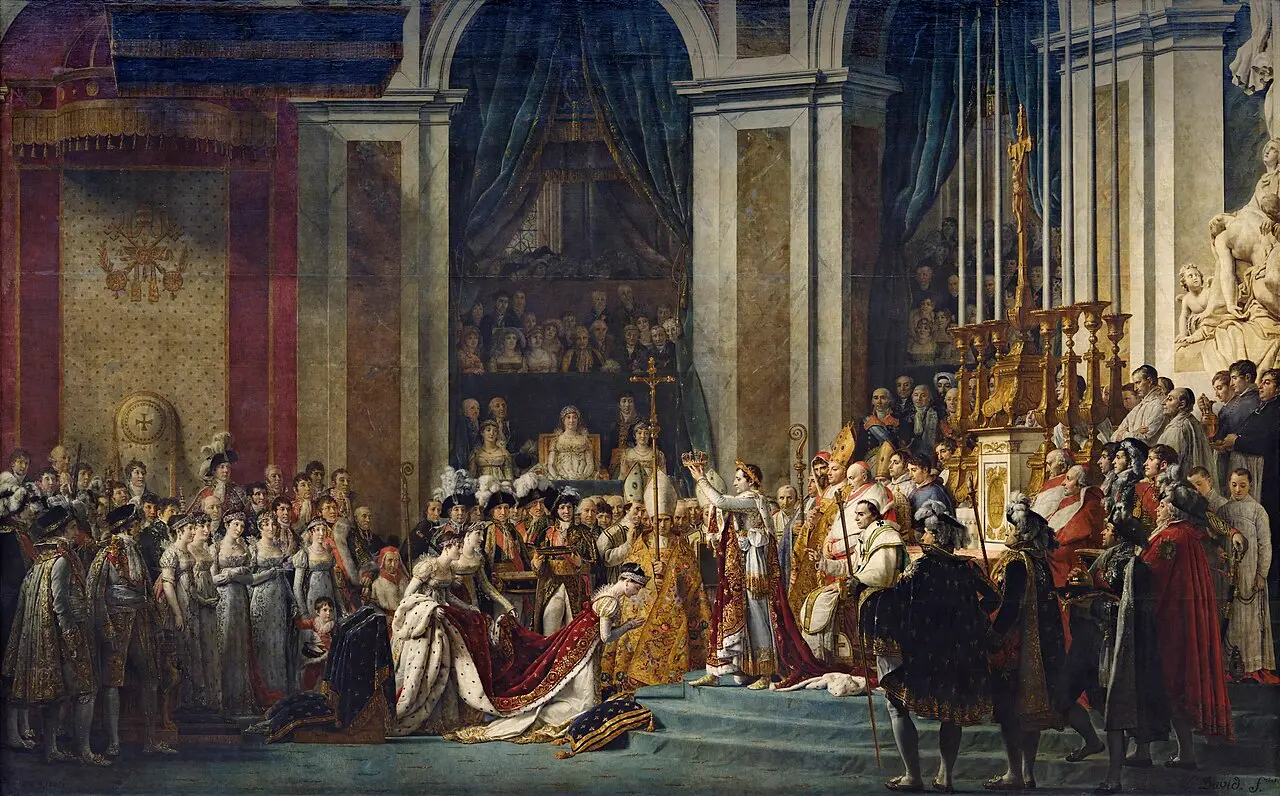
David later painted a second version, completed in 1822 in exile in Brussels, now at the Palace of Versailles. In that version one of Napoleon's sisters wears a pink dress instead of white. The original, about 6.2 by 9.8 metres, hangs in the Musée du Louvre in Paris, in the Daru room among the great French paintings of the early nineteenth century.
Own a hand-painted copy
The Coronation of Napoleon
Painted by hand in oil on canvas, any size. Free worldwide shipping.
From $299 — Make it yours.Frequently asked questions
Did Napoleon crown himself?
Yes, he crowned himself, but David chose to paint the moment when Napoleon crowned Joséphine, which looked less arrogant.
Was Napoleon's mother at the coronation?
No. Letizia Bonaparte did not attend, but Napoleon had David paint her in the place of honour.
How big is The Coronation of Napoleon?
The original measures about 6.2 by 9.8 metres, one of the largest paintings in the Louvre.
Where is The Coronation of Napoleon?
The original is in the Musée du Louvre in Paris; a second version is at the Palace of Versailles.
Sources and further reading
- Musée du Louvre, collection notes on The Consecration of the Emperor Napoleon
- Sylvain Laveissière (ed.), Le Sacre de Napoléon peint par David (Louvre, 2004)
- Philippe Bordes, Jacques-Louis David: Empire to Exile (2005)
