

Listen to this article
0:00 / 3:36 · Read by ArtLogia
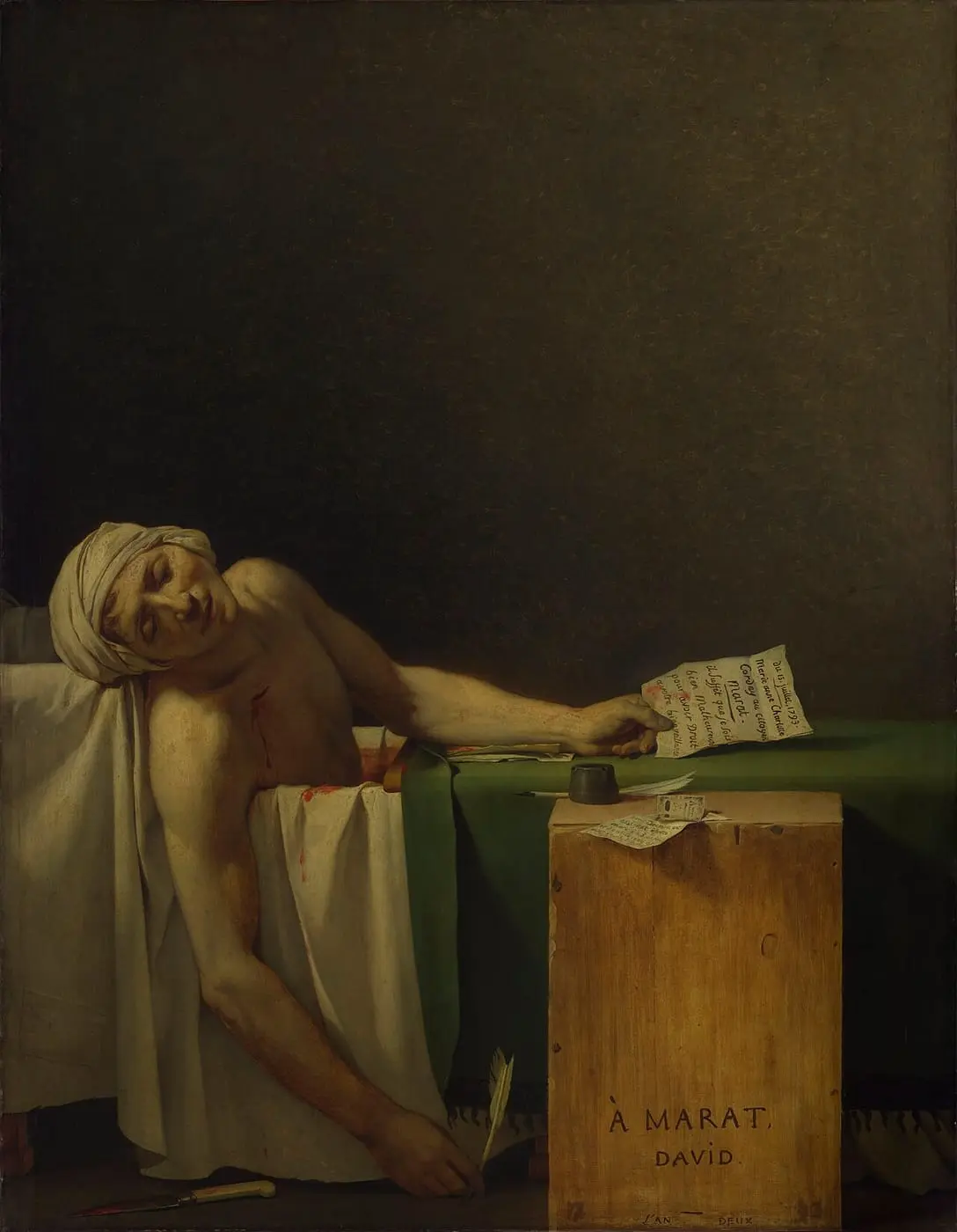
The revolutionary journalist Jean-Paul Marat lies dead in his bath, a letter in one hand and a quill in the other, the knife that killed him on the floor. Painted by his friend Jacques-Louis David in 1793, The Death of Marat turned a political murder into a modern Pietà.
In this article
A murder in Paris
On 13 July 1793, at the height of the French Revolution, Charlotte Corday, a young woman from Normandy who supported the moderate Girondins, came to the Paris apartment of Jean-Paul Marat. Marat was a radical journalist and deputy, whose newspaper L'Ami du peuple called for the execution of enemies of the Revolution. He suffered from a painful skin disease and spent hours in a medicinal bath, where he worked and received visitors. Corday gained entry by promising names of traitors, then stabbed him in the chest. She was guillotined four days later.
Jacques-Louis David, the leading painter of the Revolution, was a friend of Marat and a member of the National Convention. He had seen Marat in his bath the day before the murder. The Convention asked him to commemorate the martyr, and he completed the painting in less than four months.
The dead hero
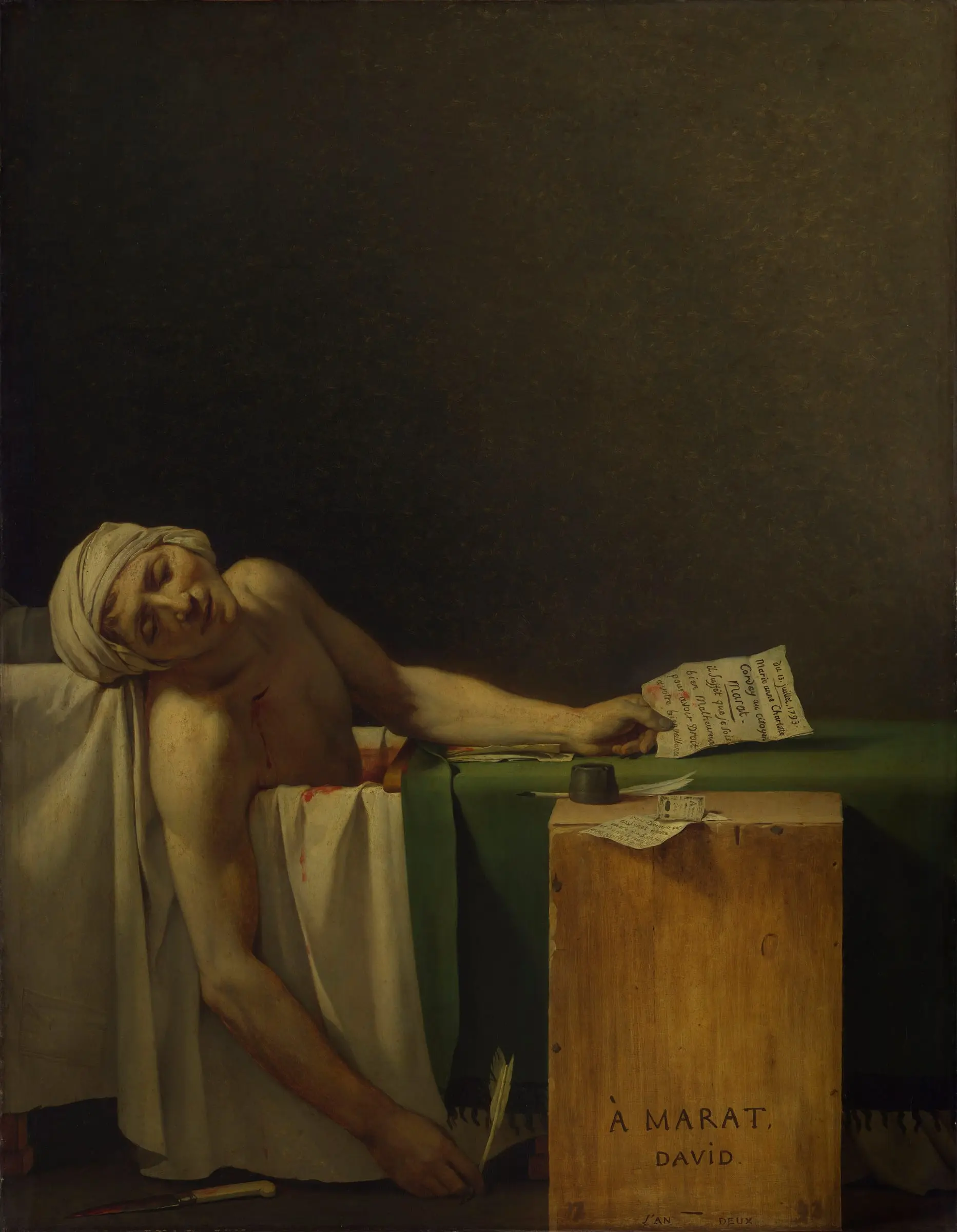
Marat's body slumps in the bath, his head wrapped in a white towel soaked in vinegar to relieve his illness. His face is calm, almost peaceful, and his wound is small and discreet. David idealised him: his skin, in reality disfigured by disease, is smooth and pale. The pose of the arm hanging down recalls the dead Christ in paintings of the Deposition and Michelangelo's Pietà.
 Detail 1
The head in the turban
Marat's head, wrapped in a vinegar-soaked towel, falls to one side. His serene expression turns a victim into a martyr.
The letter and the quill
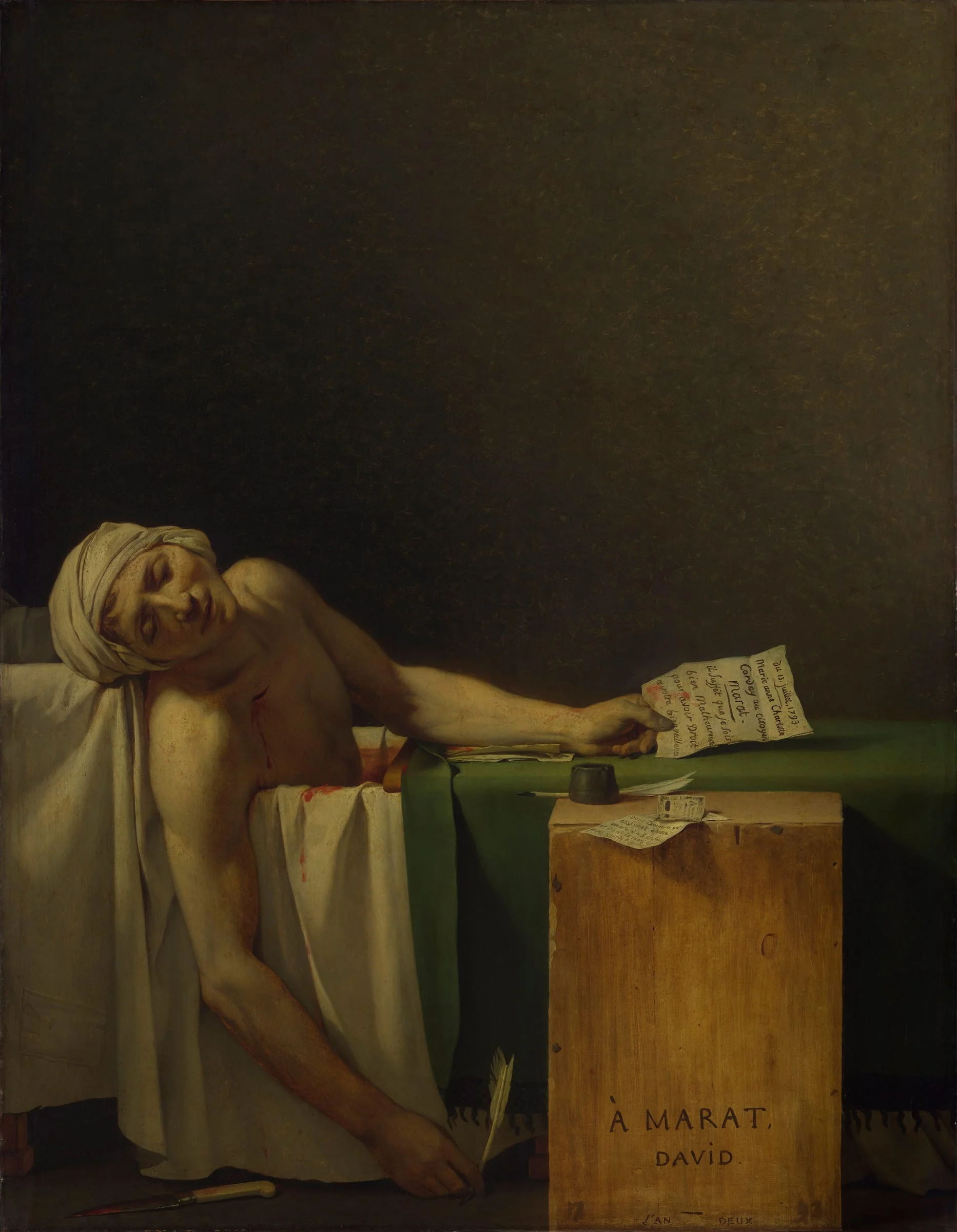
In his left hand Marat still holds the letter Corday gave him, with her name and the words "it is enough that I am unhappy to have a right to your benevolence". In his right hand, hanging over the side of the bath, he holds his quill. The message is clear: he died working for the people, even in his bath.
Detail 2Corday's letter
The letter in Marat's hand bears the name of his murderer and her plea for his help, a cruel reminder of the trick that gained her entry.
Detail 3The hanging arm and quill
Marat's right arm hangs down, still holding his pen. The gesture echoes the dead Christ in images of the Deposition.
The wooden crate
Beside the bath stands a plain wooden crate that Marat used as a desk, with an inkwell, a pen and a banknote that he was sending to a widow of a soldier. On it David painted the dedication À Marat, David, "To Marat, David", like an inscription on a tomb, with the date "l'an deux", the year two of the Republic.
Detail 4"À Marat, David"
The dedication on the crate turns the painting into a monument. The simple wood and the banknote speak of Marat's poverty and generosity.
The empty space
The upper half of the painting is almost empty: a dark, flickering wall that seems to fill with shadow and light. This void makes the scene feel solemn and silent, like a chapel. Later artists and critics saw in this abstraction one of the first signs of modern painting.
A painting hidden and rediscovered
After the fall of Robespierre in 1794, Marat's reputation collapsed, and David took the painting back. When he went into exile in Brussels after the restoration of the monarchy, it stayed hidden in his family. His heirs gave it to the Royal Museums of Fine Arts of Belgium in Brussels in 1893, where it remains. Several copies by David's studio exist, one of them in the Louvre.
The original measures about 1.65 by 1.28 metres.
Own a hand-painted copy
The Death of Marat
Painted by hand in oil on canvas, any size. Free worldwide shipping.
From $299 — Make it yours.Frequently asked questions
Who killed Marat?
Charlotte Corday, a supporter of the Girondins, stabbed Marat in his bath on 13 July 1793.
Why was Marat in a bath?
He suffered from a painful skin disease and spent long hours in a medicinal bath, where he wrote and received visitors.
What is written on the wooden crate?
David painted the dedication "À Marat, David" (To Marat, David), like an inscription on a tomb.
Where is The Death of Marat?
The original is in the Royal Museums of Fine Arts of Belgium in Brussels.
Sources and further reading
- Royal Museums of Fine Arts of Belgium, collection notes on The Death of Marat
- T. J. Clark, Farewell to an Idea: Episodes from a History of Modernism (1999)
- Warren Roberts, Jacques-Louis David, Revolutionary Artist (1989)
