


Listen to this article
0:00 / 3:29 · Read by ArtLogia
The Assyrian king Sardanapalus reclines calmly on his bed as his servants slaughter his concubines, horses and treasures before his enemies arrive. Shown at the Salon of 1827–1828, Eugène Delacroix's vast painting shocked critics with its violence, colour and chaos.
In this article
A legend of destruction
Sardanapalus was a legendary king of Assyria, described by ancient historians as a decadent ruler devoted to luxury. When his capital, Nineveh, was besieged by rebels, he chose to die rather than surrender: he had a great pyre built and burned himself with his wives, servants and treasures. The English poet Lord Byron told the story in a tragedy published in 1821, which inspired Eugène Delacroix.
Delacroix showed the painting at the Paris Salon of 1827–1828. Critics were horrified by its violence, its sensuality and its apparent disorder, and the director of fine arts warned him that he would receive no more state commissions if he continued in this way.
The impassive king
In the upper left, Sardanapalus reclines on his huge red bed, dressed in white, leaning on his elbow. He watches the destruction around him with total calm, almost boredom. His indifference is the most disturbing element of the scene.
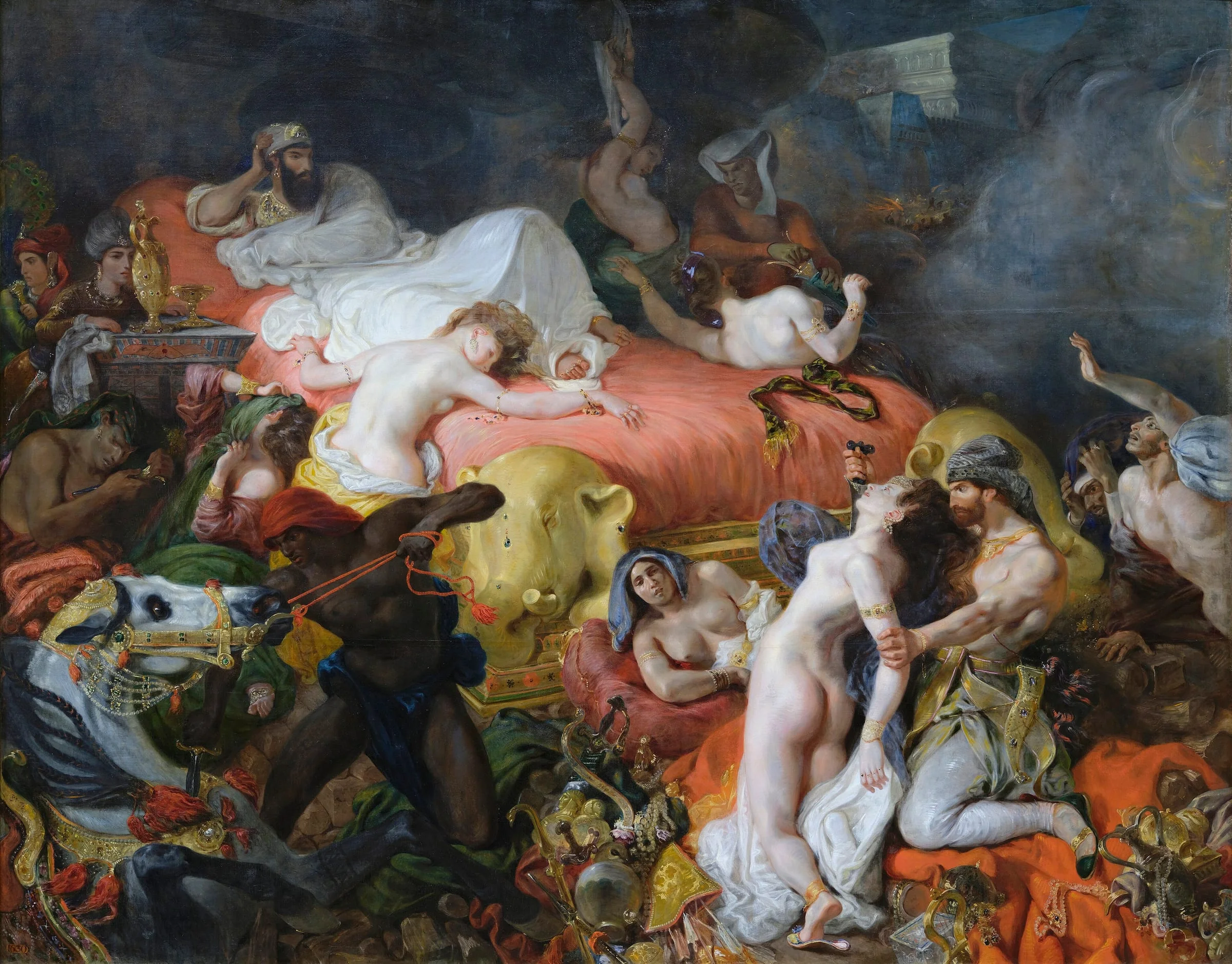 Detail 1
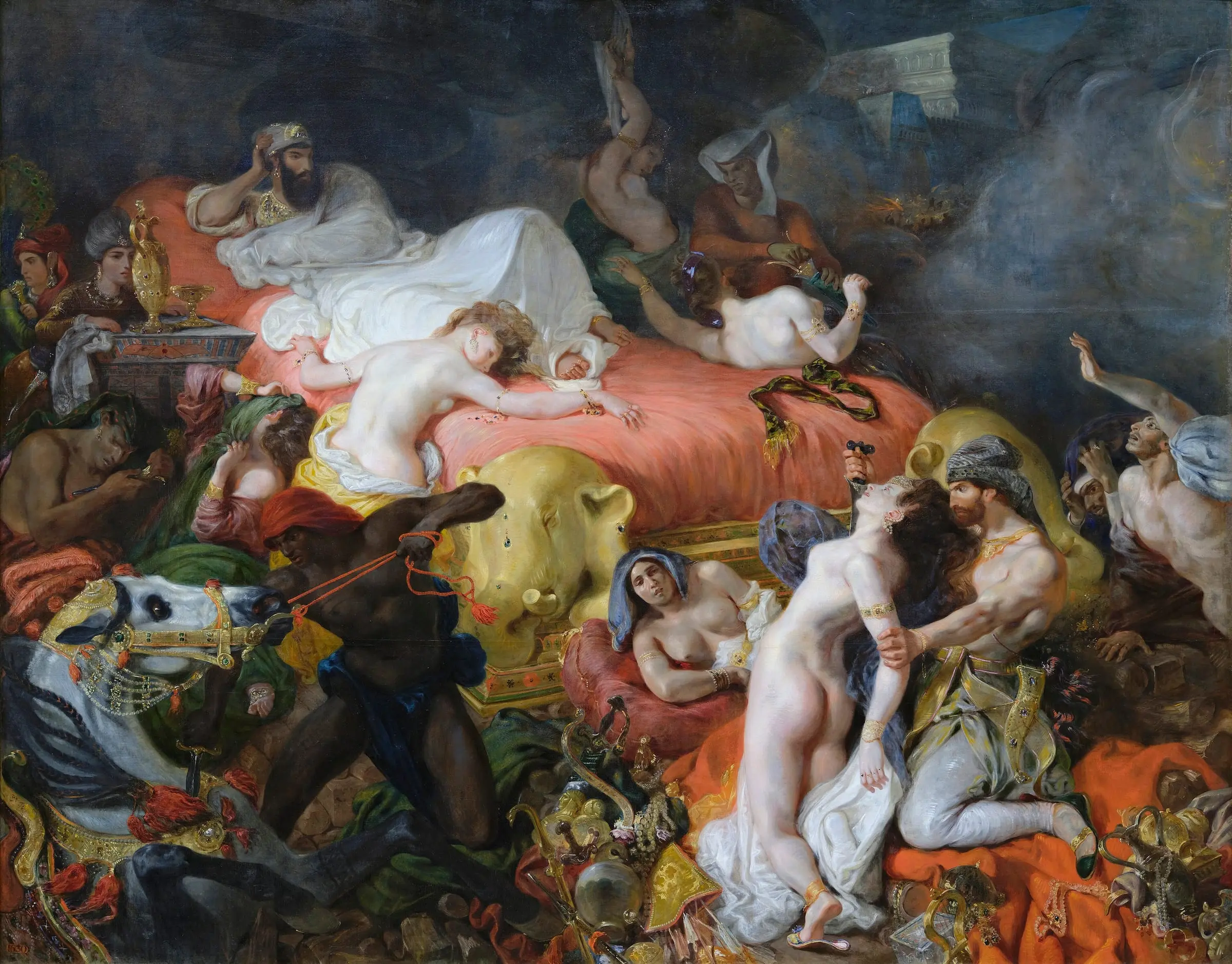
The impassive king
Sardanapalus reclines on his bed in white robes, watching the slaughter with cold detachment.
The slaughter
Around the bed, the king's slaves kill his concubines and his favourite horse, so that no one and nothing he loved can fall into the hands of his enemies. Delacroix composed the scene as a swirling diagonal of bodies, fabrics and jewels, running from the king at the top left down to the lower right.
Detail 2The slaughtered horse
In the lower left, a servant drags a richly harnessed horse to its death, its eyes wide with terror.
Treasures on the pyre
The bed is decorated with golden elephant heads, and the floor is strewn with jewels, gold vessels, a hookah, weapons and fabrics, all destined for the flames. Delacroix painted them with rich, glowing colour inspired by Rubens and the Venetian painters.
Detail 3The golden elephant
A golden elephant head decorates the foot of the king's bed, one of the treasures that will perish in the fire.
Colour and movement
The painting is dominated by an intense red, the colour of the bed, the fabrics and the blood. Delacroix used colour and movement, rather than clear drawing and composition, to express passion, in direct opposition to the Neoclassical style of David and Ingres. That is why the painting became a manifesto of French Romanticism.
Detail 4Smoke and darkness
In the upper right, smoke and darkness close in on the scene, as the siege reaches its end.
A painting rediscovered
After the scandal, Delacroix kept the painting in his studio for years and sold it in 1846. It was acquired by the Louvre in 1921. It measures about 3.9 by 5 metres and hangs in the Musée du Louvre in Paris, near Liberty Leading the People.
Romanticism versus Neoclassicism
In the 1820s, French painting was divided between two camps. The Neoclassicists, led by Ingres and the heirs of David, valued clear drawing, balanced composition and moral subjects from antiquity. The Romantics, led by Delacroix, valued colour, movement, emotion and subjects of passion and violence, often drawn from literature. The Death of Sardanapalus was the most extreme statement of the Romantic position: a chaotic swirl of bodies, jewels and fabrics, dominated by red, without a stable centre or a clear moral. Critics called it a fiasco, and even Delacroix's friends were troubled. Today it is admired as a daring masterpiece whose energy and colour anticipate the art of the later nineteenth century.
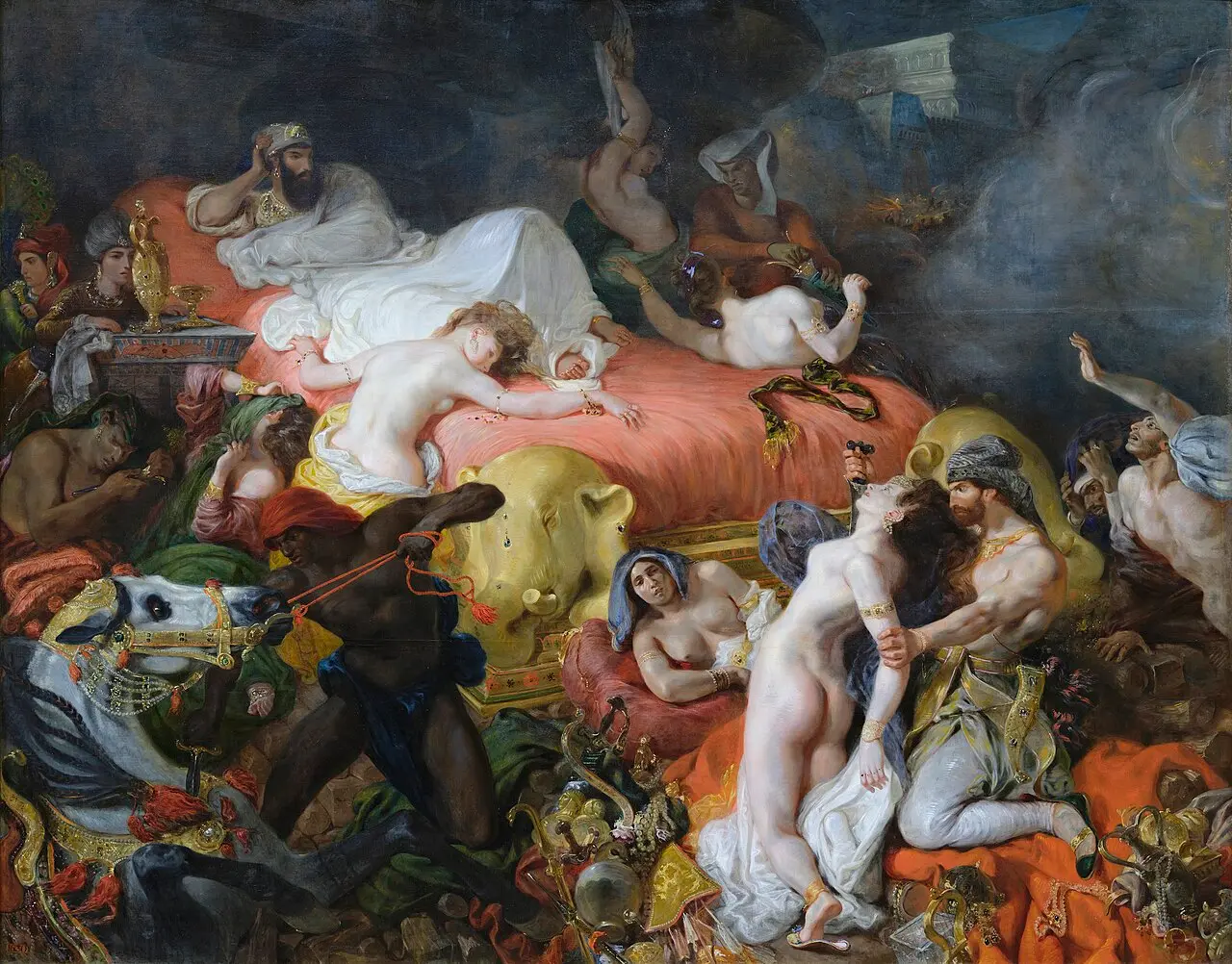
Own a hand-painted copy
Death of Sardanapalus
Painted by hand in oil on canvas, any size. Free worldwide shipping.
From $299 — Make it yours.Frequently asked questions
Who was Sardanapalus?
Sardanapalus was a legendary king of Assyria who, according to legend, destroyed himself and his possessions rather than surrender to his enemies.
What inspired Delacroix's painting?
It was inspired by Lord Byron's tragedy Sardanapalus, published in 1821.
Why was the painting controversial?
Critics were shocked by its violence, sensuality and apparently chaotic composition at the Salon of 1827–1828.
Where is The Death of Sardanapalus?
It is in the Musée du Louvre in Paris.
Sources and further reading
- Musée du Louvre, collection notes on The Death of Sardanapalus
- Lord Byron, Sardanapalus (1821)
- Barthélémy Jobert, Delacroix (1998)
