

Listen to this article
0:00 / 4:18 · Read by ArtLogia
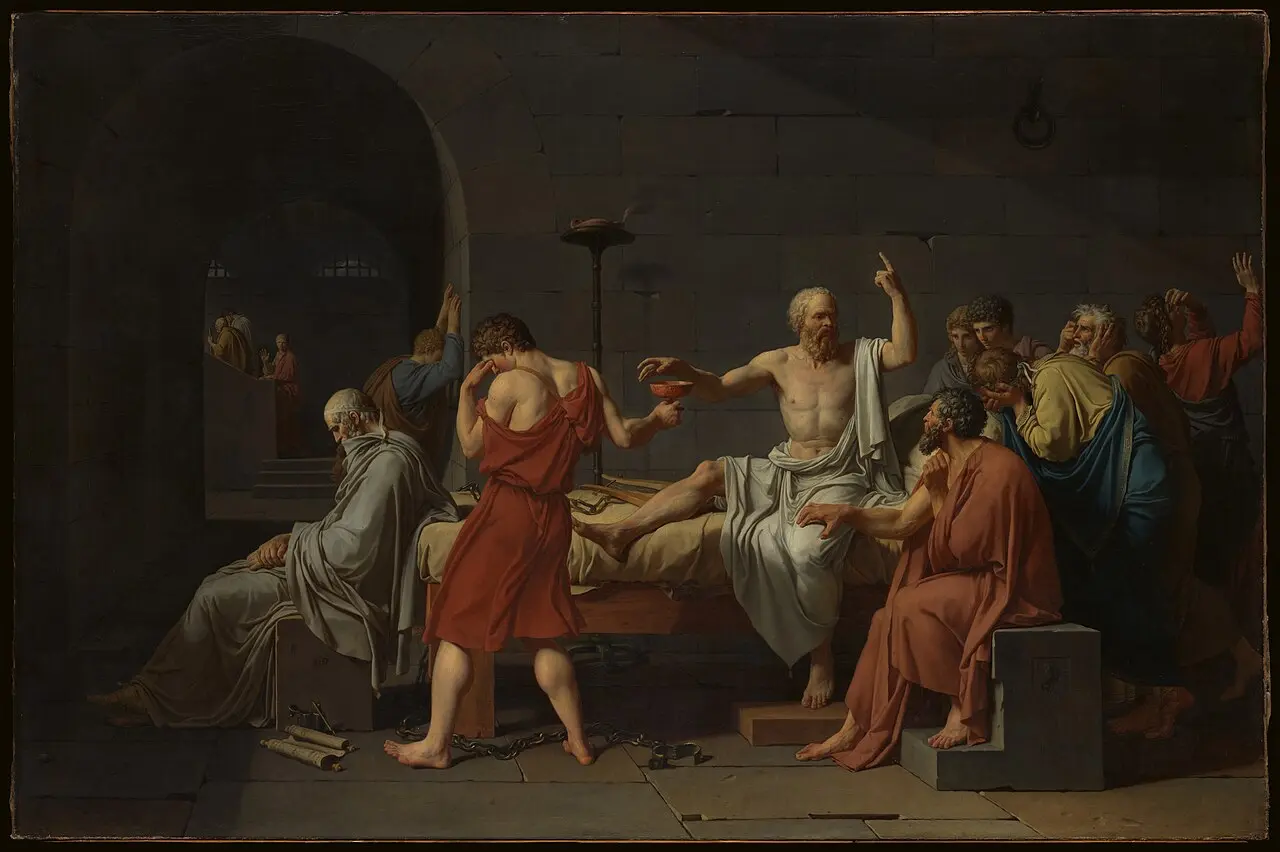
Condemned to death for corrupting the youth of Athens, Socrates calmly reaches for the cup of poison while his followers despair around him. Jacques-Louis David's 1787 painting turned an ancient story into a lesson in courage and conviction.
In this article
The last day of Socrates
In 399 BC, the Athenian philosopher Socrates was sentenced to death for impiety and for corrupting the young with his questions. He could have escaped from prison, as his friends urged, but he refused, saying that a citizen must obey the laws even when they are unjust. On his last day he spent hours discussing the immortality of the soul with his followers, then drank a cup of hemlock and died calmly.
His pupil Plato described that day in the dialogue Phaedo. Almost two thousand two hundred years later, in 1787, Jacques-Louis David painted the moment when Socrates reaches for the cup without looking at it, still talking, his finger raised towards the heavens.
A Neoclassical manifesto
David was the leading painter of Neoclassicism, the style that looked to ancient Greece and Rome for clear forms and moral examples. The painting was commissioned by Charles-Michel Trudaine de la Sablière, a young aristocrat. It was shown at the Salon of 1787, where it was hailed as a masterpiece; Thomas Jefferson, then in Paris, saw it and admired it.
The composition is like a frieze in an ancient relief: the figures are arranged in a shallow space parallel to the picture surface, against a plain stone wall. The light is strong and clear, the contours sharp, the colours restrained, so that nothing distracts from the drama of the moral choice.
Socrates
Socrates sits upright on his bed, his body muscular and idealised, though he was about seventy when he died. His left hand points upwards, towards the realm of ideas and the immortal soul he has been describing; his right hand reaches for the cup without hesitation. He is the only calm figure in the room.
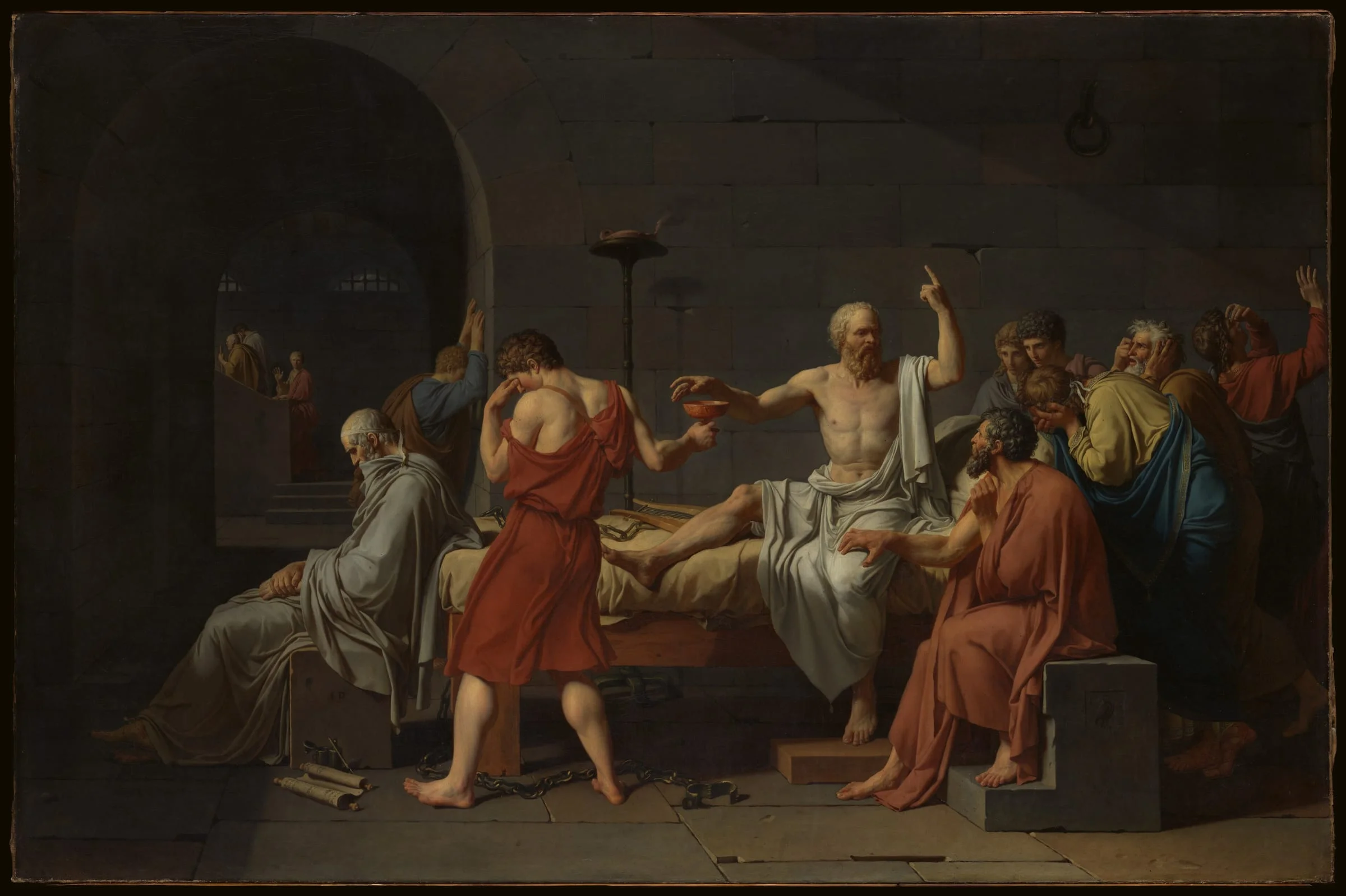 Detail 1
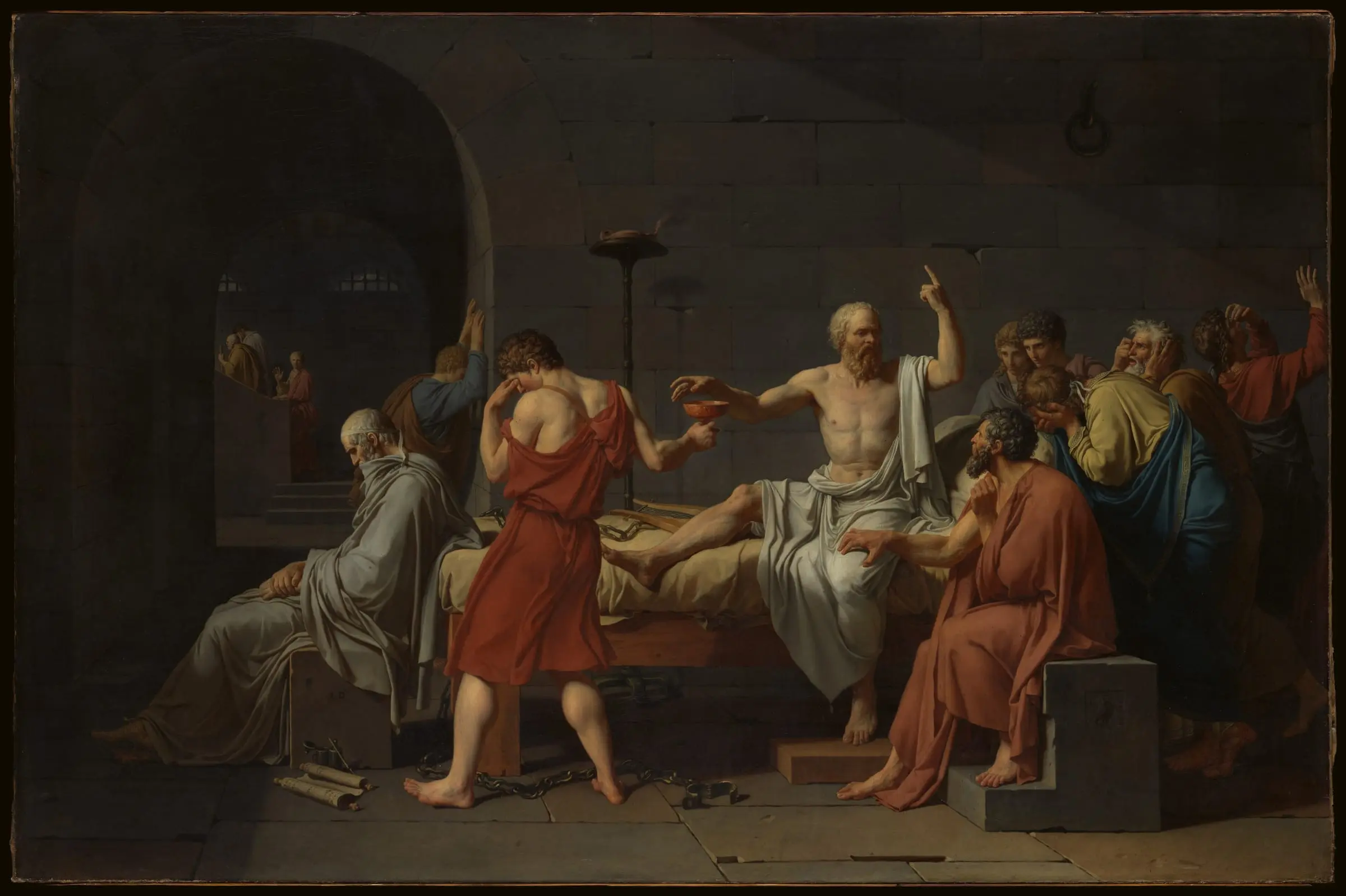
The raised finger
Socrates points upward as he speaks about the immortality of the soul. His gesture is the moral centre of the painting.
The cup of hemlock
A young jailer, turning his face away in shame and grief, hands him the cup. Their hands nearly meet in the centre of the painting, the point where life and death touch. The jailer covers his eyes with his other hand, unable to watch.
Detail 2The hand and the cup
Socrates reaches for the poison without looking at it. The jailer offering the cup turns away, his face hidden in his hand.
The disciples
Around the bed, the followers of Socrates show every degree of grief. Crito, his old friend, sits beside him and grips his thigh, looking intently into his face. On the right, young men weep, cover their faces or lean against the wall in despair. Their emotion makes the philosopher's serenity even more striking.
Detail 3Grief on the right
The disciples on the right give way to grief, each in a different pose. David contrasts their emotion with the calm reason of Socrates.
Plato at the foot of the bed
At the foot of the bed sits an old man, turned away from the scene, his head bowed: Plato. He was in fact young at the time of Socrates' death, and according to his own account he was ill and absent. David portrayed him as an old man remembering, as if the whole scene were his memory. On the bench beside him lie a scroll and a pen, and David signed his name and initials there.
Detail 4Plato remembering
Plato sits at the foot of the bed with his back to the scene, lost in thought. David painted him old, as the author who would record this day.
In the background, through an archway, Socrates' wife Xanthippe is led away up the stairs, raising her hand in farewell. Her departure, following Plato's account, leaves the philosopher among his friends.
A painting for a revolution
Two years after the painting was exhibited, the French Revolution broke out. David became one of its leading artists, and his scenes of ancient virtue, sacrifice and civic duty, from The Oath of the Horatii to The Death of Socrates, seemed to announce its ideals.
Seeing The Death of Socrates
The painting measures about 1.3 by 2 metres and is in the Metropolitan Museum of Art in New York, in the galleries of European paintings.
Own a hand-painted copy
The Death of Socrates
Painted by hand in oil on canvas, any size. Free worldwide shipping.
From $299 — Make it yours.Frequently asked questions
What does The Death of Socrates show?
It shows the Athenian philosopher Socrates in 399 BC reaching for the cup of hemlock he was condemned to drink, while discussing the immortality of the soul.
Who is the old man at the foot of the bed?
He is Plato, Socrates' pupil, shown as an old man remembering the scene he later described in the Phaedo.
When was The Death of Socrates painted?
Jacques-Louis David painted it in 1787.
Where is The Death of Socrates?
It is in the Metropolitan Museum of Art in New York.
Sources and further reading
- Metropolitan Museum of Art, collection notes on The Death of Socrates
- Plato, Phaedo
- Dorothy Johnson, Jacques-Louis David: Art in Metamorphosis (1993)
