

Listen to this article
0:00 / 4:15 · Read by ArtLogia
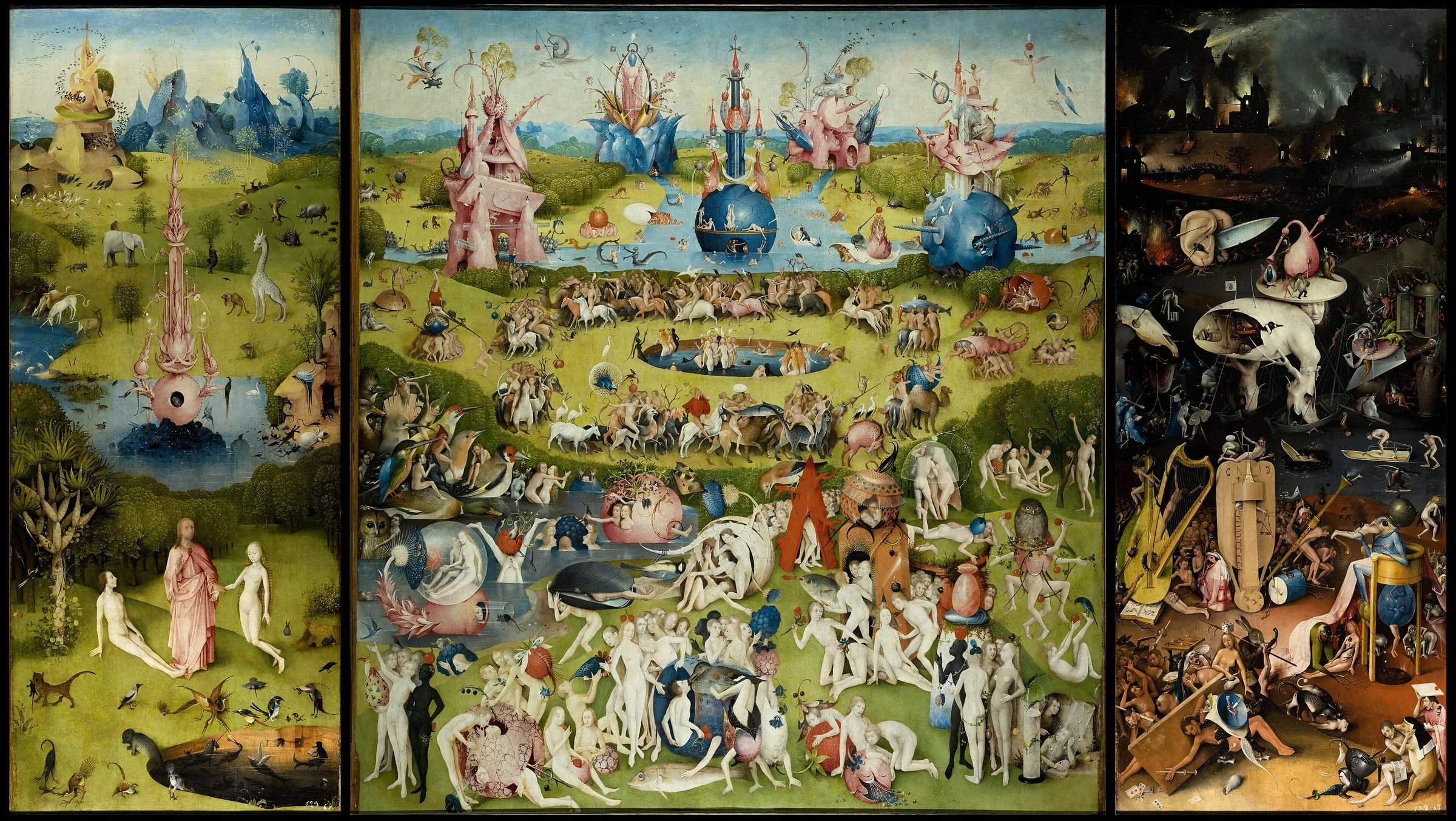
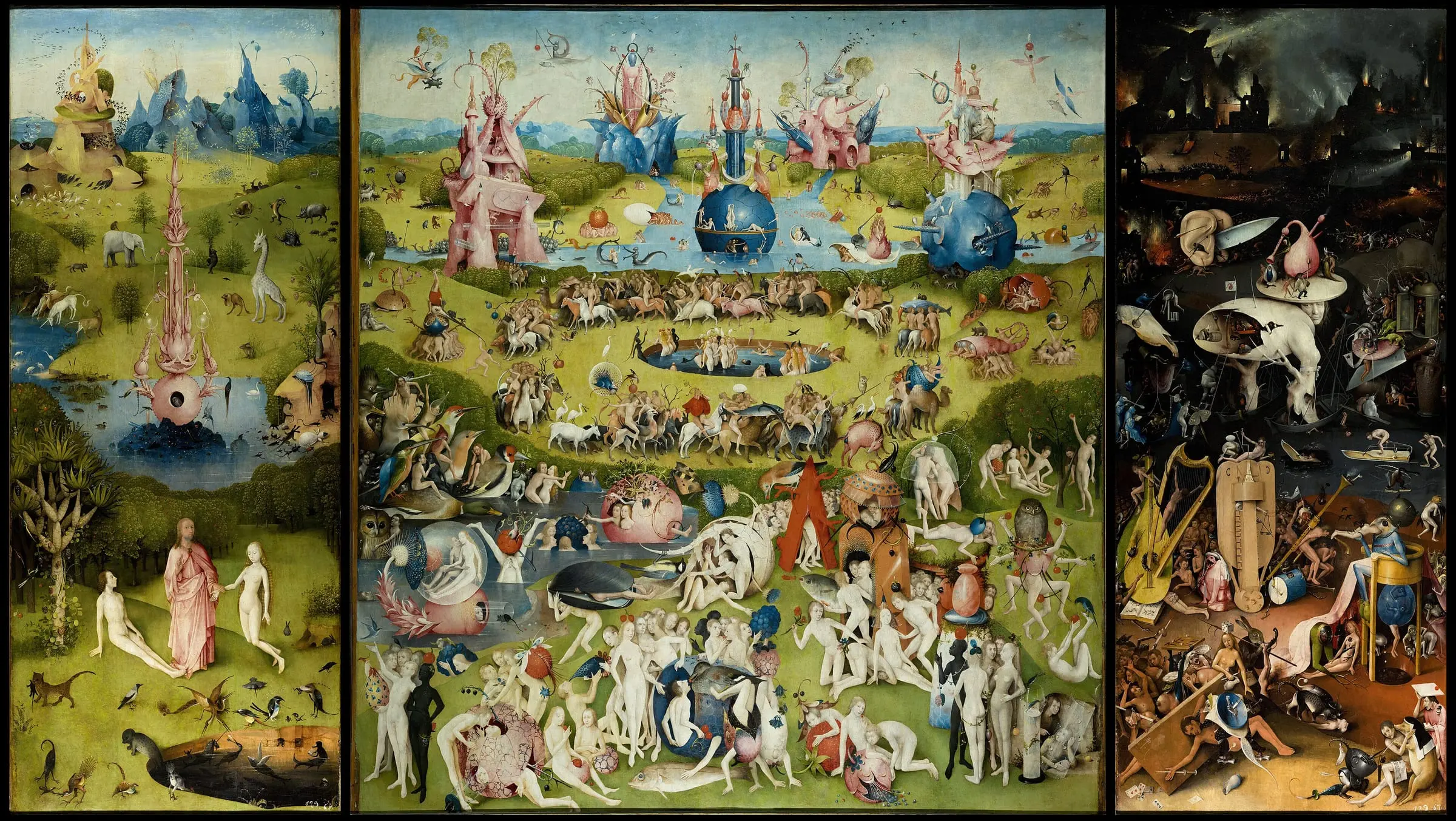
On the left, God presents Eve to Adam in Paradise. In the centre, hundreds of naked people play among giant fruits and fantastic birds. On the right, Hell swallows them in darkness and fire. Hieronymus Bosch's triptych is one of the strangest and most fascinating paintings ever made.
In this article
A painting to be opened
Hieronymus Bosch painted The Garden of Earthly Delights around 1490–1510 in 's-Hertogenbosch, in what is now the Netherlands. It is a triptych, an altarpiece-like painting with a central panel and two folding wings. When the wings are closed, they show the world on the third day of creation, a transparent globe in grey tones. When opened, they reveal an explosion of colour across three panels about four metres wide.
It was not made for a church but probably for the Nassau family's palace in Brussels, where visitors in the sixteenth century were already astonished by it. King Philip II of Spain, who loved Bosch's work, acquired it, and it entered the Escorial monastery in 1593. Since 1939 it has been in the Prado.
The left panel: Paradise
The left wing shows the Garden of Eden. God, in the form of Christ, takes Eve by the wrist and presents her to Adam, who has just woken. Around them lies a landscape of fresh greens and blues, with a pink fountain of life in the middle and exotic animals, including a giraffe and an elephant. But even here, small details hint at what is to come: a cat carries off a mouse, and strange creatures crawl out of the pool.
 Detail 1
God presents Eve to Adam
In the Garden of Eden, God holds Eve's wrist as Adam looks up at her. This first union of man and woman leads to everything that happens in the next panels.
The central panel: the garden of pleasure
The central panel is crowded with hundreds of naked men and women, white and black, playing, embracing, riding animals and eating enormous strawberries, cherries and grapes. Giant birds, fish and shells mix with the people. In the middle, a procession of riders on horses, camels and other beasts circles a pool of bathing women. In the background rise fantastic pink and blue structures like the towers of a dreamlike city.
Detail 2The cavalcade around the pool
Riders on horses, unicorns and other beasts circle a pool of bathing women. The circular procession is often read as an image of desire that never ends.
Is this a paradise or a warning? Most historians read the central panel as a vision of humanity lost in sensual pleasure, without awareness of sin: a world of delights that is fragile and fleeting, like the fruits that will rot. Others have suggested more mystical meanings. Bosch left no explanation, and the panel remains open to interpretation.
The right panel: the musical Hell
The right wing plunges into darkness. Cities burn in the background, and in the foreground sinners are tortured by demons. Bosch fills Hell with musical instruments used as instruments of torment: a man is crucified on the strings of a harp, another is trapped in a drum, and a giant lute crushes a body. Music, a symbol of earthly pleasure, becomes punishment.
Detail 3Instruments of torment
A sinner hangs on the strings of a giant harp while others are crushed by a lute and a hurdy-gurdy. The pleasures of music turn into punishment.
At the centre of Hell stands the Tree-Man, a giant figure whose body is a broken eggshell, standing on legs like tree trunks set in boats. His pale face turns to look at us, and some believe it is a self-portrait of Bosch. Inside his body, sinners sit in a tavern.
Detail 4The Tree-Man
The hollow Tree-Man, with an eggshell body and a face turned towards us, is one of the most famous images in Bosch's work. A tavern scene is hidden inside him.
Why it still fascinates
The Garden of Earthly Delights has inspired artists for five centuries, from the Surrealists, especially Salvador Dalí, to musicians, filmmakers and tattoo artists. Its countless small scenes reward hours of looking, and each viewing reveals something new. A large reproduction can turn a wall into a world to explore.
Seeing the Garden of Earthly Delights
The open triptych measures about 2.2 by 3.9 metres. It is in the Museo del Prado in Madrid, displayed so that visitors can also see the grey paintings on the backs of the wings.
Own a hand-painted copy
The Garden of Earthly Delights
Painted by hand in oil on canvas, any size. Free worldwide shipping.
From $299 — Make it yours.Frequently asked questions
What is the meaning of The Garden of Earthly Delights?
Most historians read it as a warning about sin: from Paradise on the left, humanity falls into sensual pleasure in the centre and is punished in Hell on the right.
Who painted The Garden of Earthly Delights?
The Netherlandish painter Hieronymus Bosch painted it around 1490–1510.
What is shown on the outside of the triptych?
When closed, the wings show the world on the third day of creation, painted in shades of grey.
Where is The Garden of Earthly Delights?
It is in the Museo del Prado in Madrid.
Sources and further reading
- Museo del Prado, collection notes on The Garden of Earthly Delights
- Reindert Falkenburg, The Land of Unlikeness: Hieronymus Bosch, The Garden of Earthly Delights (2011)
- Hans Belting, Hieronymus Bosch: Garden of Earthly Delights (2002)
